
Reviewed · POMPEII ARCHAEOLOGIST-LED TOURS
Pompeii: Entry Ticket and Guided Tour with an Archaeologist
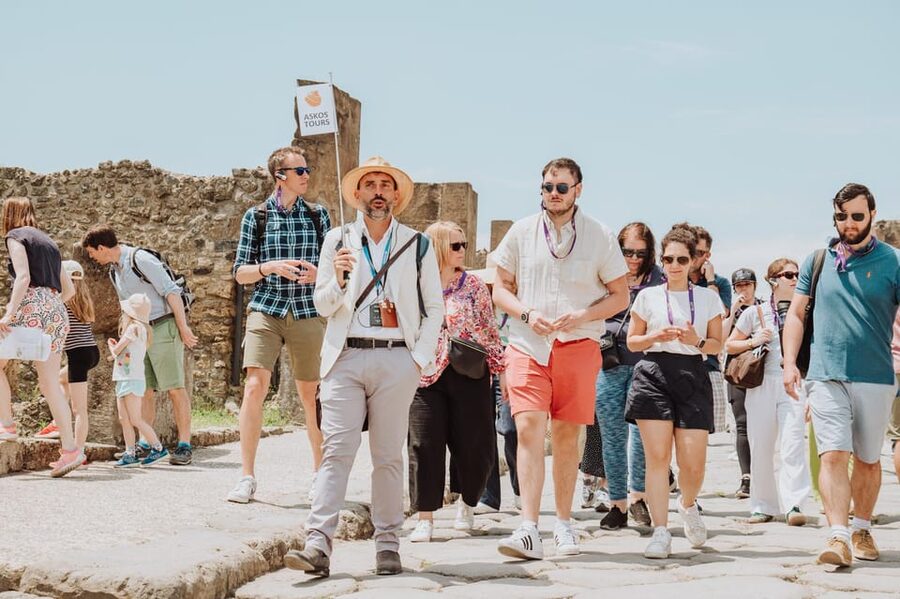
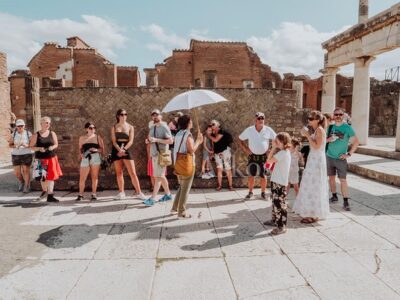
Pompeii feels close-up with an archaeologist guiding. I love the archaeologist-led storytelling that turns walls and street corners into real 1st-century life. I also like the skip-the-line entry, so your 2 hours start doing something instead of waiting.
Your biggest heads-up: the site is all walking on uneven stone with some steps, and it’s not suitable for wheelchair users or mobility scooters. If you have mobility limits, plan on a different style of visit.
In This Review
- Key things I’d make sure to notice
- Why this Pompeii tour works better than self-walking
- Skip-the-line Pompeii: getting to the good stuff fast
- The walk starts at Pompeii’s edges: Porta Marina and Temple of Apollo
- Foro Civile di Pompei: civic space in plain view
- House of the Faun: why this mansion became a star
- Lupanar: the uncomfortable part of Pompeii—and why it matters
- House of Menander: domestic life, art, and status signals
- Macellum and Forum Baths: daily life, not just monuments
- Pace, headsets, and how to avoid the common annoyances
- Price and value: what $35 buys you here
- Practical tips to make your day smoother
- Should you book this Pompeii archaeologist tour with Askos Tours?
- FAQ
- How long is the Pompeii entry ticket and guided tour?
- What’s included with this Pompeii experience?
- Do you skip the ticket line?
- Is this tour wheelchair accessible?
- What languages is the live guide available in?
- Can I bring a small dog?
- Is there free cancellation?
Key things I’d make sure to notice
- Skip-the-line entry bundled with your visit so you lose less time outside.
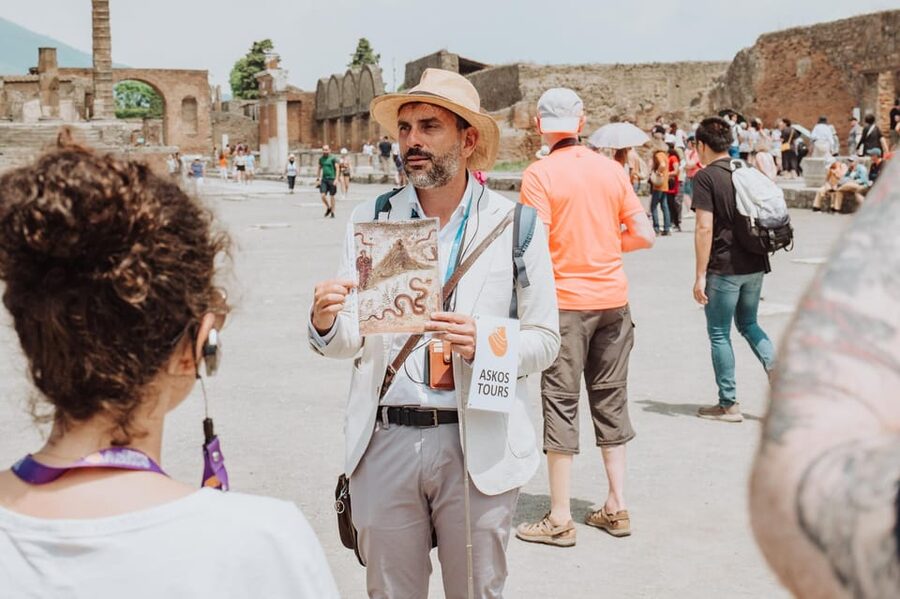
- Small group pacing (up to 20), which keeps questions possible.
- Headsets for 10+ people so you can follow the guide over crowd noise.
- Standout stops like the House of the Faun, the Lupanar, and the House of Menander.
- A route built for context, moving from gates and temples toward civic spaces and daily-life sites.
- Real details, not just famous facades, like baths, a market (Macellum), and plaster casts.
Why this Pompeii tour works better than self-walking
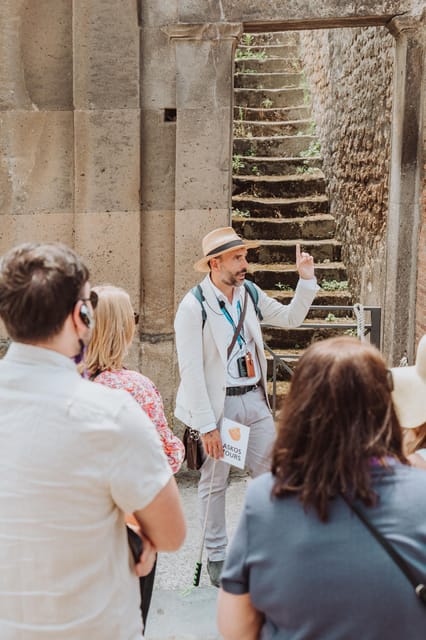
Pompeii can overwhelm you fast. It’s huge, visually repeatable, and easy to miss what you’re looking at. A guided route fixes that. You get a sequence that makes the city feel like a place people actually lived, shopped, argued, prayed, and relaxed.
What I like most is the “why” behind the “what.” You don’t just hear names of buildings. You learn how spaces worked together: a gate that funnels traffic, a temple area tied to public life, homes that signal status, and everyday stops like baths and food markets. That’s what makes the ruins feel less like a museum and more like a city frozen mid-routine.
Also, the vibe in this format is built for questions. Because the group is capped at up to 20, you’re not just chasing a moving target in a crowd. It’s the kind of tour where you can ask something and get a clear answer before you move on.
More of the site walked with an archaeologist
- Pompeii: Entry Ticket and Guided Tour with an Archaeologist
★ 4.8 · 19,459 reviews - Pompeii: Small Group Tour with an Archaeologist
★ 4.8 · 12,264 reviews - Pompeii 3hours Villa of Mysteries tour with an Archaeologist
★ 4.8 · 486 reviews
Skip-the-line Pompeii: getting to the good stuff fast
This tour includes your Pompeii entrance ticket through Pompei Express, and that’s a real time-saver. Pompeii lines can chew up the day, especially if you’re trying to see more than one major attraction in Campania. Here, the value is that you pay for access plus an expert to interpret what you’re seeing right away.
Think of the $35 price as paying for three things in one:
- admission, so you’re not buying separately
- a guided route, so you’re not wandering blind
- interpretation, so details don’t blur together
With a 2-hour duration, that timing matters. You want the “first hour energy” to go into understanding key sites, not queue management.
The walk starts at Pompeii’s edges: Porta Marina and Temple of Apollo
You meet at a starting location that can vary by booking, and one option listed is Via Villa dei Misteri, 2. From there, the first stretch is a practical warm-up to set your bearings.
You pass Porta Marina, and that gate matters because it frames how people entered and moved into town. Then you pass the Temple of Apollo. Even without long stops here, these early markers are useful. They tell you where you are in the city’s logic, so later stops don’t feel random.
One nice feature: the tour starts with movement, not a long lecture. You’re already walking through the urban layout while the guide links spaces into a mental map. If you’ve ever left Pompeii feeling like you saw a lot but understood little, this structure helps prevent that.
Foro Civile di Pompei: civic space in plain view
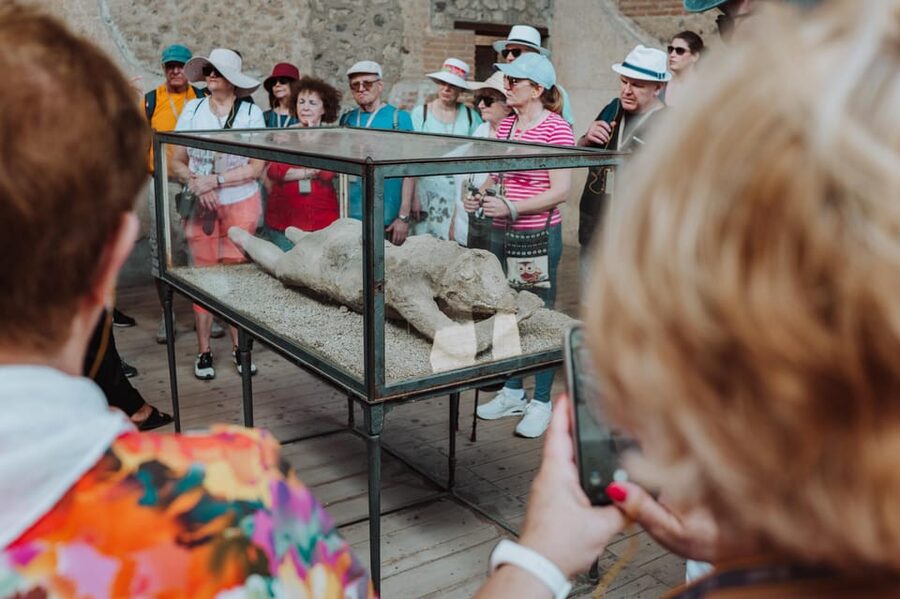
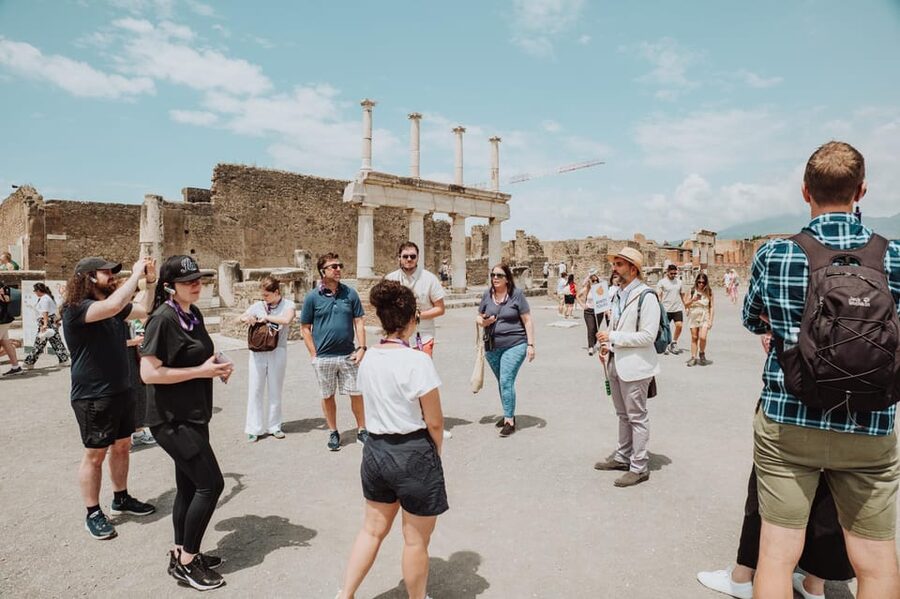
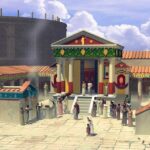
Next comes the Foro Civile di Pompei, with about 20 minutes here. This is where Pompeii looks most like a political and social machine. You’ll be in the center of “public Pompeii,” where the city’s civic identity showed up.
This stop is also a good one for photos, because you’ll see how monumental buildings sit in relation to streets and movement. Just know: it’s a walking tour, so you won’t have time to linger like you might with a self-guided ticket. Use the time you’re given to ask one or two questions and lock in the big picture.
If rain or wind shows up, this is a place where you’ll still get the meaning of the structures even if you’re tired. The guide’s job is to keep the city readable, even when the weather tries to mess with your concentration.
House of the Faun: why this mansion became a star
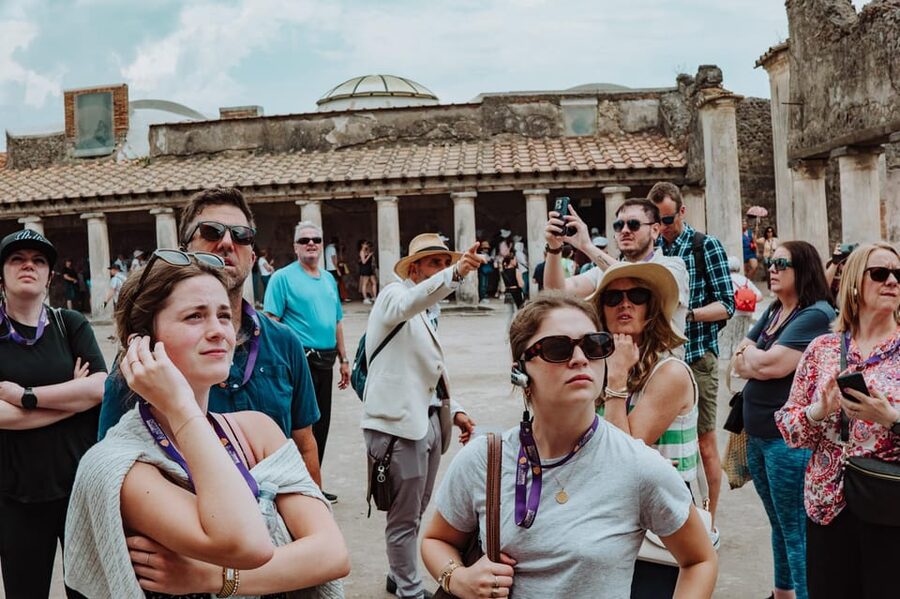
The tour then spends around 20 minutes on the House of the Faun. This is one of Pompeii’s most celebrated homes, and it earns that reputation. You’ll see how elite domestic life was built around art, layout, and visible wealth.
What you’ll get from a guided stop here is interpretation. Houses at Pompeii can look like walls and hallways. With a guide, you start noticing the social cues: how rooms connect, what kinds of spaces were designed for display, and how daily life would have flowed through those areas.
The House of the Faun also helps you reset your expectations. You go from public spaces into private space, and the scale of difference is striking. It’s a reminder that Pompeii wasn’t only temples and markets. It was neighborhoods.
More tickets to the site


Lupanar: the uncomfortable part of Pompeii—and why it matters
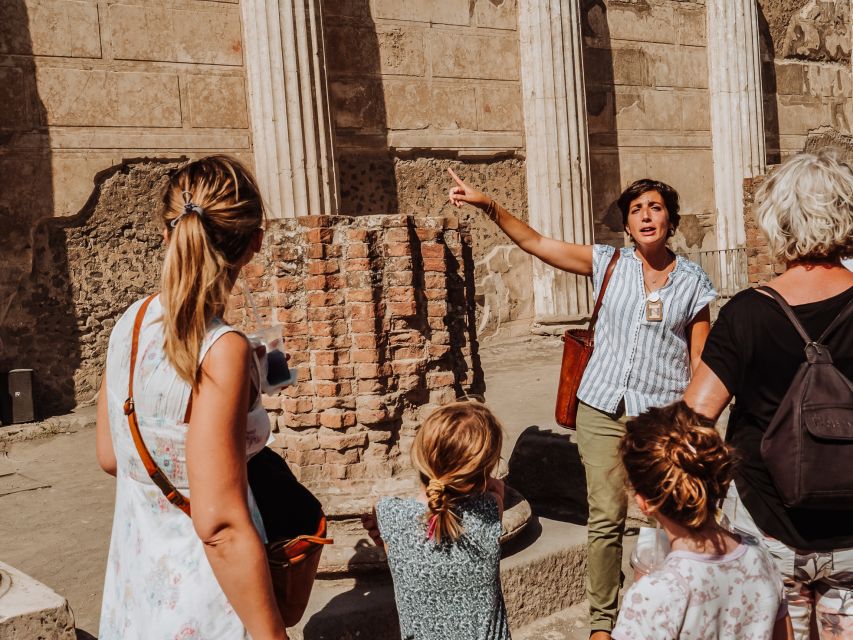
Then you visit the Lupanar (the brothel area) for about 20 minutes. This is the stop that makes Pompeii famous for its darker details, including the very human reality that sex work existed in the ancient city.
You don’t need to be shocked. You need context. A good archaeologist guide treats the site like evidence, not gossip. You’ll get a sense of how the building functioned and how the design supported its role in the city.
This is also one of those stops where the guide’s tone matters. Some guides bring humor without turning it into a joke. One guide name you may hear in this operator’s orbit is Teresa, who many describe as both funny and expert. Another common style is the “story first” approach, the kind that explains what you’re seeing before you start forming opinions.
House of Menander: domestic life, art, and status signals
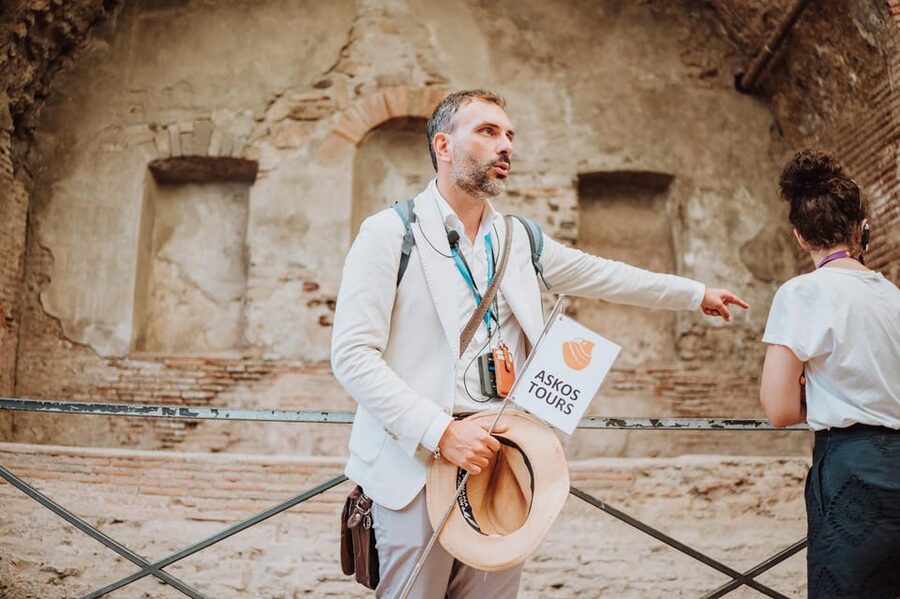
After the Lupanar, you move to the House of Menander for another guided stop of about 20 minutes. If the House of the Faun is about glamour and display, the House of Menander often feels like a different flavor of elite life—still wealthy, still intentional, but with its own story told through its rooms and decoration.
This stop is valuable because you compare. You’ll see how two households can tell different messages about identity and taste. That kind of contrast is hard to create on your own unless you already know what to look for.
Also, this is a good moment to ask a question about how Romans lived day to day—because the guide has already “set up” the city’s rhythms through earlier civic areas and market-adjacent spaces.
Macellum and Forum Baths: daily life, not just monuments
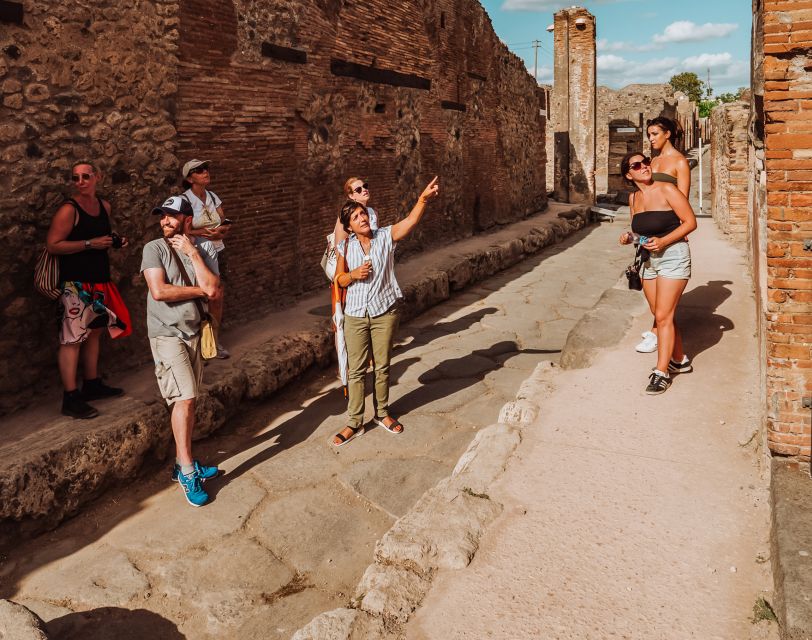
You finish with shorter guided stops: the Macellum of Pompeii (around 10 minutes) and the Forum Baths (around 10 minutes).
The Macellum is the food market. In a city this large, the market isn’t a side note. It’s where people connect supply to daily meals. A guided stop helps you understand what kinds of commerce and routine would have happened here. Even in 10 minutes, you can walk away with the sense that the economy ran through places like this.
The Forum Baths are the flip side: public routine tied to hygiene and social life. Baths weren’t only about cleaning. They were a chance to talk, linger, and reset the day. Seeing the spaces in a guided context helps you interpret what might otherwise look like broken rooms.
Because these stops are shorter, your best strategy is to watch your footing first, then soak up the “function” of each place. If you trip over the ground, you’ll miss the meaning.
Pace, headsets, and how to avoid the common annoyances
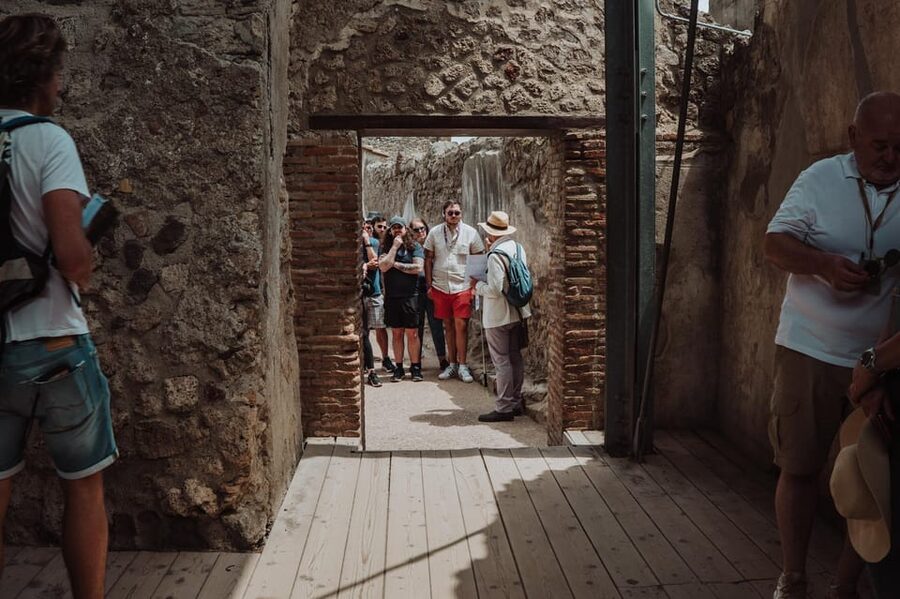
This tour is built for walking, with a total duration of about 2 hours. That’s a tight window for Pompeii. The route covers multiple major areas, so you won’t be taking slow, wandering breaks.
Headsets are included for groups of 10 or more. In practice, that means you can hear the guide clearly even when crowds compress your space. Still, if you find audio is faint, you’ll want to adjust the earpieces quickly and keep them positioned. I’d rather you deal with that in the first minutes than lose half your tour.
Your shoes matter. Several guides emphasize uneven ground and a few steps along the way. If your footwear is soft or slippery, you’ll feel it by stop two. Bring water too. This is the part of Italy where you can get dehydrated even when the temperature feels manageable.
Finally, remember the site rules: mobility scooters aren’t allowed, and the tour isn’t suitable for wheelchair users. If you’re unsure, check your own comfort with uneven stone before you commit.
Price and value: what $35 buys you here
At $35 per person for a 2-hour walk, the value depends on one question: do you want Pompeii explained or decoded?
If you go on your own, you’ll see plenty. You might still enjoy the “wow” factor. But you’ll likely spend time figuring out what matters. For $35, you’re paying to reduce that confusion. You get a guided route with an archaeologist guide and skip-the-line entry, plus headsets for larger groups.
This is the sweet spot for people who want to feel oriented fast. It’s also a good buy if you’re short on time in the region. You’ll leave with a stronger sense of the city’s layout and what to look for if you choose to return later on your own.
Practical tips to make your day smoother
Start with your body, not your camera. Pompeii is uneven. You’ll walk and you may climb a couple of steps. Plan for that, and your brain stays free for the tour instead of focused on balance.
Bring:
- good, grippy walking shoes
- water (yes, even if it’s not blazing)
- a small plan for shade, since you’ll be outdoors the whole time
Language support is broad. The tour is offered in English, Spanish, French, Italian, Portuguese, and German. If your language is your weak point in Italy, this is a big plus.
Pets are allowed only under strict conditions: small dogs (up to 10 kg and max 40 cm height), on a leash, held in the arms inside buildings, and with mandatory cleanup of waste.
And one more rule to know: unaccompanied minors aren’t allowed, so plan adult supervision accordingly.
Should you book this Pompeii archaeologist tour with Askos Tours?
I’d book it if you want Pompeii to make sense quickly. This is a smart choice when you care about context—how people used homes, civic space, markets, and baths—and you’d rather not guess at what you’re looking at.
I’d skip it (or switch approach) if mobility is a concern. The walking and steps are real, and the tour isn’t suitable for wheelchair users or mobility scooters. Also, if you hate headsets or you know you struggle with audio devices, plan for that early and adjust fast.
If you can handle uneven ground and you want Pompeii explained with real archaeological interpretation, this tour is strong value for the time you have.
FAQ
How long is the Pompeii entry ticket and guided tour?
The tour lasts about 2 hours.
What’s included with this Pompeii experience?
You get the Pompei Express entrance ticket, an archaeologist guide, a small group tour, and headsets for groups of 10 people or more.
Do you skip the ticket line?
Yes. Skip-the-line access is part of the experience.
Is this tour wheelchair accessible?
No. It’s not suitable for people with mobility impairments and it’s not for wheelchair users. Mobility scooters are also not allowed.
What languages is the live guide available in?
The tour offers live guidance in English, Spanish, French, Italian, Portuguese, and German.
Can I bring a small dog?
Yes, but only small dogs are allowed (up to 10 kg and max 40 cm height). The dog must be on a leash, held in the arms inside buildings, and you must collect the excrement.
Is there free cancellation?
Yes. You can cancel up to 24 hours in advance for a full refund.
More Tickets in Pompei Campania
- Pompeii: Skip-the-Line Entrance Ticket with Audio Guide★ 4.0 · 2,509 reviews
- Pompeii: Skip-the-line-Ticket and Guided Tour★ 4.6 · 1,152 reviews
- Pompeii: Skip-the-Line Entry Ticket with Digital Guide App★ 4.1 · 770 reviews
- Pompeii: Afternoon to Sunset Guided Tour with Ticket★ 4.9 · 484 reviews
- Pompeii: Skip-the-Line Ticket with Audio Guide and Map★ 4.0 · 117 reviews
More Tour Reviews in Pompei Campania
- Pompeii: Small Group Tour with an Archaeologist★ 4.8 · 12,264 reviews
- Pompeii: Skip-the-Line Entrance Ticket with Audio Guide★ 4.0 · 2,509 reviews
- Naples: Pompeii and Mt. Vesuvius with Lunch and Wine Tasting★ 4.5 · 2,454 reviews
- Pompeii: Skip-the-line-Ticket and Guided Tour★ 4.6 · 1,152 reviews
- Pompeii: Small-Group Tour of Pompeii and Herculaneum★ 4.8 · 867 reviews
More Tours Led by an Archaeologist
- Pompeii: Small Group Tour with an Archaeologist★ 4.8 · 12,264 reviews
- Pompeii 3hours Villa of Mysteries tour with an Archaeologist★ 4.8 · 486 reviews
- Pompeii: Tour with Archaeologist Guide & Skip-the-Line Entry★ 4.5 · 478 reviews
- Pompeii and Herculaneum: Guided Tour with an Archaeologist★ 5.0 · 164 reviews
- Pompeii: Guided Tour with Archaeologist with max. 12 People★ 5.0 · 155 reviews
Just reviewed: more Pompei Campania tours and day trips



Pompeii Archaeologist-Led Tours, compared.
 ★ 4.8Small Group Tour with an ArchaeologistFrom $4012,264 reviews
★ 5.0Pompeii Small Group Tour with an ArchaeologistFrom $356,593 reviews
★ 4.8Small Group Tour with an ArchaeologistFrom $4012,264 reviews
★ 5.0Pompeii Small Group Tour with an ArchaeologistFrom $356,593 reviews
 ★ 5.0Pompeii and Herculaneum Small Group Tour with an ArchaeologistFrom $771,350 reviews
 ★ 5.0Skip the Line Guided Tour of Pompeii led by an ArchaeologistFrom $95703 reviews
 ★ 4.9Exclusive Tour with Archaeologist and Entry TicketsFrom $50634 reviews
 ★ 5.0Pompeii Private Tour with an Archaeologist and Skip The Line – 3 hoursFrom $302564 reviews
 ★ 5.0Pompeii Skip-the-line Tour with Archaeologist GuideFrom $71559 reviews
 ★ 5.0Explore Pompeii with an ArchaeologistFrom $35511 reviews
Browse the lists this tour appears in