
Reviewed · POMPEII ARCHAEOLOGIST-LED TOURS
Pompeii and Herculaneum Small Group Tour with an Archaeologist
Two ruins, one clear plan. This archaeologist-led small-group day makes ancient Italy feel usable, with ticket-line skips and headsets that keep the story going. I especially like the guide-led pace through Pompeii’s big public sites, plus the guided walk through Herculaneum right after, when everything is still fresh in your head. The main drawback: the schedule is tight, and that means Pompeii (huge) can feel a bit rushed, with some people finding the lunch stop less magical than the ruins.
What you get for your money is not just access to two archaeology parks. You also get someone to translate what you’re seeing, from merchants’ shelter in the Basilica to the everyday-room details inside houses and baths. If you hate structured tours or want lots of free time to wander without a guide, you may want to plan a slower self-guided day instead.
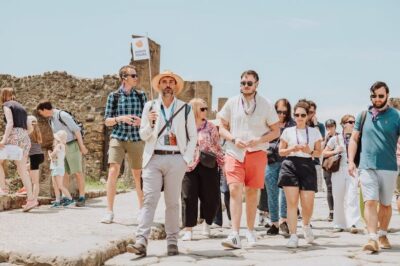
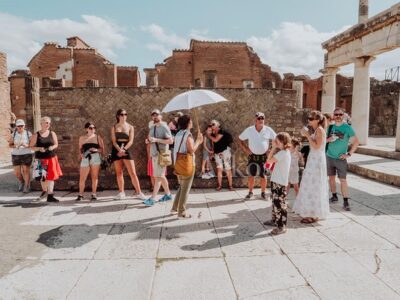
This is also a good option if you’re trying to connect two very different places without battling transit on your own. The group stays small (up to 20), so you’re not stuck yelling across a crowd, and the meeting points make it easier to start cleanly.
In This Review
- Key things I’d book this for
- How this Pompeii-to-Herculaneum day actually flows
- Meet points and transportation: minibus vs Circumvesuviana train
- Pompeii’s biggest hits: Basilica, Forum, baths, brothel, and theaters
- Walking Pompeii with an archaeologist: why the guide changes everything
- Herculaneum in about two hours: houses, baths, and public buildings
- Lunch timing and the mall stop: the trade-off to know
- Value check for $77: what’s truly included
- Pace, crowds, and comfort: when the day feels rushed
- Who should book this archaeologist-led tour
- Should you book this Pompeii and Herculaneum archaeologist tour?
- FAQ
- FAQ
- How much does the Pompeii and Herculaneum small group tour cost?
- How long is the tour?
- Where do I meet the archaeologist guide?
- Is transportation between Pompeii and Herculaneum included?
- Are admission tickets included?
- Do I get a guided visit at both sites?
- Are headsets included?
- What size is the group?
- Is lunch included?
- Is free cancellation available?
Key things I’d book this for
- Pompeii and Herculaneum guided time: two guided blocks that help you connect the dots
- Skip-the-line entry included for Pompeii plus Herculaneum admission
- Headsets for everyone so you can actually hear the archaeologist
- Handled transfer between sites (minibus for most starts, train for the Pompeii start)
- A guide-led route at Herculaneum that gets you to the ticket office fast
How this Pompeii-to-Herculaneum day actually flows
The core idea is simple: you do Pompeii first, then you go to Herculaneum, with your archaeologist staying with the group for both halves. Pompeii is about two hours with your guide walking you through major stops, then there’s time for a quick lunch break (own expense) before you transfer. After that, Herculaneum is another guided stretch of about two hours, focused on well-preserved houses, baths, and public buildings.
For many people, the value is the sequencing. Pompeii can be overwhelming because the site sprawls. Having a guide pick the most meaningful anchors helps you build a mental map, so the rest of what you see feels less random.
The itinerary also keeps movement practical. You’re not left alone trying to figure out which entrance to use or how to beat lines. At Herculaneum, the guide leads the group directly to the ticket office, then you continue through the ruins in an orderly route.
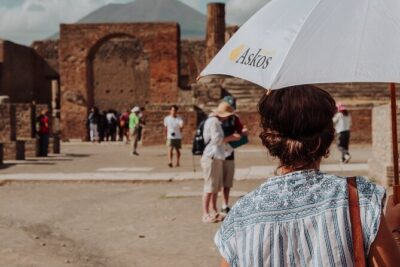
More of the site walked with an archaeologist
- Pompeii and Herculaneum Small Group Tour with an Archaeologist
★ 5.0 · 1,350 reviews - Skip the Line Guided Tour of Pompeii led by an Archaeologist
★ 5.0 · 703 reviews - Pompeii Private Tour with an Archaeologist and Skip The Line – 3 hours
★ 5.0 · 564 reviews
Meet points and transportation: minibus vs Circumvesuviana train
Your exact start point depends on where you booked from, and that matters because it changes your day’s rhythm.
- If you start in Pompeii: you meet at Porta Marina Superiore, and you get a one-way included Circumvesuviana train ticket to Herculaneum (about 30 minutes, plus about a 10-minute walk).
- If you start in Naples or Rome: you meet at Starhotels Terminus, and you travel to Herculaneum with the guide by modern minibus.
- If you start in Sorrento: you meet at Piazza Angelina Lauro, and you also travel by modern minibus.
That transportation choice has a real impact on your stress level. The minibus options are straightforward: you meet, you ride, you arrive together. The Pompeii option uses the train, so you get a more local-feeling transfer, but you’ll want to be comfortable walking that short distance from the station.
End-of-day drop-offs are also tied to where you began. Naples and Sorrento starts include return transport to those areas. Rome travelers are dropped at Naples station. If you start in Pompeii, you finish in the Herculaneum ruins area and you handle your onward plans from there.
Pompeii’s biggest hits: Basilica, Forum, baths, brothel, and theaters
Pompeii is where the guide earns their keep. You could wander for hours and still feel like you’re collecting fragments. Instead, your time is built around major public spaces and showpiece buildings that teach you how the city worked.
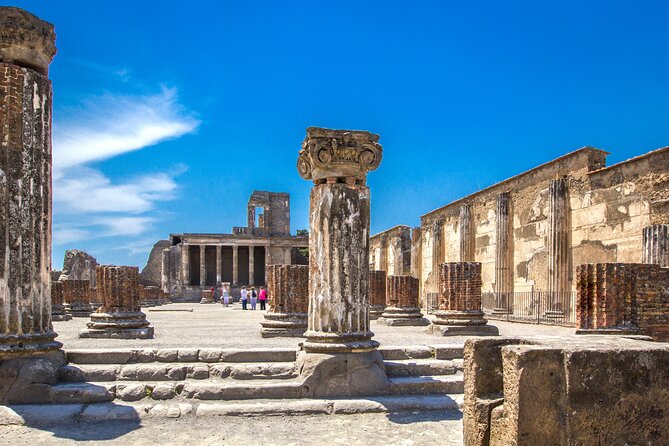
Basilica (Portico for merchants and activity)
You start with the Basilica, described as an open portico where merchants and other daily activities took shelter. It’s a strong opening stop because it frames Pompeii as a working city, not just a museum of ruins.
Forum (the main square)
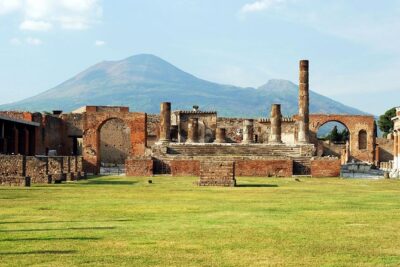
Next comes the Forum of Pompeii, the ancient main square. This is the place where public life gathered, so it helps you understand where people would have spent their time doing normal things.
House of Menander (luxury and decoration)
You then shift to private-life architecture with the House of Menander, one of Pompeii’s richer, more magnificent houses for architecture, decoration, and contents. Even if you’re not a “house person,” this kind of stop shows you how far beyond simple living these homes could be.
Granaries of the Forum (fountain details and casts)
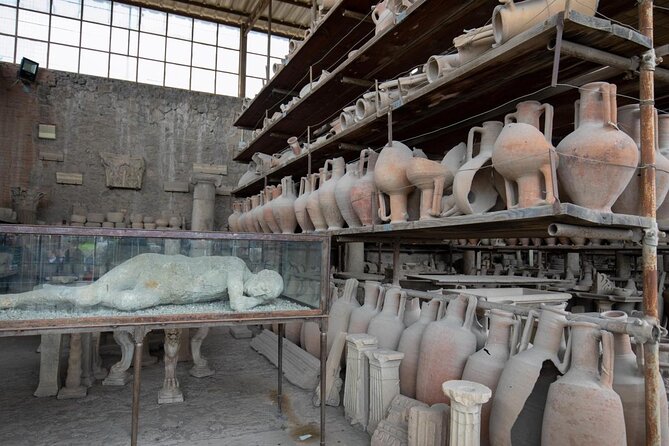
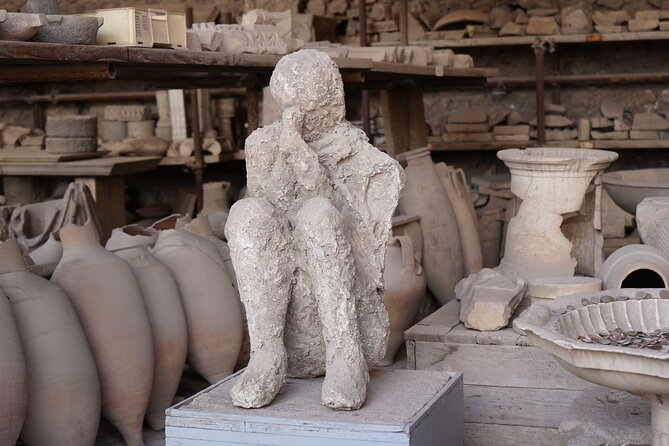
At the Granaries of the Forum, you’ll see marble tables and stone features linked to fountains, plus casts connected to the eruption (including victims, and even a dog and a tree). This stop is emotional, but it’s also practical: it gives you concrete details that help you picture the aftermath rather than keeping it abstract.
Stabian Baths (oldest thermal complex in the city)
The Stabian Baths (Terme Stabiane) are next, a vast complex and described as the oldest thermal complex in Pompeii. Baths are a great guide-led stop because you can instantly grasp why they mattered in daily routines.
Lupanar (Pompeii’s famous brothel)
You pass through the Lupanar, Pompeii’s most famous brothel in the ruined city. This is one of those places that makes people feel surprised and a little uncomfortable. A good archaeologist turns that discomfort into understanding by putting it into the broader context of what the city contained and how people interacted.
House of the Faun (major private residence)
The House of the Faun is a huge private residence, noted for being one of the largest and most impressive. This is the sort of stop where, even in a limited time window, you can sense scale and wealth quickly.
Teatro Piccolo and Teatro Grande (theater essentials)
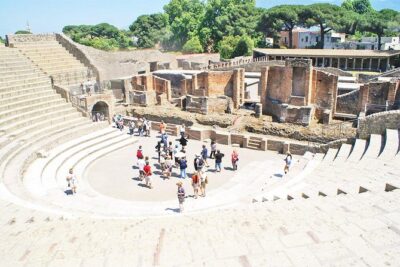
Finally, you visit the Odeon / Teatro Piccolo and the Teatro Grande, Pompeii’s most important theater. These stops are especially satisfying if you like civic spaces: they show how entertainment and public gatherings were built into city life.
One practical note: Pompeii is so big that no guided highlight tour can make you feel like you “finished” it. If you’re hoping for slow wandering, consider using this tour as your orientation first, then come back for extra time later.
Walking Pompeii with an archaeologist: why the guide changes everything
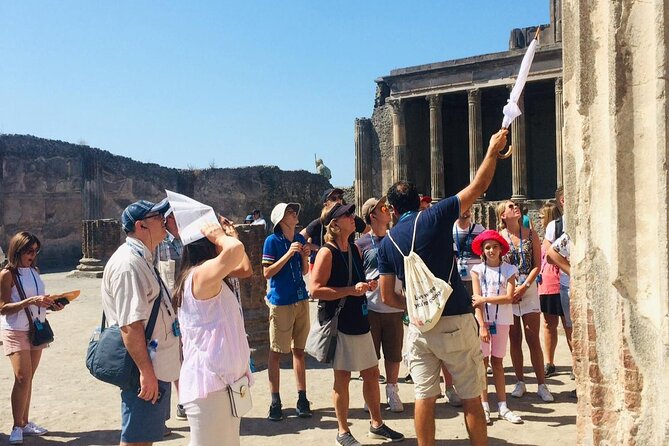
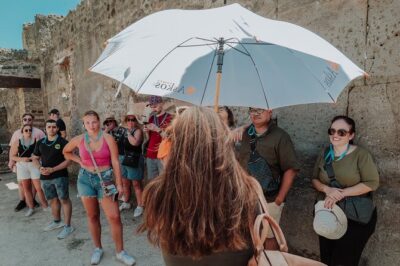
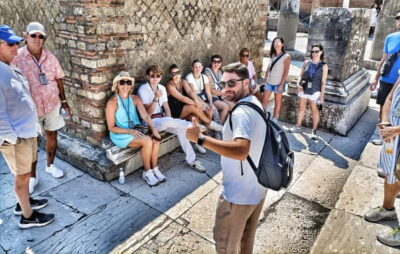
The tour is built around an archaeologist guide, and that difference shows up in how the stops get connected. Instead of you guessing why a certain space matters, you get explanations tied to architecture, city planning, and what people did there.
I’ve seen guide names in this program like Michele, Diego, Tomas, Paulo, Antonio, Alfredo, Amadeo, Vince, Gianni, and Michael, and the common thread is the ability to answer questions while keeping the route moving. You’ll also have headsets, which means you can keep your eyes on the ground-level details instead of craning for every sentence.
Do keep expectations realistic about pace. The stops are timed, and even when the guide is excellent, you’ll feel the push forward. That’s great for first-timers and city-mappers, less great if you want long pauses to stare at frescoes or plaster casts without interruption.
Also, if you’ve got a specific interest—houses, baths, theater, or everyday city spaces—this route covers those pillars pretty directly. It’s not just a checklist of famous buildings; it’s designed to let you compare public life and private life back-to-back.
Herculaneum in about two hours: houses, baths, and public buildings
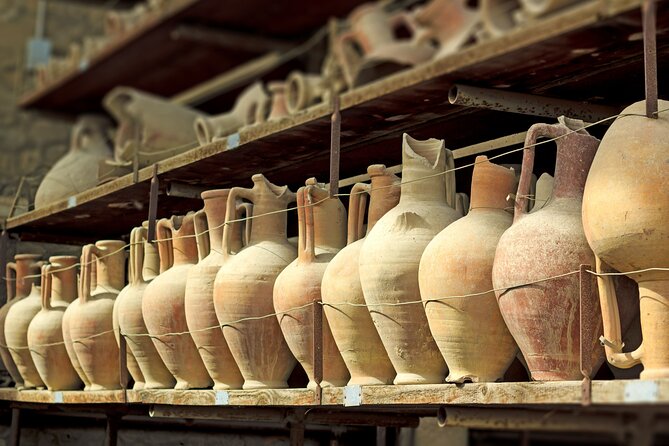
Herculaneum is smaller than Pompeii, and that makes it easier to feel like you’re actually walking through a town instead of sprinting across ruins. The tour transfers you there, then your archaeologist leads you straight to the ticket office, so the administrative stuff doesn’t eat the best part of the day.
Once you’re inside, the guiding focus is on lived-in spaces that are still readable. You spend time moving through houses, bath areas, and civic or cult-linked buildings, with stops broken down to highlight specific features.
Here are the standout stops you’ll hit:
House of the Deer
Named for marble statues of stags or deer found in the peristyle. It’s a quick but memorable clue that the home had a curated decorative program.
Terrazza di M. Nonio Balbo
This is connected to M. Nonius Balbus, described as the city’s major benefactor restoring and building public buildings, with details recorded in a long inscription. If you like inscriptions, this is a satisfying moment in a short tour.
College of the Augustales
A building thought to relate to the cult of Emperor Augustus and the headquarters of the Collegium Augustalium (and possibly even local civic organization). Even if you don’t know the terms, the guide can help you connect it to how communities formed.
Casa del Rilievo di Telefo
An unusual house, noted for having private access to the adjoining Suburban Thermae to the south. It’s a small detail that makes the layout feel intentional and practical.
Partem Domus lignea / Casa del Tramezzo di Legno
A stop tied to an important wooden partition that remained. It’s one of those moments where you can see how different materials survived differently.
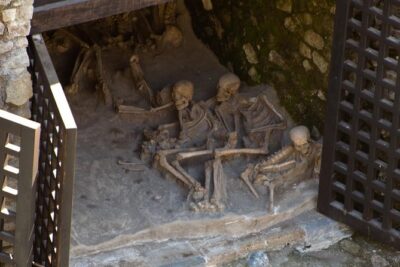
House of the Skeleton
The house takes its name from human remains found in a second-floor room in 1831. It’s a heavy stop, but it’s explained as part of the story the site preserves.
Central Thermae
The Central Thermae are set up with separate men’s and women’s baths and separate entrances. This is very “you can picture it” architecture: you’ll know where someone would go and what the system was designed to do.
House of the Black Salon
A more luxurious mansion with a monumental entrance still retaining the carbonised remains of the doorposts and lintel. This is one of the stops that tends to make people stop walking and look again.
Casa Sannitica and Casa del Bel Cortile (distinct house layouts)
Casa Sannitica is described with an atrium, Ionic columns along a gallery, and fresco decorations. Casa del Bel Cortile is described as especially original, with a courtyard plus stairway and a stone balcony instead of an atrium. Those two stops help you see that “Roman house” wasn’t one single template.
House of the Grand Portal
Finally, you’ll see a domus in the center of the archaeological area with collonnati and frescoes, plus charred remains of wooden parts. It’s a good closing image for the day: big, formal, and still legible.
Herculaneum’s structure is ideal for a guided day because the guide can pick the most telling rooms and features without you needing to decode everything alone.
More of Herculaneum next door

Lunch timing and the mall stop: the trade-off to know
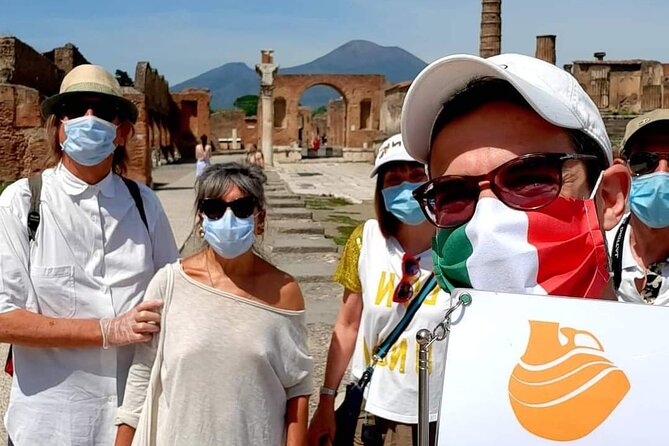
Between Pompeii and Herculaneum, you have a quick lunch break that’s not included. In practice, this tends to mean a stop at a convenient dining option rather than a long sit-down meal. Some people love having a predictable break; others feel it pulls them out of the ruins bubble.
If you want maximum atmosphere, consider eating before the first meeting time or packing something simple for the break window. If you’re more interested in comfort and having choices nearby, the provided convenience can be fine, even if it doesn’t feel like you’re still inside ancient Italy.
Either way, keep your energy for the second half. Herculaneum is where the “wow, these details survived” effect hits, and you’ll notice it more when you’re not hungry or distracted.
Value check for $77: what’s truly included
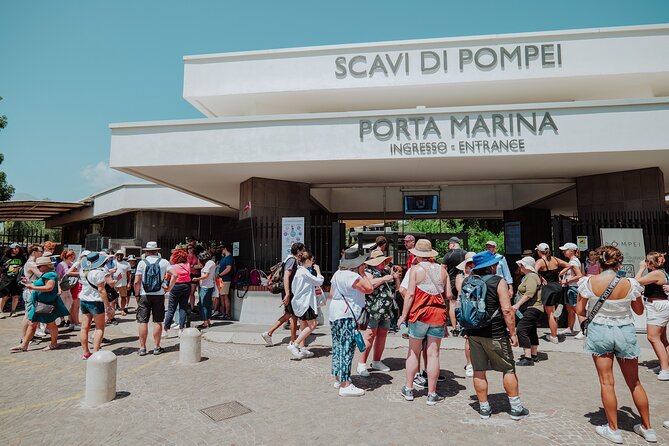
At $77.09 per person, this tour competes well because it bundles the expensive parts of the day: two guided site visits plus admission access for both ruins.
You also get practical inclusions:
- Herculaneum entry tickets included (listed as 16 euros adult, 2 euros for EU citizens 18–25)
- Pompeii entry tickets included (listed as 20 euros adult)
- Skip-the-ticket-line entry for Pompeii via Pompeii express tickets
- Headsets for all participants
- Guided tours in both sites
- Transport between the sites depending on your starting location
That means your money is going toward three things that are hard to DIY: (1) competent interpretation, (2) time saved at the entrances, and (3) the transfer that prevents you from losing half your day to logistics.
The group cap of 20 also matters. It’s small enough for questions and human-scale listening, especially with headsets in play.
Pace, crowds, and comfort: when the day feels rushed
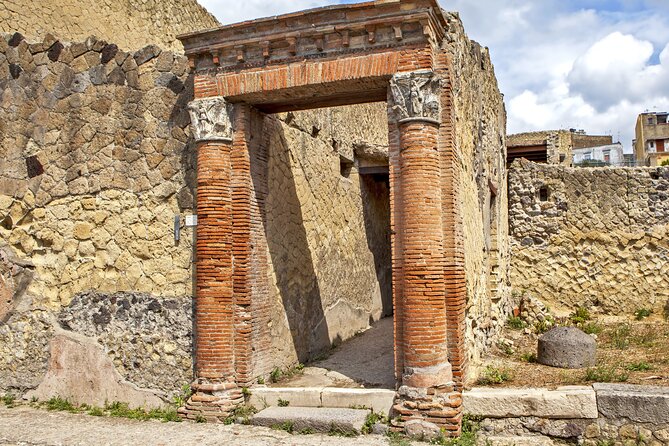
This tour is designed for highlights, not for slow exploration. Pompeii gets about two hours with the archaeologist, and Herculaneum gets about two hours as well. That can feel like a lot, and it can also feel short, because Pompeii’s size is real and the temptation is to keep walking once you start noticing details.
There are also occasional comfort snags that you can plan around. Headsets are included, and that’s a big plus for hearing the guide. Still, like any audio system outdoors, you might have moments where reception is imperfect, so you’ll want to stay close to the guide when the group tightens up.
Rain can change the experience too, but the day is structured so you usually keep moving. Still, Pompeii and Herculaneum are outdoors, so bring weather-appropriate shoes and a rain layer that works with walking.
If you’re sensitive to long standing and lots of pavement, plan for breaks only when the itinerary provides them. This is a full-day program in practice, even though the posted duration is listed as 6 to 11 hours depending on your start point and timing.
Who should book this archaeologist-led tour
This tour is a strong match for you if:
- You want two sites in one day without sorting tickets and logistics yourself
- You like guided explanations that connect architecture and daily life
- You’re first-timing Pompeii and want a fast way to understand the layout
- You want Herculaneum because it’s smaller and you can process what you see in a guided flow
It can be a weaker match if:
- You want lots of free time to roam without a route
- You expect plenty of time to go back for extra viewing once a highlight hits
- You need accessibility accommodations beyond what the tour notes generally covers (the tour is not recommended for visually impaired guests unless accompanied by a dedicated personal assistant)
If you’re the kind of traveler who likes asking questions, this program tends to reward that behavior. The guide stops make it easier to ask about what you’re seeing, from baths to houses to theaters.
Should you book this Pompeii and Herculaneum archaeologist tour?
I’d book this tour if you want a high-signal day: clear Pompeii anchors, then a guided Herculaneum walk that lets you feel what you’re seeing rather than just ticking off ruins. The value is strongest when you factor in both admission tickets, headsets, and the fact that transportation is handled between sites.
I would not book it if you’re planning this as your one-and-only chance to spend hours drifting through Pompeii. If you want unhurried time, you might use this tour as an orientation, then return on your own for extra exploration later.
If you do book, go in with one mindset: highlights, not total coverage. With that expectation, you’ll come away with a much clearer picture of ancient daily life—and you’ll have a guide’s explanations to make the stones feel like a city.
FAQ
FAQ
How much does the Pompeii and Herculaneum small group tour cost?
It costs $77.09 per person.
How long is the tour?
The duration is listed as about 6 to 11 hours.
Where do I meet the archaeologist guide?
You meet at Porta Marina Superiore for the Pompeii option, Starhotels Terminus for Naples and Rome options, and Piazza Angelina Lauro for the Sorrento option.
Is transportation between Pompeii and Herculaneum included?
Yes. Naples, Rome, and Sorrento options use modern minibus with the guide, and the Pompeii option uses an included Circumvesuviana train ticket (plus walking).
Are admission tickets included?
Yes. Admission tickets to both Pompeii and Herculaneum are included, with Pompeii express entry tickets for Pompeii.
Do I get a guided visit at both sites?
Yes. You get a guided visit in Pompeii (about two hours) and a guided visit in Herculaneum (about two hours).
Are headsets included?
Yes, headsets are included for all participants.
What size is the group?
The tour has a maximum of 20 travelers.
Is lunch included?
No. Meals and drinks are not included, though there is a quick lunch break available before the transfer.
Is free cancellation available?
Yes. You can cancel up to 24 hours in advance for a full refund.
More Tour Reviews in Pompeii
- Pompeii Small Group Tour with an Archaeologist★ 5.0 · 6,593 reviews
- Discover the Ancient Ruins of Pompeii: Day Trip from Rome★ 3.5 · 2,247 reviews
- Skip the Line Guided Tour of Pompeii led by an Archaeologist★ 5.0 · 703 reviews
- Pompeii Ticket + Tour with Optional Tasting Experience at Pompeii★ 5.0 · 663 reviews
- Pompeii private tour with an Official Guide★ 5.0 · 631 reviews
More of Herculaneum
- Private Day Tour to Vesuvius, Herculaneum & Pompeii with Pick Up★ 5.0 · 279 reviews
- The Ultimate Ruins of Pompeii and Herculaneum Private Day Trip★ 5.0 · 103 reviews
- Naples: Pompeii & Herculaneum Day Trip – Small Group Tour★ 4.5 · 72 reviews
- Pompeii and Herculaneum small group Excursion from Naples★ 5.0 · 70 reviews
- Half-Day Exclusive Private Tour of Pompeii and Herculaneum★ 5.0 · 49 reviews
More Tours Led by an Archaeologist
- Pompeii Small Group Tour with an Archaeologist★ 5.0 · 6,593 reviews
- Skip the Line Guided Tour of Pompeii led by an Archaeologist★ 5.0 · 703 reviews
- Pompeii Private Tour with an Archaeologist and Skip The Line – 3 hours★ 5.0 · 564 reviews
- Pompeii Skip-the-line Tour with Archaeologist Guide★ 5.0 · 559 reviews
- Explore Pompeii with an Archaeologist★ 5.0 · 511 reviews
Just reviewed: more Pompeii tours and day trips



Pompeii Archaeologist-Led Tours, compared.
 ★ 4.8Entry Ticket and Guided Tour with an ArchaeologistFrom $3519,459 reviews
 ★ 4.8Small Group Tour with an ArchaeologistFrom $4012,264 reviews
★ 5.0Pompeii Small Group Tour with an ArchaeologistFrom $356,593 reviews
★ 4.8Small Group Tour with an ArchaeologistFrom $4012,264 reviews
★ 5.0Pompeii Small Group Tour with an ArchaeologistFrom $356,593 reviews
 ★ 5.0Skip the Line Guided Tour of Pompeii led by an ArchaeologistFrom $95703 reviews
 ★ 4.9Exclusive Tour with Archaeologist and Entry TicketsFrom $50634 reviews
 ★ 5.0Pompeii Private Tour with an Archaeologist and Skip The Line – 3 hoursFrom $302564 reviews
 ★ 5.0Pompeii Skip-the-line Tour with Archaeologist GuideFrom $71559 reviews
 ★ 5.0Explore Pompeii with an ArchaeologistFrom $35511 reviews
Browse the lists this tour appears in