
Reviewed · POMPEII ARCHAEOLOGIST-LED TOURS
Explore Pompeii with an Archaeologist
Pompeii is loud with ideas. This tour turns the ruins into a clear story with an expert archaeologist at your side, plus skip-the-line entry so you spend less time waiting and more time looking. I like that it’s structured enough to hit major sights fast, yet small enough to ask real questions as you walk.
What I love most is the way the guide explains everyday life behind the big names—so the Foro, homes, baths, and even the famous street stops make sense as a single city. The second thing I like is the practical pace: about 2 hours, multiple highlights, and time to regroup on uneven ground.
One consideration: it’s still Pompeii, so once you’re inside, crowds can make hearing harder even with headsets, and you’ll do plenty of walking. If you hate crowds or have mobility limits, you might want to think twice about a “see a lot fast” format.
In This Review
- Key things to know before you go
- The real value of a 2-hour Pompeii highlight tour
- How the tour starts: Porta Marina Superiore and skip-the-line entry
- The Forum walk: Foro de Pompei, Basilica, and Granaries
- Lupanar and street scenes: Pompeii’s harder edge
- Houses that explain a city: House of Menander and House of the Faun
- Baths at Stabian Baths (Terme Stabiane): when the city relaxed
- Teatro Grande: the theater stop that helps everything click
- House of the Vettii: the dramatic closer
- Small group dynamics, Q&A time, and headset practicalities
- Price, pacing, and whether the skip-the-line part is worth it
- What to bring for a hot, walking-heavy day
- Who this Pompeii archaeologist tour is best for
- Tour guide experience: you’ll likely meet one of these names
- Should you book this Pompeii with an archaeologist tour?
- FAQ
- FAQ
- How long is the Pompeii with an archaeologist tour?
- Where do I meet the guide?
- What’s included in the ticket price?
- Is the tour offered in English?
- Is it a small group?
- Do I need to bring anything to enter?
- Is it easy to hear the guide during the tour?
- Are service animals allowed, and what about dogs?
- What is the cancellation policy?
Key things to know before you go
- Skip-the-line admission helps you beat the worst wait and start walking sooner.
- Max 20 people per guide keeps the tour personal, not a lecture.
- Headsets (for groups of 16+) help you catch explanations in busier sections.
- 12+ highlights in about 2 hours gives you a smart hit-list without trying to do Pompeii solo.
- Archaeologist guidance means you’re not just looking at walls—you’re learning why they mattered.
- Heat and stairs are real—bring sun protection and a refillable bottle.
The real value of a 2-hour Pompeii highlight tour
At $35.67 per person, this is not the cheapest thing on a Pompeii day—but it can be great value if you want structure. Pompeii is huge, and doing it alone means you’ll either wander aimlessly or rush. Here, you get a set route and a guide who ties the stops together.
Also, Pompeii rewards time spent on interpretation. If you’ve ever looked at a site and thought, So what am I supposed to notice?—this style fixes that. You’ll walk away with a much clearer sense of how the city functioned, not just what it looked like.
The other quiet advantage is momentum. The tour is about 2 hours, and that forces smart prioritizing. If you’re on a tight schedule, this format helps you feel like you actually accomplished something.
More of the site walked with an archaeologist
- Pompeii and Herculaneum Small Group Tour with an Archaeologist
★ 5.0 · 1,350 reviews - Skip the Line Guided Tour of Pompeii led by an Archaeologist
★ 5.0 · 703 reviews - Pompeii Private Tour with an Archaeologist and Skip The Line – 3 hours
★ 5.0 · 564 reviews
How the tour starts: Porta Marina Superiore and skip-the-line entry
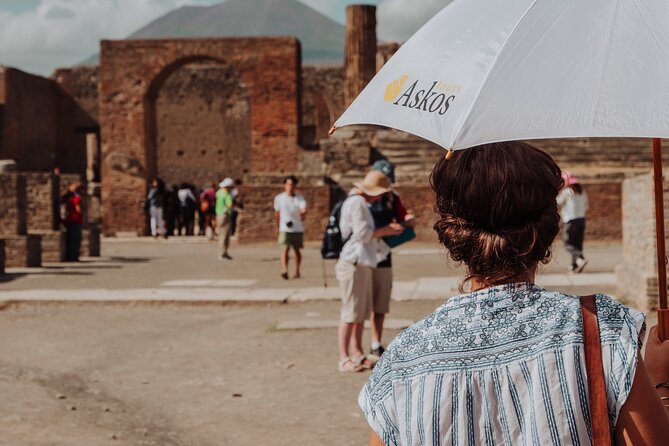
You meet at Via Villa dei Misteri, 2 and then head into Pompeii’s archaeological area. The guided portion begins at the main entrance called Porta Marina Superiore, where the guide holds an Askos Tours sign.
This matters because the biggest time-sink in Pompeii is usually getting moving at the start. With the mobile ticket and admission included, you’re not stuck figuring out gates, lines, and timing while your day slips away.
Bring the basics you’ll thank yourself for later: sun protection, water, and shoes for uneven surfaces. One practical tip from guide-focused reviews: bring a fan or something to cool down, and refill when you can, since fountains are available in the area.
The Forum walk: Foro de Pompei, Basilica, and Granaries
Stop 2 is Foro de Pompeya, the main square. This is where Pompeii feels most “city-like,” because it’s centered on public life—markets, civic events, and the everyday rhythm of the town.
Then you move to the Basilica (Stop 3). Even if you don’t know what to look for, the courthouse setting makes it easier to understand why this area mattered. Expect explanations that connect spaces to social life, not just dates and names.
Stop 5 is the Granaries of the Forum. These are the kind of ruins people overlook because they don’t look dramatic from a distance. But in an archaeologist-led walk, they become a doorway into how Pompeii fed itself—food storage and supply, not just architecture.
A drawback to plan for: this section can be busy, so you’ll want to listen closely early on. If you’re in a crowd, don’t fight for “perfect views”—focus on the information your guide is giving, then check out the details right after.
Lupanar and street scenes: Pompeii’s harder edge
Stop 4 is the Lupanar, Pompeii’s famous brothel. It’s not comfortable subject matter, but it’s also one of the most historically revealing places you can visit. A good guide helps you see it as part of city life—economy, law, neighborhood behavior—rather than sensational trivia.
After that, you get a shift in pace to how people moved through the city. Stop 9 is Via dell’Abbondanza, one of Pompeii’s main streets. This is also marked as Admission Ticket Free, which can be helpful if you’re thinking in terms of what’s included where.
Then Stop 10 is the Thermopolium VI, a type of Roman street-side eatery. Thermopolia are great because they’re practical, “real life” ruins. You start imagining quick meals, regular customers, and how food fit into a busy schedule.
If you’re sensitive to crowded interiors or you hate tight, active walking days, this “hard edge + street life” stretch can feel like a lot at once. Still, it’s a smart way to avoid a Pompeii day that’s only pretty facades.
Houses that explain a city: House of Menander and House of the Faun
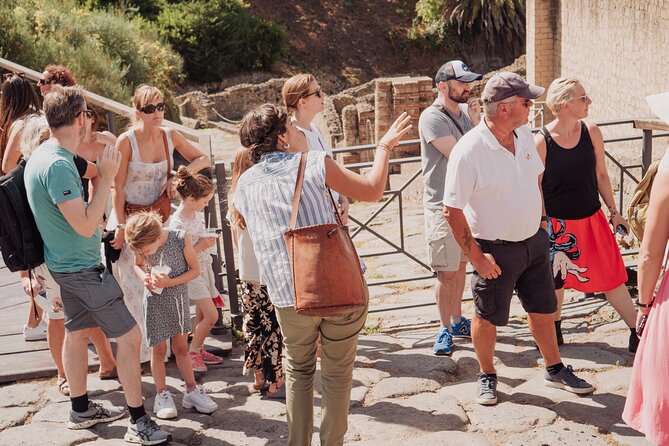
Stop 6 is the House of Menander. Houses in Pompeii are tricky because you can’t fully “read” them from outside. With a guide, you’ll know what to look for: layout choices, how rooms connect, and what daily movement likely looked like.
Stop 7 is the House of the Faun. This is a big step in scale and usually one of the more memorable stops in the route. In a guided format, you’re less likely to miss what’s important inside the structure because your guide is pointing out the clues.
One reason these house stops work well in a 2-hour tour: they give you a contrast. After the Forum and street locations, the houses show you what status and privacy meant in Pompeii.

Baths at Stabian Baths (Terme Stabiane): when the city relaxed
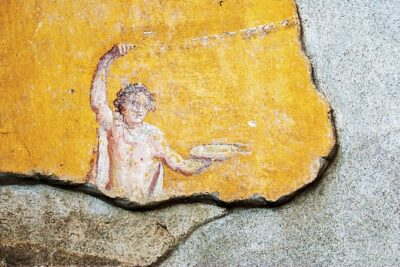
Stop 8 is the Stabian Baths (Terme Stabiane). Baths are a key piece of Roman life, and Pompeii helps you see how public relaxation worked in real architectural terms.
The benefit of adding the baths here is pacing. You’ve already covered civic space and commercial life. Baths bring in a different mood—routine, hygiene, social behavior—so your brain doesn’t only process “big civic rocks.”
The main thing to watch is timing. Each stop is roughly brief, and baths can involve movement through multiple areas. If you’re hoping for an in-depth solo exploration, treat this as your orientation, then keep your curiosity for later.
Teatro Grande: the theater stop that helps everything click
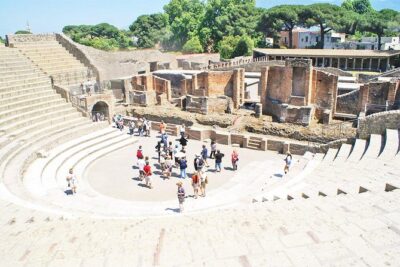
Stop 11 is Teatro Grande, the large theater. Even if you’ve studied Roman theater before, Pompeii makes it feel closer to everyday life. It’s not just architecture—it’s the idea of public gatherings, performances, and community moments.
In a short tour like this, the theater also does a useful job: it ties together the earlier civic and social spaces. You start to see the city as a system, not a pile of separate buildings.
House of the Vettii: the dramatic closer
The route ends with Stop 12, the Casa dei Vettii (House of the Vettii). This is often a highlight because the house setting shows off how private spaces could still be expressive and social.
What you’ll get from the guide here is interpretive. Instead of only staring at room details, you’ll learn what those choices meant in status and taste. It’s a strong finale because you finish your “city story” with something personal—how people lived behind the public face of Pompeii.
Even better: the tour ends at Piazza Esedra. That gives you a place to decide whether you want to keep exploring on your own or just call it a win and head onward.
Small group dynamics, Q&A time, and headset practicalities
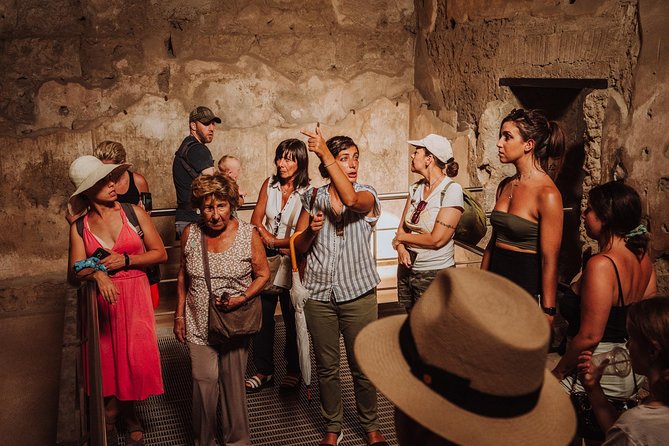
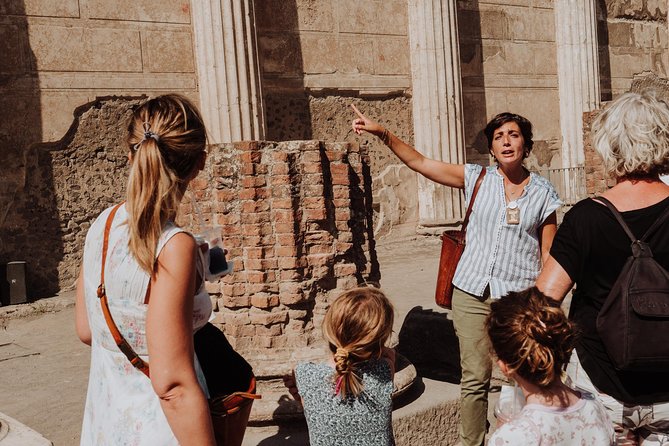
This is a small group experience with a maximum of 20 travelers per guide. That matters more than people expect. In Pompeii, questions aren’t “extra”—they’re the difference between seeing ruins and understanding them.
Headsets are provided for groups of 16 or more, which helps if you’re stuck near a cluster of people during explanation time. One review specifically highlighted how helpful the earphone amplifier was, which matches what you’ll feel in real life: sound can get messy in crowded areas.
Based on what I’d optimize for, here’s how you get the most out of the Q&A: ask one question that connects two stops. Example: how does this house relate to the public square? Guides can usually tie it together quickly, and you’ll get more than one random fact.
Price, pacing, and whether the skip-the-line part is worth it
The cost is $35.67 per person, with admission included and an archaeologist guiding you. For Pompeii, the value is really in what’s bundled: skip-the-line entry plus guided interpretation in a short window.
If you’re traveling with limited time, it’s often cheaper than you think to pay for a guide instead of spending hours trying to “figure it out” with a map. Pompeii’s scale punishes indecision.
Also, note that it’s typically booked about 30 days in advance on average. That’s a sign you’re competing for limited slot time. If Pompeii is a fixed item on your trip plan, I’d book early rather than hope.
What to bring for a hot, walking-heavy day
Plan for serious walking on uneven ground. One review called it a real work-out, and that matches the reality of walking through excavated streets and stepped entrances.
Bring:
- sun protection (hat or umbrella can help)
- a refillable water bottle
- something to cool you down (a fan can be clutch)
If you get overwhelmed by heat, don’t power through in silence. Ask your guide for quick context points as you rest. You’ll still feel like the tour is working even if you need breaks.
Who this Pompeii archaeologist tour is best for
This works best if you want a structured Pompeii day with expert interpretation and multiple highlights in about 2 hours. It’s also a strong fit for families, since guide styles in reviews ranged from patient explanations to kid-friendly pacing.
It’s also a good choice if you’ve been to Pompeii before but want a clearer lens. Several reviews described how much more meaningful the ruins felt once guided commentary added structure.
If you want to roam slowly with no route and spend 4–5 hours reading and re-reading every corner, you might find this too fast. This tour is built to check major highlights and get the story started.
Tour guide experience: you’ll likely meet one of these names
Different guides can shape how Pompeii feels. Names that show up in strong feedback include Mario Celentano, Julia, Alexandra, Ilaria, Diego, Rosanna, Teresa, Antonio, Rafaela, Sergio, and Jolanta.
Common threads across those standout experiences: clear pacing, strong communication in English, and guides who respond to questions. So when you book, you’re not just buying access—you’re buying a specific kind of explanation style.
Should you book this Pompeii with an archaeologist tour?
If your goal is to see the big sights, understand what you’re looking at, and avoid wasting half your day stuck at the wrong entrances, I’d book it. The skip-the-line setup, small group size, and archaeologist guidance are the “why” behind the price.
I’d skip it only if you want a long, slow, quiet Pompeii day or you know you’ll struggle with crowds and lots of walking. In that case, you’d likely enjoy a slower, more flexible format more.
FAQ
FAQ
How long is the Pompeii with an archaeologist tour?
It runs for about 2 hours.
Where do I meet the guide?
You’ll meet at Via Villa dei Misteri, 2, 80045 Pompei NA, Italy (main starting point). The guide meets at the archaeological site entrance called Porta Marina Superiore.
What’s included in the ticket price?
The price includes the Pompeii admission fee, dedicated guidance, assistance, and the Pompeii admission tickets for the listed stops.
Is the tour offered in English?
Yes, it’s offered in English.
Is it a small group?
Yes. The group size is limited to a maximum of 20 travelers per guide.
Do I need to bring anything to enter?
You’ll use a mobile ticket. Headsets are provided for groups of 16 or more.
Is it easy to hear the guide during the tour?
Headsets are included for groups of 16 or more, which helps in busier areas. The tour also uses headsets to support listening.
Are service animals allowed, and what about dogs?
Service animals are allowed. Dogs are permitted only if they are no more than 10 kg and 40 cm max height, must be on a leash, and must be held in the arms inside buildings; you must also collect their excrement.
What is the cancellation policy?
You can cancel for free up to 24 hours in advance of the experience start time for a full refund. If you cancel less than 24 hours before, the amount paid is not refunded.
More Tour Reviews in Pompeii
- Pompeii Small Group Tour with an Archaeologist★ 5.0 · 6,593 reviews
- Discover the Ancient Ruins of Pompeii: Day Trip from Rome★ 3.5 · 2,247 reviews
- Pompeii and Herculaneum Small Group Tour with an Archaeologist★ 5.0 · 1,350 reviews
- Skip the Line Guided Tour of Pompeii led by an Archaeologist★ 5.0 · 703 reviews
- Pompeii Ticket + Tour with Optional Tasting Experience at Pompeii★ 5.0 · 663 reviews
More Tours Led by an Archaeologist
- Pompeii Small Group Tour with an Archaeologist★ 5.0 · 6,593 reviews
- Pompeii and Herculaneum Small Group Tour with an Archaeologist★ 5.0 · 1,350 reviews
- Skip the Line Guided Tour of Pompeii led by an Archaeologist★ 5.0 · 703 reviews
- Pompeii Private Tour with an Archaeologist and Skip The Line – 3 hours★ 5.0 · 564 reviews
- Pompeii Skip-the-line Tour with Archaeologist Guide★ 5.0 · 559 reviews
Just reviewed: more Pompeii tours and day trips





Pompeii Archaeologist-Led Tours, compared.
 ★ 4.8Entry Ticket and Guided Tour with an ArchaeologistFrom $3519,459 reviews
 ★ 4.8Small Group Tour with an ArchaeologistFrom $4012,264 reviews
★ 5.0Pompeii Small Group Tour with an ArchaeologistFrom $356,593 reviews
★ 4.8Small Group Tour with an ArchaeologistFrom $4012,264 reviews
★ 5.0Pompeii Small Group Tour with an ArchaeologistFrom $356,593 reviews
 ★ 5.0Pompeii and Herculaneum Small Group Tour with an ArchaeologistFrom $771,350 reviews
 ★ 5.0Skip the Line Guided Tour of Pompeii led by an ArchaeologistFrom $95703 reviews
 ★ 4.9Exclusive Tour with Archaeologist and Entry TicketsFrom $50634 reviews
 ★ 5.0Pompeii Private Tour with an Archaeologist and Skip The Line – 3 hoursFrom $302564 reviews
 ★ 5.0Pompeii Skip-the-line Tour with Archaeologist GuideFrom $71559 reviews
Browse the lists this tour appears in