
Reviewed · POMPEII ARCHAEOLOGIST-LED TOURS
Pompeii: Small Group Tour with an Archaeologist
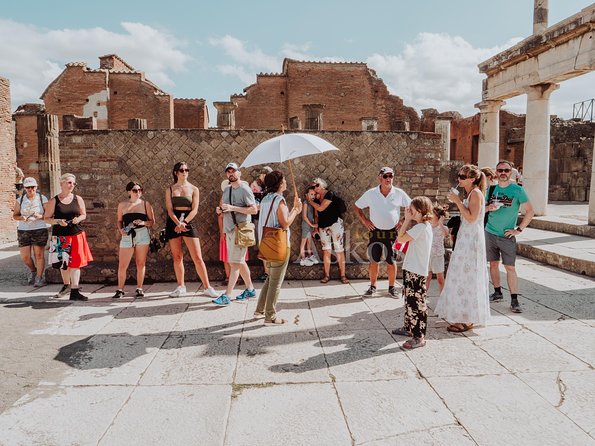
Pompeii hits different with an archaeologist beside you. This small-group or private tour helps you read the city in real time, from the first gate to the Forum’s views of Mount Vesuvius. I especially love how you get up-close wall art—frescoes, mosaics, and daily-life details—without getting lost in the ruins.
One possible drawback: the site is uneven and full of steps and ramps, so this isn’t the best match if you have mobility limits.
If you want a Roman crash course that still feels human, this tour is built for that. Guides like Roxanne, Alexandra, and Alessandra show real personality, from humor to clear explanations, which makes Pompeii easier to follow—and more memorable.
In This Review
- Key highlights at a glance
- Pompeii Comes Into Focus Fast
- 2 Hours or 3 Hours: Choose Your Pompeii Pace
- Enter Through Porta Marina Superiore and Get Your Bearings
- Forum Life: Civic Power, Public Space, and Everyday Noise
- Temples and The City’s Religious Map
- Baths and Theater: Social Life You Can Picture
- Homes, Frescoes, and Why Pompeii Decoration Matters
- The Lupanar: A Tour Stop With Adult Themes
- Plaster Casts and the Moment the Story Turns Real
- How the Tour Works in Real Life (Group vs Private)
- Headsets and Listening Without Straining
- What You’ll Do After the Guided Part Ends
- Price and Value: Is $40 Worth It
- Who This Tour Fits Best
- Quick Before-You-Go Notes
- Should You Book This Pompeii Tour?
- FAQ
- How long is the Pompeii tour?
- What extra stop do I get on the 3-hour tour?
- Is the entry ticket included?
- Do we get headsets to hear the guide?
- Can I book a private tour instead of a shared small group?
- What languages are available?
- Where do I meet the guide?
- Is the tour wheelchair friendly?
- What should I bring, and what isn’t allowed on-site?
- Can I cancel, and is pay-later available?
Key highlights at a glance
- UNESCO Pompeii with an archaeologist guide who helps you connect streets, buildings, and daily life
- Two lengths to match your time, with a 3-hour option that includes the Villa of the Mysteries
- A route that starts at Porta Marina Superiore and works through key civic areas like the Forum and Basilica
- Stand close to frescos, mosaics, and plaster casts so the story feels physical
- End with free time to wander the archaeological park on your own
Pompeii Comes Into Focus Fast

Pompeii is enormous, and on your own it’s easy to miss what matters. This tour gives you a guided storyline, so you’re not just looking at ruins—you’re understanding how a real Roman city functioned: law, religion, markets, baths, homes, and even leisure.
I like that the visit doesn’t stay abstract. You walk past big-ticket structures like the Great Theater and the Forum, then you slow down for what most people would skim: artwork in houses, surviving decorative surfaces, and small clues that explain how space was used.
More of the site walked with an archaeologist
- Pompeii: Entry Ticket and Guided Tour with an Archaeologist
★ 4.8 · 19,459 reviews - Pompeii: Small Group Tour with an Archaeologist
★ 4.8 · 12,264 reviews - Pompeii 3hours Villa of Mysteries tour with an Archaeologist
★ 4.8 · 486 reviews
2 Hours or 3 Hours: Choose Your Pompeii Pace
You can do a 2-hour tour or a 3-hour tour (the longer option adds a stop at the Villa of the Mysteries).
The shorter version is ideal when you want:
- the major highlights in a guided circuit
- a solid foundation for what you should look for after your group finishes
The 3-hour version is worth it if you know you’ll want more time inside Pompeii’s main areas and you specifically want the Villa of the Mysteries frescos. That stop tends to be a highlight because it’s the kind of place where the decoration isn’t just pretty—it helps you understand the themes and taste of the people who lived there.
Enter Through Porta Marina Superiore and Get Your Bearings

Your tour starts with the practical advantage of direction. You enter Pompeii at Porta Marina Superiore, one of the city’s gates, then you begin working along the main streets.
That first orientation matters. Pompeii can feel like a maze if you’re trying to map it alone. With a guide pacing you, you learn where the city’s center is and why certain viewpoints matter—especially the Forum, where you can see Mount Vesuvius overlooking the city.
Also, there’s a free cloakroom service next to the Porta Marina Superiore entrance (subject to availability). If you’re traveling light, this is an easy win—just remember luggage or large bags aren’t allowed on-site.
Forum Life: Civic Power, Public Space, and Everyday Noise
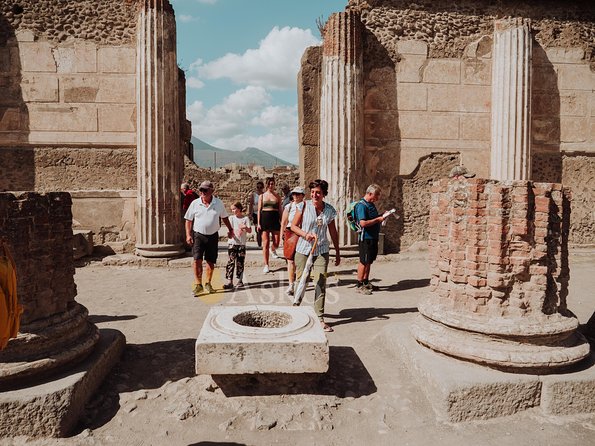
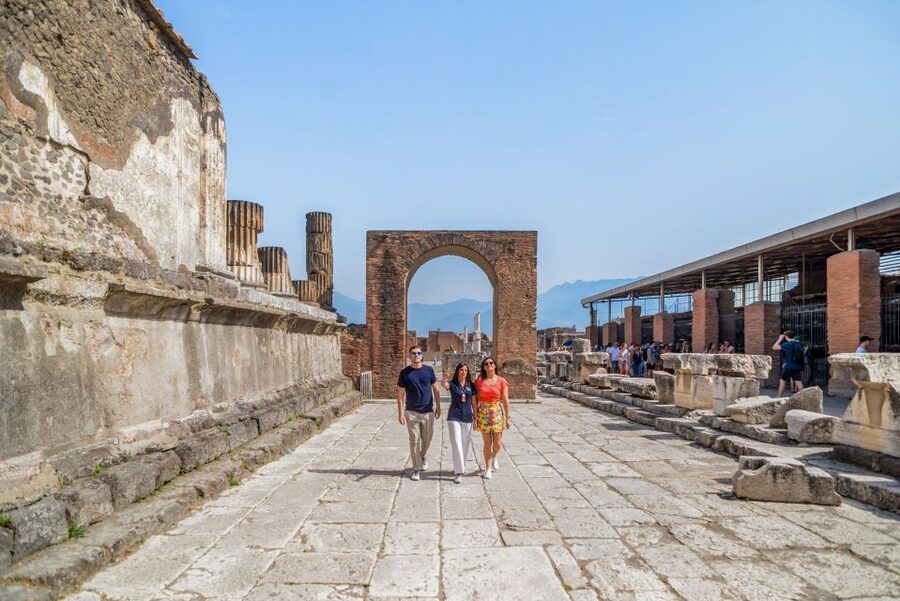
After you get oriented on the main streets, the route pushes into the heart of public life. The Forum isn’t just one building—it’s the idea of a city where politics, religion, and commerce overlap in daily routines.
You’ll spend time around the Forum area and key civic sites such as:
- the Basilica (Pompeii’s business and legal center)
- the civic zone where you get a sense of the scale of public gatherings
- views back toward the surrounding landscape, including Vesuvius
One reason I like this part of the tour is that it stops you from treating Pompeii as a museum. The Forum shows you how Romans organized time, decisions, and community. When your guide points out what each space likely meant, you start seeing the city as active—not static.
Temples and The City’s Religious Map
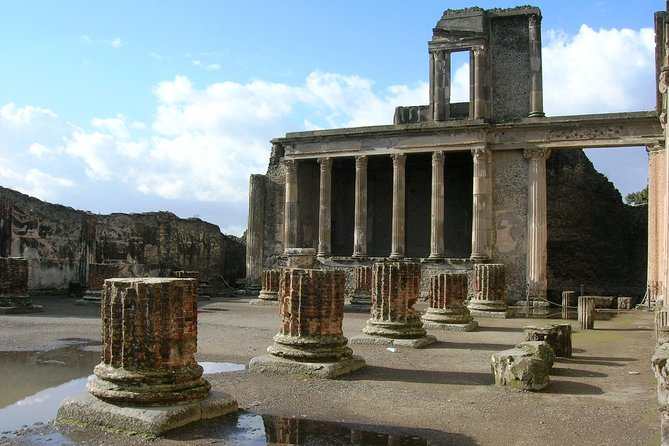
From civic space you move toward the religious layer of Pompeii. Expect stops around major temples, including the Temple of Apollo and the Temple of Jupiter.
These are useful even if you don’t consider yourself a religion-history person. Pompeii’s temples help you understand how the city’s identity was structured. Your guide’s role is to connect each temple to the larger urban layout—so you know where you are in the city’s “system,” not just where the ruins happen to be.

Baths and Theater: Social Life You Can Picture
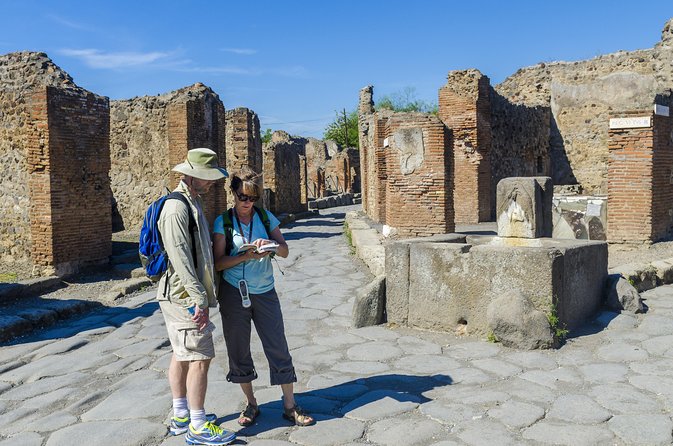
Pompeii’s baths and public entertainment spaces help you picture the city as social.
You’ll visit areas like the Forum Baths, and you’ll also see the Large Theater (one of the places that makes Pompeii feel instantly real). Even just standing where performances once happened, you can understand how gatherings shaped community life.
Practical note: the tour keeps moving, and you’ll be walking. That’s a good thing if you want a fast, high-impact route. Just plan your energy accordingly, especially if you’re combining this with other stops the same day.
Homes, Frescoes, and Why Pompeii Decoration Matters
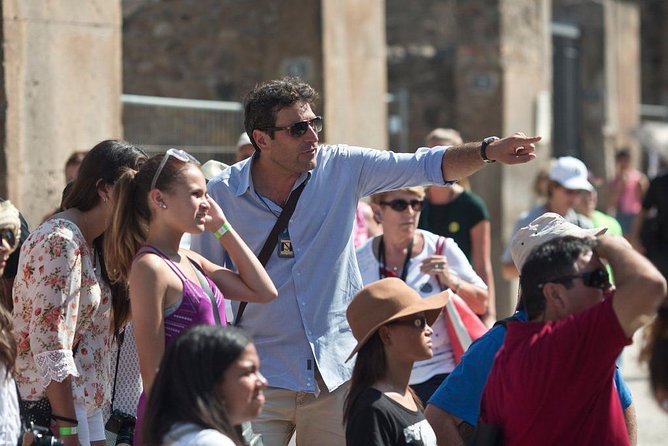
This is where the tour earns its keep.
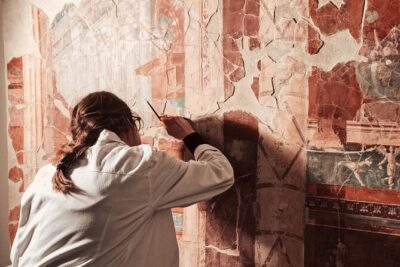
Instead of treating Pompeii as stone shells, the guide guides you toward preserved frescoes, artwork, and mosaics that show what people cared about. Stops can include residences such as the House of the Vettii and the House of Menander, plus other important homes on the route.
Two things make this section stand out:
- The guide helps you learn what you’re looking at. You’re not guessing whether a wall painting is important. You get context.
- You start spotting patterns—how rooms relate, how decoration signals status, and how daily routines would’ve felt in the spaces.
If you love details, you’ll probably find yourself slowing down more on your own afterward, because the guide taught you what to notice.
The Lupanar: A Tour Stop With Adult Themes
The Lupanar (Pompeii’s brothel) is one of the most talked-about sites here, and your guide will explain what you’re seeing and why it’s historically significant. You’ll also hear how it got its name and see preserved stone beds and frescoes linked to the setting.
This part can include adult themes, and it’s also the kind of stop that needs sensitive handling. The tour is designed to manage that context, so it’s less about shock and more about understanding social reality in Roman city life.
Plaster Casts and the Moment the Story Turns Real
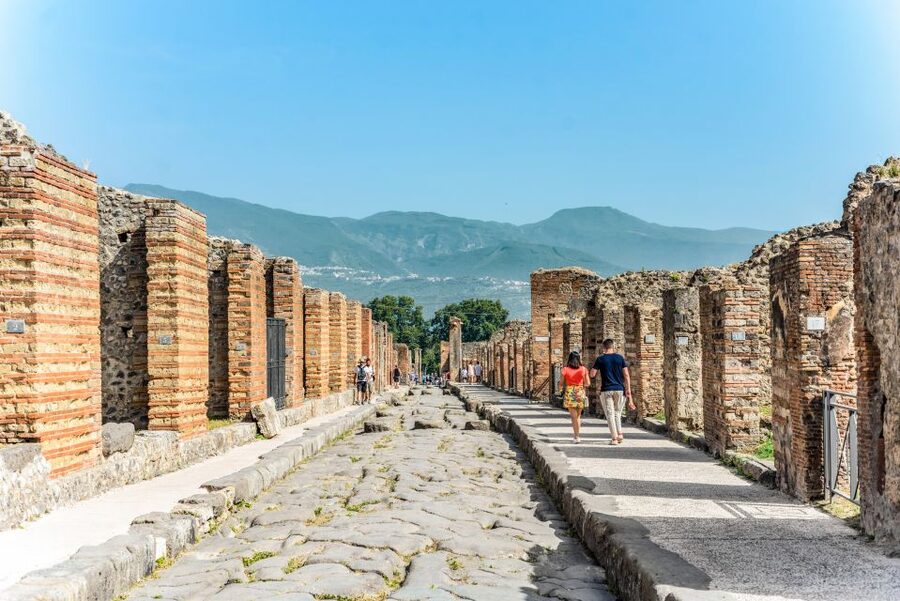
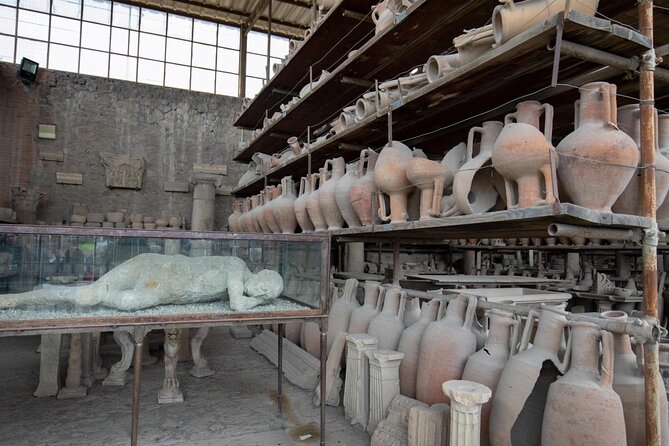
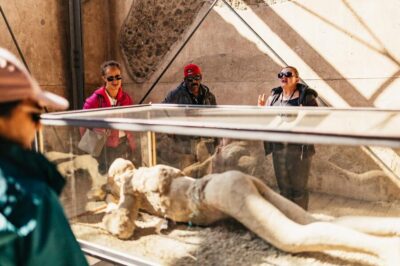
One of the most memorable elements is the display of plaster casts showing people who were in Pompeii at the time of the eruption. These are powerful because they put names you never had and images you never expected right in front of you.
Do know one practical thing: plaster casts may be presented in sealed glass cases depending on current on-site presentation. Either way, the key is the same—you’re seeing direct evidence of the human cost, and the guide connects it to the wider timeline of what happened in 79 AD.
How the Tour Works in Real Life (Group vs Private)
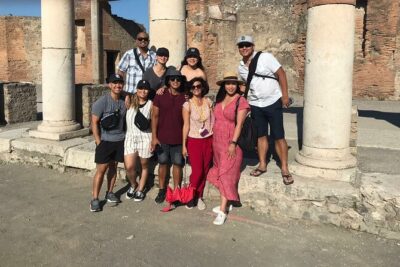
You can choose a shared small-group tour or a private tour for your group alone. Small groups can be a sweet spot because the route still feels social, but you’re not swallowed by a huge pack.
Private tours are great if:
- you want extra time at certain stops
- you’re traveling with people who learn at a slower pace
- your group wants one consistent language approach and rhythm
One thing to watch: shared and private options do not always offer the same languages. If language matters deeply, check that your preferred language matches the tour type you choose.
Headsets and Listening Without Straining
This tour includes headsets for listening when the group size is 16 or more. If you’ve ever tried to follow a guide in a loud crowd, you’ll appreciate this. It keeps your focus on what the guide is pointing at, instead of craning your neck.
Some people also find headsets a bit harder to manage than expected. Still, the upside is that you can stay engaged, especially during the explanation-heavy stops where you’ll be standing still for a few minutes.
What You’ll Do After the Guided Part Ends
At the end, you’re not rushed out. You get time to explore the archaeological site on your own, which is a big part of the value.
I like this structure because you can switch from guided storytelling to personal curiosity. If the Lupanar grabbed you, you can go back and look again. If you cared most about frescos, you can spend more time near the houses and decoration-heavy areas.
One practical tip: the park closes at 5, so earlier tour times help you protect more of your afternoon. If you book late in the day, you may find you only get a shorter window to wander independently.
Price and Value: Is $40 Worth It
At $40 per person for a 2–3 hour archaeologist-led experience, this is mostly a value question. Here’s what justifies the price:
- You’re getting the archaeologist guide to connect what you’re seeing, which is the difference between viewing ruins and understanding a city.
- The entry ticket is included, so you’re not adding a separate major cost.
- You skip the ticket line, saving time at the start when Pompeii can feel crowded.
- You also get structured stops that would be hard to prioritize if you’re short on time.
You’re paying less for convenience and more for interpretation. And for Pompeii, interpretation is what helps the place stick with you after you leave.
Who This Tour Fits Best
This is a strong fit if you:
- want a short, high-impact overview that still feels thoughtful
- like learning how a city worked, not just what it looked like
- want to see preserved art up close with help understanding it
It’s also a good family option in many cases. Some guides are playful and interactive, like the kind of energy people credited to Paulo and Anna in particular. The tour can touch adult themes at the Lupanar, so if you’re bringing kids, it helps to know your comfort level. The content is handled with context, not theatrics.
Quick Before-You-Go Notes
Plan for walking and uneven ground. Steps and ramps are part of the experience, and the tour is not recommended for wheelchair users or travelers with mobility impairments.
Bring:
- an ID or passport (a copy is accepted)
Don’t bring:
- luggage or large bags
- mobility scooters
- and note that dogs larger than 10 kg aren’t allowed on the site
If you’re sensitive to heat or want to pace yourself, consider going earlier in the day. Even when guides try to manage shade, Pompeii’s open spaces are open.
Should You Book This Pompeii Tour?
I’d book it if you want Pompeii to feel understandable quickly. The combination of an archaeologist guide, key civic and domestic highlights, and real time to wander afterward is a smart way to see Pompeii without spending your whole day decoding it.
If you have mobility challenges, I’d think twice. The route is not designed around step-free access, and the terrain can be difficult.
If you can handle walking, this tour is one of the best ways to turn Pompeii from a list of ruins into a lived-in Roman city you can actually picture.
FAQ
How long is the Pompeii tour?
You can choose a 2-hour guided tour or a 3-hour guided tour. The 3-hour option includes a visit to the Villa of the Mysteries.
What extra stop do I get on the 3-hour tour?
The 3-hour tour adds the Villa of the Mysteries visit, where you can see well-known frescoes.
Is the entry ticket included?
Yes. The Pompeii Express entry ticket is included, and the tour also offers skip-the-ticket-line access.
Do we get headsets to hear the guide?
Headsets are provided for listening when the group size is 16 or more.
Can I book a private tour instead of a shared small group?
Yes. You can choose between a shared small-group tour or a private group tour.
What languages are available?
The live tour guide is available in French, Spanish, German, Portuguese, English, and Italian.
Where do I meet the guide?
The meeting point may vary depending on the option booked, so you should confirm the exact start location for your chosen tour.
Is the tour wheelchair friendly?
No. This tour is not recommended for wheelchair users or people with mobility impairments due to steps, ramps, and uneven terrain.
What should I bring, and what isn’t allowed on-site?
Bring an ID or passport (a copy is accepted). Smoking isn’t allowed, and luggage or large bags aren’t allowed. Mobility scooters aren’t allowed either, and dogs larger than 10 kg aren’t allowed on the site.
Can I cancel, and is pay-later available?
You can cancel up to 24 hours in advance for a full refund. You can also reserve now and pay later.
More Tour Reviews in Pompei Campania
- Pompeii: Entry Ticket and Guided Tour with an Archaeologist★ 4.8 · 19,459 reviews
- Pompeii: Skip-the-Line Entrance Ticket with Audio Guide★ 4.0 · 2,509 reviews
- Naples: Pompeii and Mt. Vesuvius with Lunch and Wine Tasting★ 4.5 · 2,454 reviews
- Pompeii: Skip-the-line-Ticket and Guided Tour★ 4.6 · 1,152 reviews
- Pompeii: Small-Group Tour of Pompeii and Herculaneum★ 4.8 · 867 reviews
More Tours Led by an Archaeologist
- Pompeii: Entry Ticket and Guided Tour with an Archaeologist★ 4.8 · 19,459 reviews
- Pompeii 3hours Villa of Mysteries tour with an Archaeologist★ 4.8 · 486 reviews
- Pompeii: Tour with Archaeologist Guide & Skip-the-Line Entry★ 4.5 · 478 reviews
- Pompeii and Herculaneum: Guided Tour with an Archaeologist★ 5.0 · 164 reviews
- Pompeii: Guided Tour with Archaeologist with max. 12 People★ 5.0 · 155 reviews
Just reviewed: more Pompei Campania tours and day trips



Pompeii Archaeologist-Led Tours, compared.
 ★ 4.8Entry Ticket and Guided Tour with an ArchaeologistFrom $3519,459 reviews
 ★ 5.0Pompeii Small Group Tour with an ArchaeologistFrom $356,593 reviews
 ★ 5.0Pompeii and Herculaneum Small Group Tour with an ArchaeologistFrom $771,350 reviews
 ★ 5.0Skip the Line Guided Tour of Pompeii led by an ArchaeologistFrom $95703 reviews
 ★ 4.9Exclusive Tour with Archaeologist and Entry TicketsFrom $50634 reviews
 ★ 5.0Pompeii Private Tour with an Archaeologist and Skip The Line – 3 hoursFrom $302564 reviews
 ★ 5.0Pompeii Skip-the-line Tour with Archaeologist GuideFrom $71559 reviews
 ★ 5.0Explore Pompeii with an ArchaeologistFrom $35511 reviews
Browse the lists this tour appears in