
Reviewed · POMPEII VIRTUAL REALITY & 3D TOURS
Pompeii: Virtual Museum ticket
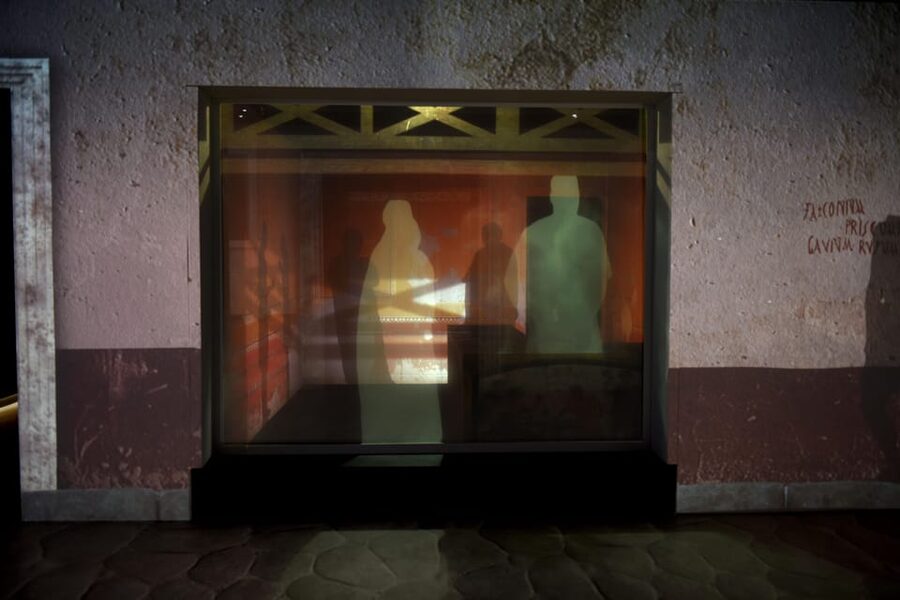
Pompeii becomes real before your eyes. This Pompeii Virtual Museum ticket walks you through reconstructed scenes from daily life right up to the Vesuvius eruption that ended the city. I especially like the animated, top-down views of key monuments, and the way the experience makes the moment before the disaster feel human, not just dramatic.
Two other things I like: you get a paper city map to help you connect what you see virtually to what you might later notice on the ground, and you can add a skip-line entrance option for the archaeological area. One possible drawback to keep in mind: this is not a full guided tour of the ruins, and there’s no audio guide included—so you’ll want to use the time to watch closely and then, if you choose the add-on, read the real site at your own pace.
In This Review
- Key takeaways before you go
- Getting oriented at the IBT Center meeting point
- What you actually do in the Pompeii Virtual Museum
- 3D reconstructions that make the Forum, baths, and Amphitheater click
- The human scenes: banquet moments and life in the Lupanar
- The Vesuvius finale: why the eruption sequence matters
- Optional add-on: Pompeii archaeological area skip-line entry
- Practical rules that affect how smooth your visit feels
- Price and value: is $14 a good deal?
- Who this experience fits best
- Should you book the Pompeii Virtual Museum?
- FAQ
- How long does the Pompeii Virtual Museum take?
- What does the ticket include?
- Is the Pompeii archaeological area ticket included?
- Is there an audio guide or guided tour included?
- Can I take photos inside?
- Are pets allowed?
- Where do I meet for this experience?
Key takeaways before you go
- Pre-eruption daily life is the focus, not only the disaster moment
- Animated 3D views of the Forum, baths, and Amphitheater help you understand layout
- 3D reconstructions are designed to make major buildings feel easier to picture later
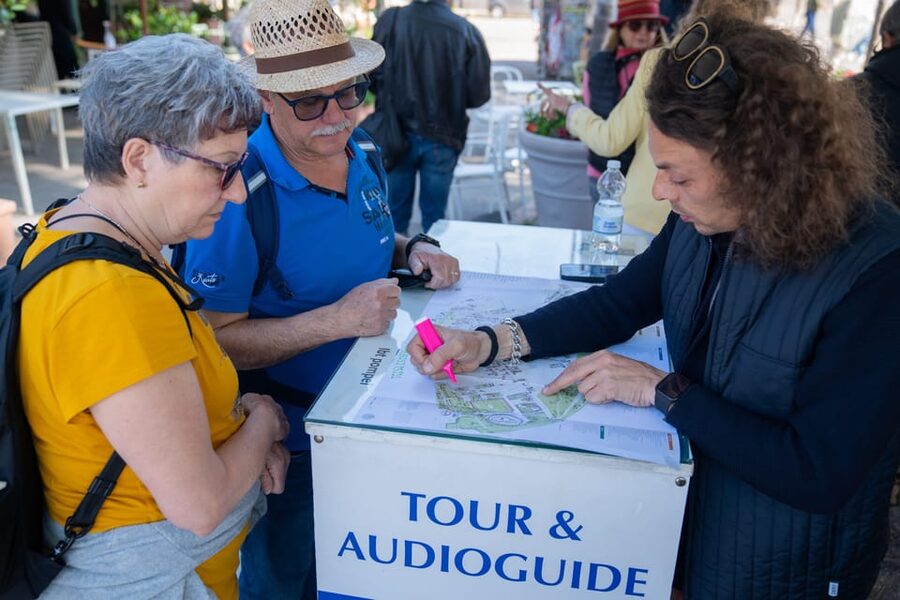
- A paper map gives you something tangible to connect virtual scenes to the archaeological area
- If you add it, you get skip-the-line for the Pompeii archaeological area (not for Villa dei Misteri)
Getting oriented at the IBT Center meeting point

You’ll meet at the Office called IBT Center/Touristation, next to Chalet Donna Lucia. That matters more than it sounds. In Pompeii, it’s easy to lose time before you even start, and a clear meeting spot helps you get into the right rhythm fast—especially if you’re pairing this with a visit to the ruins.
Once you arrive, you’ll have assistance at the Touristation Office. In practice, this is helpful if you need help matching your ticket to the right session or figuring out where to go next. You also get free Wi-Fi, which can be useful if you’re checking maps or saving your plans for later.
One small tip: wear comfortable shoes and plan to keep your hands free. You can’t bring luggage or large bags inside, and the rules about what you can carry can slow you down at the entrance if you’re overpacked.
See the city put back together in 3D
- Pompeii: 3D Walking Tour with Entry Ticket
★ 4.3 · 102 reviews - Pompeii: Virtual Museum ticket
★ 4.5 · 37 reviews - Pompeii & Virtual Museum Private 2-in-1 Kid’s Tour
★ 4.9 · 9 reviews
What you actually do in the Pompeii Virtual Museum
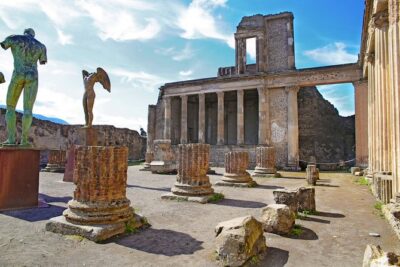
The core experience is a virtual, reconstructed walk through Pompeii from around 2000 years ago, centered on life before the eruption in 79 AD. The emphasis is on seeing a section of the city in a way that’s hard to get from ruins alone. Real Pompeii is powerful, but it’s also broken—walls without roofs, streets without the same street-level context.
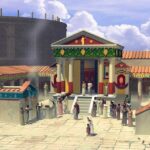
Here, you’re shown a “complete” version: houses, streets, and major buildings rebuilt into a coherent picture. The experience is designed to turn you into a participant. You’re not just watching a film. You’re moving through reconstructions that try to recreate what daily life might have looked like, so you can mentally place yourself in the city instead of standing back and only looking at fragments.
The duration can range from 30 minutes to 4 hours, depending on the starting time and availability. That wide range is the biggest thing to watch. If you’re on a tight schedule, choose a slot that matches your energy. If you’re flexible, longer sessions give you time to let the reconstructions sink in before you head to the archaeological area.
3D reconstructions that make the Forum, baths, and Amphitheater click
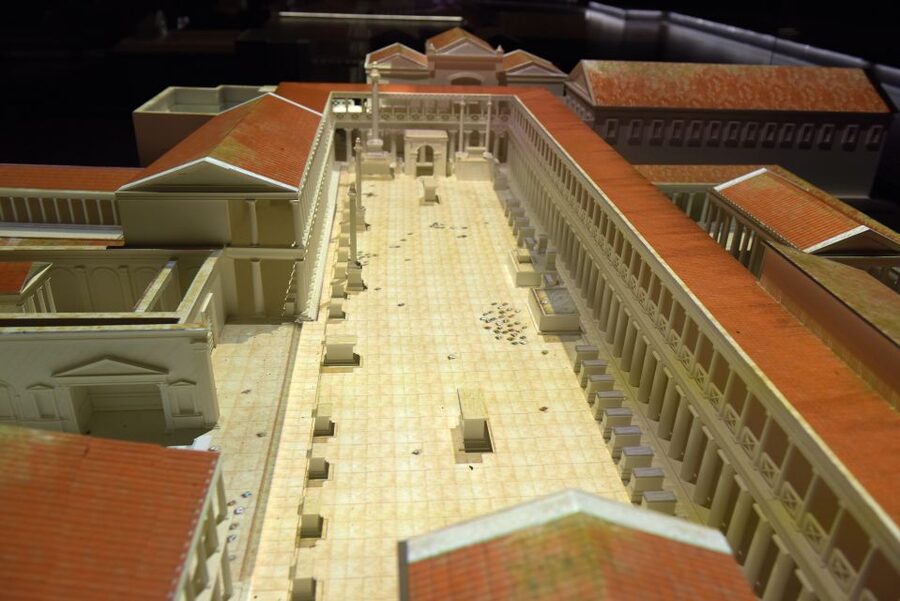
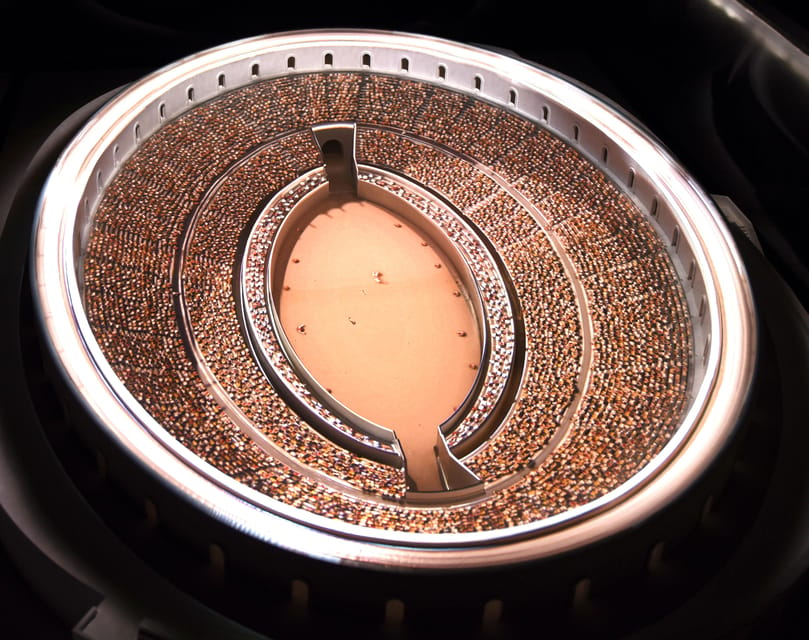
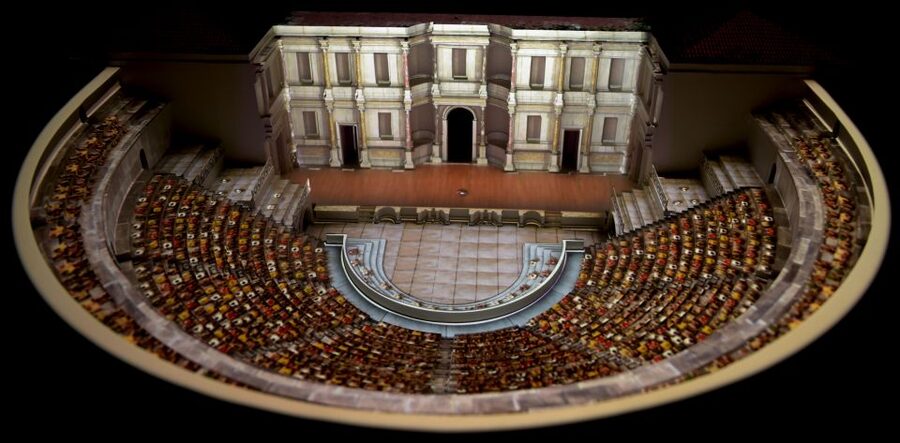
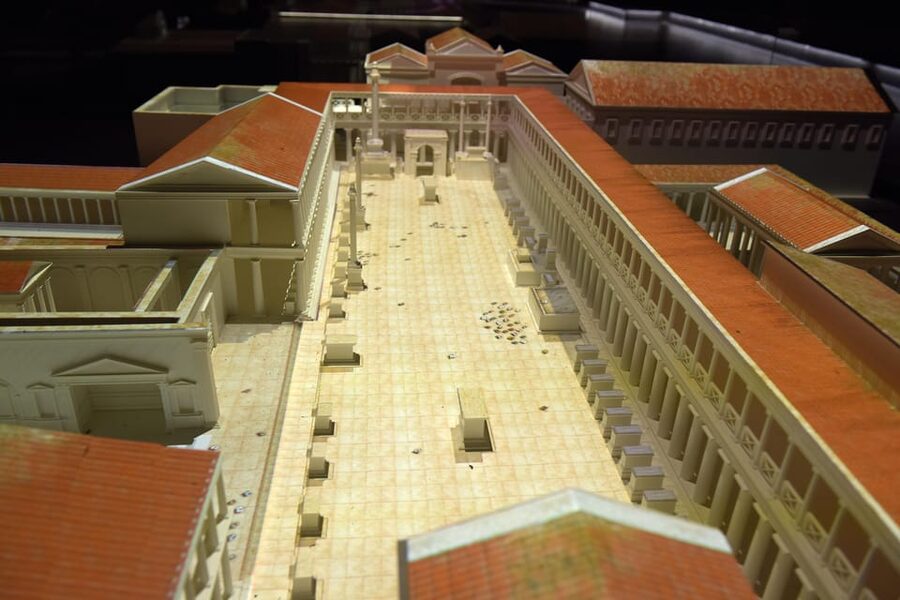
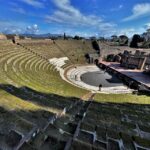
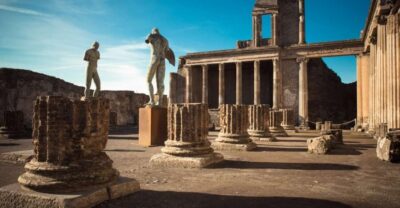
One of the best parts for me is the way the experience uses animated reconstructions of major buildings, including what places like the Forum, the baths, and the Amphitheater looked like when they weren’t in ruins.
Why this is valuable: Pompeii’s monuments can be confusing at ground level. You might spot a wall, an arch, or a foundation and still wonder how everything connected. The virtual animation helps with that “wait, where was that in relation to this?” problem. You get a clearer mental map of the city’s structure, which makes your later real-world observations feel quicker and more satisfying.
You also get 3D reconstructions of important buildings, presented in a way that’s meant to help you understand scale and layout. Even if you don’t add the archaeological site ticket, this portion can still be a strong history-in-a-picture experience. If you do add the ruins, it becomes a preparation tool—less guessing, more noticing.
The human scenes: banquet moments and life in the Lupanar
The museum doesn’t stick only to monumental history. It also recreates social life. You can stroll the reconstructed streets, stop in for a Roman banquet, and even spy on the goings-on of the Lupanar (the area associated with brothels).
That may sound like a gimmick, but it actually helps you understand why Pompeii still feels modern. People lived, loved, fought, ate, and spent time in places that were part of their routines. When you later look at a real neighborhood or a doorway location on the ground, you’re better able to imagine how it functioned.
Just be aware: this isn’t a museum tone that stays polite and neutral the entire time. It’s meant to show daily life, including the grittier or more controversial parts of it. If you’re sensitive to adult themes, you should consider that the experience includes scenes like the Lupanar.
The Vesuvius finale: why the eruption sequence matters
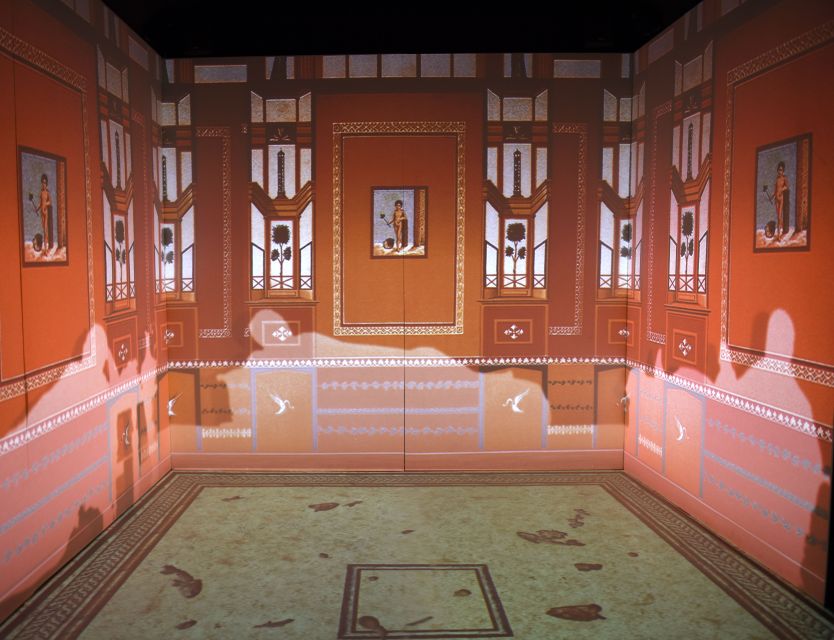
The experience ends with the spectacle of the eruption of Vesuvius—the event that ended the city but also turned it into an enduring time capsule for modern visitors.
I like this ending because it gives you emotional context. Pompeii isn’t just “old rocks.” It’s a city with routines, interruptions, and ordinary moments right before a catastrophic event. When the eruption sequence arrives after you’ve already seen the city as a lived-in place, it feels less like a disaster clip and more like the rupture of something that was functioning normally.
And if you’re adding the archaeological area entry ticket, this finale helps you read the site better. You’ll have a stronger sense of what you’re looking at: not only where things ended, but also what was lost.
More tickets to the site

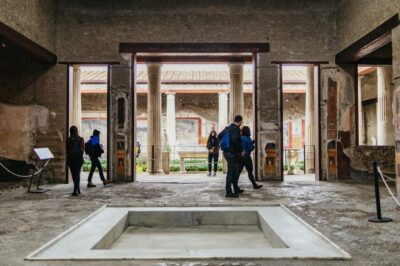

Optional add-on: Pompeii archaeological area skip-line entry
If you select the add-on, you’ll get a ticket for the Pompeii archaeological area and a skip-the-line ticket for the archaeological area. That’s a real value lever in Pompeii because queues can eat up your day.
However, the add-on comes with specific limits. For example, entrance to Villa dei Misteri is not included. If that villa is a must for your planning, you’d need separate entry information.
What I recommend: treat the virtual museum as the “setup” and the ruins as the “proof.” The virtual part helps you picture the city’s structure; the archaeological site helps you see the textures—stone, uneven surfaces, the way spaces feel in real scale. Together, they can make your visit more coherent.
Also, this matters for your time planning. The virtual museum alone can be anywhere from 30 minutes to 4 hours. Add the archaeological area and suddenly your day changes. If you’re visiting in peak season, give yourself enough cushion to move between areas without stress.
Practical rules that affect how smooth your visit feels
A few on-site rules can shape your comfort level:
- No photography inside. Your phone might feel useless for capturing what you see, so plan on relying on memory and the connections you make.
- No food and drinks inside.
- No pets are allowed for the main museum experience.
- If you add the archaeological area: small dogs are permitted inside the archaeological area, but they must be kept on a leash and carried when inside buildings.
Also keep in mind what’s not included. There’s no guided tour and no audio guide. That doesn’t make it worse; it just changes the experience. You’ll get the reconstructions, but you won’t have someone narrating along the way like a traditional guided tour. If you like learning through your own questions, you’ll do fine. If you prefer a constant human commentary, you may want to consider a separate guided option.
You’re also not getting transportation or food included, so build those costs into your day.
Price and value: is $14 a good deal?
At about $14 per person, this virtual museum ticket can be good value—especially if you use it strategically.
Here’s the way I think about it:
- If you’re short on time or you’re pacing a longer trip, a virtual reconstruction can help you get the “big picture” of Pompeii quickly. The 3D reconstructions of the Forum, baths, and Amphitheater are the kinds of elements that often take extra time to interpret on-site.
- If you’re visiting Pompeii and want a clean mental map before stepping into the ruins, this ticket can make your walking time more productive. It can turn the archaeological area into something you understand rather than something you simply navigate.
- If you were hoping for a deep, guided narration throughout, you’ll likely feel shortchanged. The lack of an audio guide and guided tour is part of the tradeoff at this price point.
For me, the best value scenario is when you do both: virtual museum first, then (optionally) the archaeological area with the skip-line ticket. The virtual portion gives you context; the ruins give you scale.
Who this experience fits best
This works especially well if you’re:
- Going with people who enjoy visuals and clear structure (3D and animated reconstructions make the city readable)
- Short on time and want to see Pompeii’s layout and major spaces without spending extra hours figuring it out
- Visiting the ruins and want your time there to feel more connected and less confusing
It might be less satisfying if you:
- Want a full guided walk through Pompeii with constant commentary
- Prefer to take photos inside attractions (since photography is not allowed)
- Expect this to replace the archaeological site entirely (it’s a reconstruction; the ruins are still the main event)
Should you book the Pompeii Virtual Museum?
Yes, you should book this if you want a smart, time-saving way to understand Pompeii’s layout and everyday life, and if you’re likely to visit the archaeological area afterward. The combination of animated 3D reconstructions, a paper map, and a finale that frames the eruption makes it easier to turn the ruins into a story you can follow.
Skip it or rethink it if you’re mainly looking for a guided tour experience, a place where you can take lots of photos, or a substitute for walking the real archaeological streets. At this price, it’s best as a prep-and-context ticket—then let the actual site do the emotional heavy lifting.
FAQ
How long does the Pompeii Virtual Museum take?
The experience duration can range from 30 minutes up to 4 hours, depending on availability and the starting time you choose.
What does the ticket include?
Your ticket includes a reserved entry to the Pompeii Virtual Museum, a paper city map, assistance at the Touristation Office, and free Wi-Fi. If you select the add-on, you also get skip-the-line entry for the Pompeii archaeological area.
Is the Pompeii archaeological area ticket included?
It’s included only if you select the optional add-on entry ticket. Without the add-on, you’re visiting the virtual museum.
Is there an audio guide or guided tour included?
No. A guided tour and an audio guide are not included.
Can I take photos inside?
No. Photography inside is not allowed.
Are pets allowed?
Pets are not allowed. If you add the archaeological area, small dogs are permitted there but must be on a leash and carried when inside buildings.
Where do I meet for this experience?
Report to the Office called IBT Center/Touristation next to Chalet Donna Lucia.
More Tickets in Pompei Campania
- Pompeii: Entry Ticket and Guided Tour with an Archaeologist★ 4.8 · 19,459 reviews
- Pompeii: Skip-the-Line Entrance Ticket with Audio Guide★ 4.0 · 2,509 reviews
- Pompeii: Skip-the-line-Ticket and Guided Tour★ 4.6 · 1,152 reviews
- Pompeii: Skip-the-Line Entry Ticket with Digital Guide App★ 4.1 · 770 reviews
- Pompeii: Afternoon to Sunset Guided Tour with Ticket★ 4.9 · 484 reviews
More Tour Reviews in Pompei Campania
- Pompeii: Entry Ticket and Guided Tour with an Archaeologist★ 4.8 · 19,459 reviews
- Pompeii: Small Group Tour with an Archaeologist★ 4.8 · 12,264 reviews
- Pompeii: Skip-the-Line Entrance Ticket with Audio Guide★ 4.0 · 2,509 reviews
- Naples: Pompeii and Mt. Vesuvius with Lunch and Wine Tasting★ 4.5 · 2,454 reviews
- Pompeii: Skip-the-line-Ticket and Guided Tour★ 4.6 · 1,152 reviews
Pompeii Rebuilt, More 3D Tours
- Pompeii: 3D Walking Tour with Entry Ticket★ 4.3 · 102 reviews
- Pompeii & Virtual Museum Private 2-in-1 Kid’s Tour★ 4.9 · 9 reviews
- Pompeii: Family-Friendly Augmented Reality Tour with Ticket★ 3.6 · 5 reviews
- Pompeii: AR Glasses Augmented Reality Tour★ 5.0 · 3 reviews
- Pompeii Ruins: Virtual Tour 360° with Authorized Storyteller★ 5.0 · 3 reviews
Just reviewed: more Pompei Campania tours and day trips



Pompeii Virtual Reality & 3D Tours, compared.
 ★ 4.33D Walking Tour with Entry TicketFrom $61102 reviews
 ★ 4.5Skip-the-Line Ticket and Virtual MuseumFrom $6066 reviews
 ★ 4.5walking tour with 3D glasses and with entrance ticketFrom $6261 reviews
 ★ 5.0Pompeii 360° – 4-hour tour with an expert Guide in archaeologyFrom $20336 reviews
 ★ 4.9Pompeii & Virtual Museum Private 2-in-1 Kid’s TourFrom $2379 reviews
 ★ 4.5Private Pompeii Tour with 3D Virtual Reality Headset – Tour Assistant OnlyFrom $1248 reviews
★ 4.5Pompeii Skip-the-Line Ticket and Virtual MuseumFrom $608 reviews
★ 4.5Private Pompeii Tour with 3D Virtual Reality Headset – Tour Assistant OnlyFrom $1248 reviews
★ 4.5Pompeii Skip-the-Line Ticket and Virtual MuseumFrom $608 reviews
 ★ 4.5Private Pompeii Tour with 3D Virtual Reality HeadsetFrom $2177 reviews
Browse the lists this tour appears in