
Reviewed · POMPEII PRIVATE GUIDED TOURS
Private Pompeii Tour with 3D Virtual Reality Headset
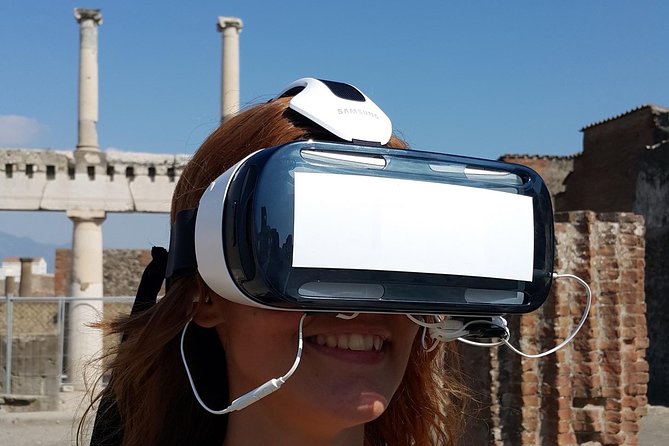
Pompeii changes when you see it in 3D. This private tour pairs a licensed local guide with 3D 360 virtual reality so you can watch Pompeii’s streets, shops, and homes re-form around you. I also like how the guide’s audio commentary gives you context as the ruins become a living city again. One real drawback to plan for: VR isn’t for everyone, and the health warnings are serious if you have a seizure history, strong dizziness issues, or certain vision or medical conditions.
You get to pick a morning or afternoon slot, and the pace fits a real visit to the Pompeii Archaeological Park: walking on uneven ground, stepping from ruins into reconstructions, then asking questions while everything clicks. The tour is private (just your group), and it runs in all weather, so you’re not stuck playing weather roulette. Wear comfortable shoes and travel light, because you may need to carry a lightweight bag strap across your shoulder during the visit.
If you’re bringing teens or kids, read the VR rules carefully. Use of the Gear VR headsets is not recommended for children under 13, kids 9–12 are allowed only at a parent’s discretion, and children under 9 can’t use the headsets. If any of those age limits or the medical cautions apply, you’ll want to think twice before booking.
In This Review
- Key highlights
- Where you meet and how the first minutes feel
- How the 3D 360 Gear VR experience actually works
- Pompeii Archaeological Park: what your guide leads you to see
- Stepping back 2,000 years: why VR helps more than you’d think
- Timing, walking comfort, and what to bring
- English guide plus group discounts: value for different budgets
- Safety and who should think twice about the VR headset
- The guide experience and the VR animation trade-off
- Should you book this private Pompeii VR tour?
- FAQ
- How long is the Private Pompeii Tour with a VR headset?
- Where does the tour start and end?
- What is included in the price?
- Is transportation to and from Pompeii included?
- Are children allowed to use the VR headset?
- Does the tour run in bad weather?
- Who should consult a doctor before using the Gear VR headset?
Key highlights
- Private tour with a licensed local guide for a more personal, question-friendly experience
- 3D 360 Gear VR that reconstructs ancient Pompeii around you
- Audio commentary that helps you connect what you see in VR to what’s still standing in the park
- Skip-the-line entrance included for the Pompeii Archaeological Park
- Morning or afternoon option, operating in all weather
Where you meet and how the first minutes feel
The whole experience starts at Piazza Esedra (80045 Pompei NA), and it ends back at the same meeting point. That matters because Pompeii can feel spread out, and having a clear start/end point makes your day calmer, especially if you’re pairing it with other plans in Naples or around the coast.
Once you meet, expect a straightforward setup: you’ll get instructions for the headset use, then you’ll move into the main Pompeii Archaeological Park experience. The tour is designed to work in all weather, so don’t build your schedule around sun. Also, you’ll be walking over uneven terrain, so comfortable shoes are not a “nice idea”—they’re the difference between enjoying the day and rushing to sit down.
You should also plan for light packing. The guidance is to minimize bags and backpacks, and you may have to wear a lightweight bag across your shoulder during the tour. If you’re the type who shows up with a camera strap, water bottle, and a small daypack, consider leaving what you don’t need back at your base.
Finally, note that this is offered in English. If English is your comfort zone, you’ll likely get the most out of both the guide’s explanations and the audio commentary that supports the VR sequences.
Prefer your own guide? More private tours
- Pompeii private tour with an Official Guide
★ 5.0 · 631 reviews - Pompeii Private Tour with an Archaeologist and Skip The Line – 3 hours
★ 5.0 · 564 reviews - Visit in Pompeii – Pompeii Private Tour with Ada
★ 5.0 · 436 reviews
How the 3D 360 Gear VR experience actually works
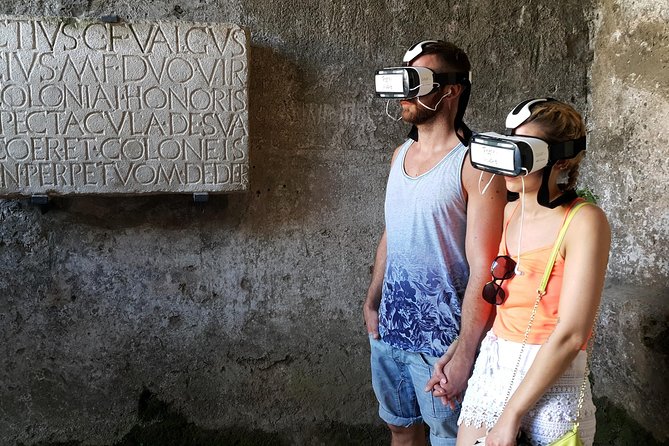
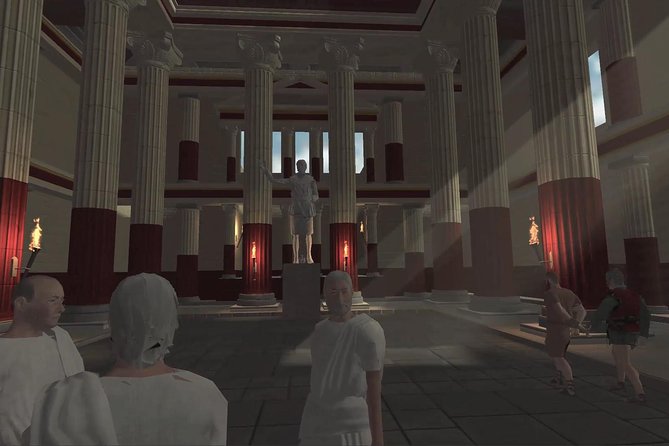
The heart of this tour is the 3D virtual reality headset experience—Gear VR—with a 360-degree view. In plain terms, you don’t just “watch” Pompeii. You look around, and the reconstructions are meant to feel like you’re standing inside the city as it existed around 2,000 years ago.
The tour uses audio commentary alongside the VR, which is key. Ruins can be impressive, but it’s easy to get lost in stone without knowing what belonged where. With audio running while you look around in VR, you’re more likely to understand what you’re seeing—temples, homes, shops, theaters, and markets—and why those spaces mattered.
Still, it’s important to calibrate your expectations about the visuals. The VR reconstructions are described as animation-based, and some people may find the graphics less like photo-real footage and more like an animated interpretation. That doesn’t ruin the concept, but it can change how you react. If you’re hoping for a super-real “walk through,” you might wish you were on a more traditional guided route instead.
Also, VR safety is not a footnote here. The headset use isn’t recommended for kids under 13, and the tour includes clear warnings for people with histories of seizures, dizziness, epilepsy, epilepsy-triggering conditions, binocular vision abnormalities, psychiatric disorders, heart conditions, pregnancy, and for elderly people unless a doctor says it’s okay. It also warns about pacemakers and other implanted devices because the Gear VR can emit radio waves. If any of that applies, consult a doctor before you go.
Pompeii Archaeological Park: what your guide leads you to see
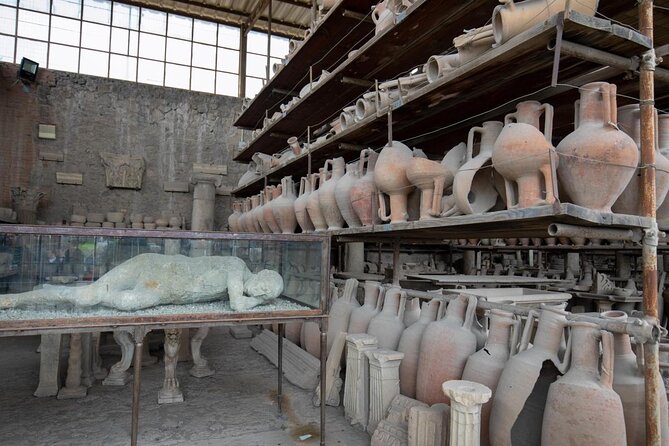
At the main stop—Pompeii Archaeological Park—you’ll spend about 2 hours in the tour experience (the overall tour is listed as about 2 to 3 hours). The structure is built around contrast: you move through the archaeological site while the headset helps “fill in” what the ruins once were.
Your licensed local guide is there for the big practical problem at Pompeii: making sense of the layout. Even with good maps, it can be hard to tell where you are in the original city plan. Your guide’s job is to help you connect what still exists to what was destroyed, so you’re not just walking from one highlight to the next.
Here’s what the experience is designed to cover while you’re moving through the park:
- Temples and religious spaces, so you can understand the role of worship and public rituals
- Homes and household life, which is where Pompeii really feels human
- Shops and everyday commerce, so the city feels like it had rhythm, not just monuments
- Theaters and entertainment, which can be surprisingly easier to visualize once you’ve seen the reconstruction
- Markets and public gathering zones, where Roman life happened in plain sight
You can also expect time for questions. That’s one underrated value of a private format: you can ask what you’re actually wondering about, instead of hoping a group’s questions get answered before you’re moved on.
One more practical note: this isn’t just a headset demo. You’ll still physically be at Pompeii’s archaeological spaces, and the walking happens on uneven ground. The experience works best when you treat it like a guided walk supported by VR, not like a sit-down show.
Stepping back 2,000 years: why VR helps more than you’d think

Pompeii is famous because it was preserved. But preservation can create a weird feeling: stone stays, people don’t. The best tours help you bridge that gap with stories and details. This one uses VR to do some of the bridge-work for you.
When the headset shows what Pompeii looked like around the time before the eruption of Mt. Vesuvius, you get a mental shortcut. Suddenly, a half-standing wall stops being a random ruin and becomes a wall for a specific kind of space—one with a function and a place in daily life.
That’s the payoff: you’re learning with your eyes. Instead of trying to picture Roman life from scattered details, you’re seeing it staged around you in 360 degrees, then tying it back to the real location outside the headset. For many people, that’s the difference between visiting Pompeii as a list of ruins versus visiting it as a city.
The trade-off is also part of the deal. Since the VR is a reconstruction, it’s an interpretation. It can feel more “instructional” than “perfectly realistic.” If your style is to obsess over authenticity details, you may prefer a traditional tour with heavier focus on what archaeologists know from the physical evidence. If your style is to get oriented fast and understand the big picture, the VR approach can be exactly the right tool.
Timing, walking comfort, and what to bring
This tour runs about 2 to 3 hours, with the main park experience listed as around 2 hours. That time window is practical because it lets you see real Pompeii without turning your day into a marathon. You’ll also have enough time to return to your meeting point without feeling like you’re rushing to catch a bus across town.
Because you’ll walk over uneven terrain, pack for comfort more than style. Comfortable shoes matter. If you wear supportive footwear, you’ll stand more easily for headset breaks and keep your pace steady during the walking segments.
Bring only what you need. The guidance is to travel light, minimize bags and backpacks, and be ready to wear a lightweight bag across your shoulder during the tour. If you’re carrying a bulky camera rig or a big tote, you may spend more energy managing your gear than absorbing the experience.
Transport to and from Pompeii is not included. That’s normal for tours at this kind of site, but it does affect planning. If you’re starting from Naples or another area, you’ll want a transit plan that gets you to Piazza Esedra with enough buffer time.
And yes, it operates in all weather, so pack accordingly. Even if the day looks bright when you leave, Pompeii weather can change quickly.
See the city put back together in 3D


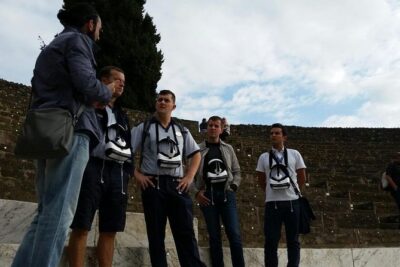
English guide plus group discounts: value for different budgets
At $217.49 per person, this tour is not a budget pick. So the key question is: what are you paying for?
You’re paying for three big items you don’t always get together:
- A licensed local guide who can answer questions and help you interpret what you’re seeing
- A skip-the-line entrance fee included for the Pompeii Archaeological Park
- A private 3D 360 VR component using Gear VR, paired with audio commentary
The private format is where value can shift fast. If you’re traveling as a small group, you’re not sharing the headset time or the guide’s attention with strangers. If you’re going solo, the price will feel heavier, but you may still find it worthwhile if you know you want a guided orientation plus a modern way to visualize the site.
There are also group discounts, which can make a real difference if you’re coordinating with friends or family. If you have flexibility to travel with at least a couple of people, check whether your total cost drops meaningfully.
One more value angle: skip-the-line access. Pompeii can have busy periods, and time saved can protect the best part of the visit—actually understanding the site once you’re in.
Safety and who should think twice about the VR headset
This is the part you should take seriously, even if you’re excited about seeing Pompeii as it once was. The tour includes warnings for people with:
- histories of seizures, dizziness, epilepsy, or seizure-triggering conditions
- preexisting binocular vision abnormalities
- psychiatric disorders
- heart conditions, other serious medical conditions
- pregnancy
- age considerations for elderly participants (consult a doctor)
It also warns that some people—about 1 in 4,000—may experience severe dizziness, seizures, epileptic seizures, or blackouts triggered by light flashes or patterns. The headset use should be stopped immediately if you feel symptoms like dizziness, disorientation, nausea, eye strain, blurred or double vision, or any motion-sickness-like effects.
There’s also a radio-frequency detail many people miss: the Gear VR can emit radio waves and can affect nearby electronics, including cardiac pacemakers. If you have a pacemaker or other implanted medical device, the guidance is not to use the Gear VR without consulting your doctor or the device manufacturer.
Most people can participate, but that doesn’t mean you should ignore the warnings. If you’ve had motion sickness with VR before, if you’re prone to migraines, or if you have any of the listed conditions, talk to a clinician first. It’s a small step that can save a bad day.
The guide experience and the VR animation trade-off
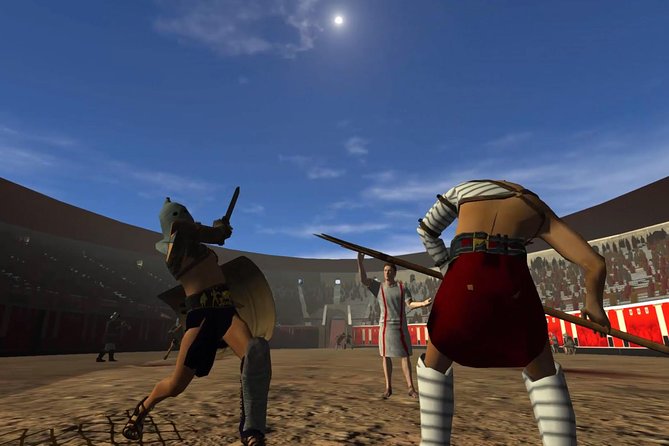
The best part of this kind of tour is the combo: a local guide who can explain what you’re seeing, and a VR layer that makes it easier to visualize how Pompeii functioned. The “aha” moment often comes when the guide points out something on the ground and the headset shows you the same area as a living street or room.
The guide component matters because Pompeii is full of details, and without help, it’s easy to miss what’s significant. Here, the guide’s audio and explanations are part of what turns the visit into understanding, not just looking.
At the same time, keep your expectations realistic about the VR visuals. The VR animation is essentially a reconstruction, and some viewers may feel it looks cartoonish compared to what their imagination builds. If that bothers you, you might end up thinking a regular guided walk would have felt more “complete.”
My advice: treat VR as a learning tool, not a replacement for Pompeii. If you’re the type who loves getting oriented quickly and you’re curious how people lived, it can be a great fit. If you need the experience to be strictly archaeology-first, you may prefer a traditional tour route.
Should you book this private Pompeii VR tour?
Book it if you want a private, guided Pompeii orientation that uses 3D 360 VR to help you visualize daily life—homes, shops, theaters, markets, and temples—around 2,000 years ago. The headset-plus-guide format is especially worth it when you like learning with both explanation and visual context.
Skip it or think hard first if VR can trigger problems for you, if you’re bringing children who fall outside the headset guidance, or if you know you strongly prefer a normal guided tour without animation-based reconstructions. In those cases, you might get more satisfaction from a traditional Pompeii guide who stays entirely grounded in what’s physically on site.
If you do book, set yourself up for success: wear supportive shoes, keep your bag light, plan a morning or afternoon time that matches your energy, and ask your guide questions while you’re on the ground. That’s where this tour does its best work—turning preserved ruins into a city you can actually picture.
FAQ
How long is the Private Pompeii Tour with a VR headset?
The tour is approximately 2 to 3 hours. The Pompeii Archaeological Park experience is listed as about 2 hours.
Where does the tour start and end?
It starts at Piazza Esedra, 80045 Pompei NA, Italy and ends back at the same meeting point.
What is included in the price?
Included items are a licensed local guide, a 3D 360 virtual reality headset (Gear VR), and a skip-the-line entrance fee. Audio commentary is also part of the experience.
Is transportation to and from Pompeii included?
No. Transport to and from Pompeii is not included.
Are children allowed to use the VR headset?
Use of the headsets is not recommended for children under 13. Parents may allow children aged 9 to 12 to use the headsets at their discretion, and children under 9 are not permitted.
Does the tour run in bad weather?
Yes. The tour operates in all weather.
Who should consult a doctor before using the Gear VR headset?
The tour data advises people with histories of seizures, dizziness, epilepsy, binocular vision abnormalities, psychiatric disorders, heart conditions, serious medical conditions, pregnant people, and the elderly to consult a doctor before taking the tour. It also notes the Gear VR can emit radio waves and may affect devices like pacemakers.
More Tour Reviews in Pompeii
- Pompeii Small Group Tour with an Archaeologist★ 5.0 · 6,593 reviews
- Discover the Ancient Ruins of Pompeii: Day Trip from Rome★ 3.5 · 2,247 reviews
- Pompeii and Herculaneum Small Group Tour with an Archaeologist★ 5.0 · 1,350 reviews
- Skip the Line Guided Tour of Pompeii led by an Archaeologist★ 5.0 · 703 reviews
- Pompeii Ticket + Tour with Optional Tasting Experience at Pompeii★ 5.0 · 663 reviews
Pompeii Rebuilt, More 3D Tours
- Pompeii: walking tour with 3D glasses and with entrance ticket★ 4.5 · 61 reviews
- Pompeii 360° – 4-hour tour with an expert Guide in archaeology★ 5.0 · 36 reviews
- Pompeii Skip-the-Line Ticket and Virtual Museum★ 4.5 · 8 reviews
- Private Pompeii Tour with 3D Virtual Reality Headset – Tour Assistant Only★ 4.5 · 8 reviews
- Pompeii Virtual Museum Entrance Ticket★ 4.5 · 3 reviews
More Private Guides at the Site
- Pompeii private tour with an Official Guide★ 5.0 · 631 reviews
- Pompeii Private Tour with an Archaeologist and Skip The Line – 3 hours★ 5.0 · 564 reviews
- Visit in Pompeii – Pompeii Private Tour with Ada★ 5.0 · 436 reviews
- Pompeii Private Tour with an Archaeologist and Skip The Line★ 5.0 · 391 reviews
- Pompeii Vineyard Escape: Private Wine Tasting & Lunch★ 5.0 · 329 reviews
Just reviewed: more Pompeii tours and day trips






Pompeii Private Guided Tours, compared.
 ★ 4.9Pompeii Ruins Private Tour with Optional Skip-the-Line EntryFrom $254732 reviews
 ★ 5.0Pompeii private tour with an Official GuideFrom $107631 reviews
 ★ 5.0Pompeii Private Tour with an Archaeologist and Skip The Line – 3 hoursFrom $302564 reviews
 ★ 5.0Visit in Pompeii – Pompeii Private Tour with AdaFrom $229436 reviews
 ★ 5.0Pompeii Private Tour with an Archaeologist and Skip The LineFrom $375391 reviews
 ★ 5.0Pompeii Vineyard Escape: Private Wine Tasting & LunchFrom $66329 reviews
 ★ 5.0Private Day Tour to Vesuvius, Herculaneum & Pompeii with Pick UpFrom $120279 reviews
 ★ 5.0Guided Small Group Tour Max 6 People with Private OptionFrom $168269 reviews
Browse the lists this tour appears in