
Reviewed · ANCIENT POMPEII HISTORY TOURS
Pompeii Ruins: Virtual Tour 360° with Authorized Storyteller
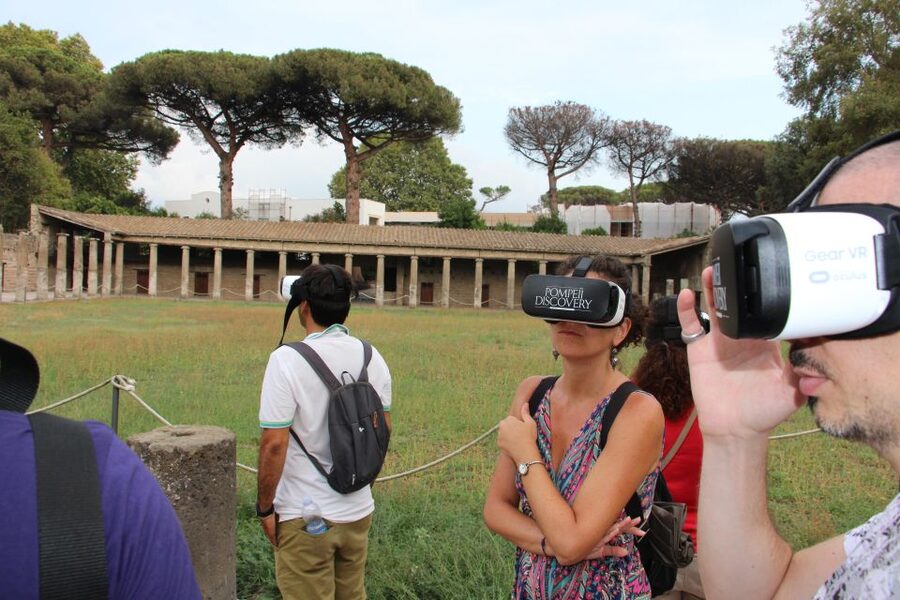
Pompeii turns three-dimensional with a local storyteller. This 360° VR experience pairs a live, authorized guide with headset time across nine key spots, so you can picture everyday life in Pompeii before the 79 A.D. eruption. I especially like the VR headset for showing the city’s layout in 3D, and the local storyteller who keeps the scenes tied to real explanations from the ground. The main consideration: the entrance ticket is not included, so budget for that on top of the tour price.
You’ll also get a practical advantage: a live guide in English or Italian, plus skip-the-ticket-line once you have your ruins entry sorted. Because it’s set up as a private group, you’re not stuck waiting for others to catch up, which matters when you’re switching between looking at stone ruins and putting on the headset.
In This Review
- Key highlights that make this Pompeii VR tour different
- Why Pompeii feels clearer with VR plus a live guide
- Price and value: what $226.57 really buys
- How the experience runs: what you’ll do once you’re at Pompeii
- Stop 1: The Forum and Basilica—your mental map starts here
- Stop 2: Pompeii’s Baths—when cleanliness and social life overlap
- Stop 3: The House of the Faun and the House of Menander
- Stop 4: The Bakery and shop activities—food and work made visible
- Stop 5: The Large Theatre and a theatrical performance
- Stop 6: Quadriporticus—gladiator training and the edge of spectacle
- Stop 7: The Lupanar—nightlife, learning, and a harder subject
- The role of the storyteller: the difference between info and meaning
- Skip the ticket line, but plan for the ticket itself
- Who should book this Pompeii VR tour (and who might not)
- Booking-smart checklist before you go
- Final verdict: should you book this Pompeii VR tour?
- FAQ
- Is the entrance ticket to the Pompeii ruins included?
- Does the tour include a live guide?
- What languages are available for the live tour?
- Are virtual reality headsets provided?
- Is this a private group?
- Is it suitable for children?
- Is it suitable for people with epilepsy?
- Is the experience wheelchair accessible?
Key highlights that make this Pompeii VR tour different
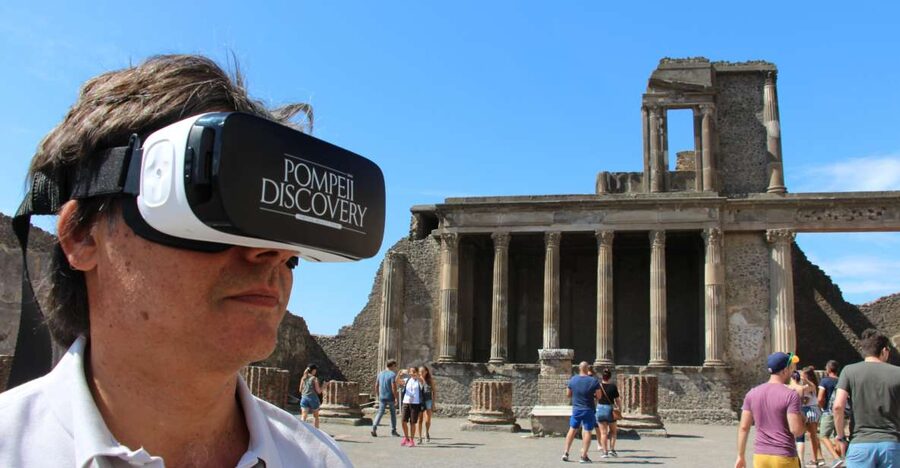
- Nine famous Pompeii locations in 3D: Forum, Basilica, Baths, House of the Faun, House of Menander, Bakery, Large Theatre, Quadriporticus, and the Lupanar
- Live authorized guide with a 360° layer that adds action like shop activity and a theatrical performance
- VR for daily life, not just monuments, including gladiators’ training and nightlife around/inside the Lupanar
- Skip-the-ticket-line for smoother time on-site (entrance ticket sold separately)
- Credibility boost: highlighted for informative value and even used as a case study at the University of Amsterdam
- Provided headsets for each participant, so you’re not sharing or waiting on tech
Why Pompeii feels clearer with VR plus a live guide
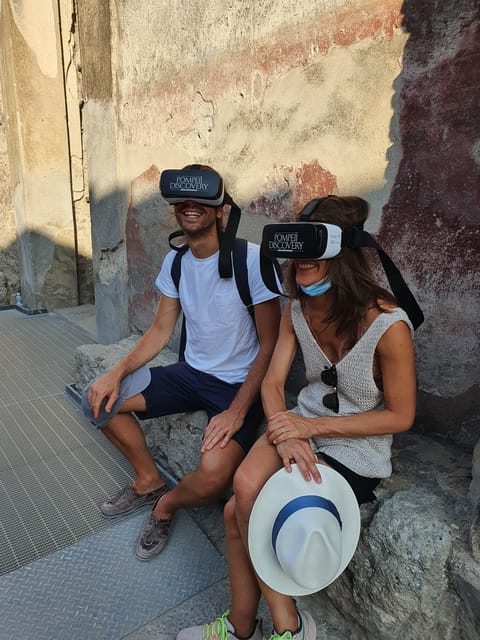
Pompeii is stunning, but it can also be a bit of a puzzle. You’re staring at walls, streets, and doorways—but your brain has to rebuild what that place looked like in daily use. This tour helps with that “rebuilding” step by pairing the ruins with a guided 3D experience.
I like the setup because it doesn’t treat VR as a replacement for the guide. Instead, the guide’s explanations come first, then the headset adds context—like seeing where the Forum sits in the city rhythm, or how public spaces connected to housing and entertainment. The result is a tour that’s both practical and more emotionally convincing than reading stone descriptions alone.
More of the story behind the stones
- Discover Pompeii: French Walking Tour of the Buried City
★ 4.8 · 253 reviews - Discover Pompeii: English Walking Tour of the Buried City
★ 4.2 · 24 reviews - Discover Pompeii: Spanish Walking Tour of the Buried City
★ 5.0 · 5 reviews
Price and value: what $226.57 really buys
The price is listed as $226.57 per group, up to 2 people. On paper that can look steep, but the value angle is tied to what’s included: a local authorized guide in your language plus virtual reality headsets for each participant. You’re not just paying for narration—you’re paying for equipment-based interpretation.
The one cost factor you must plan for is the ruins entry ticket. Since it’s not included, I’d treat the tour as a premium “how-to-see-Pompeii” add-on rather than a bundled ticket. If you already know Pompeii is going to be a big highlight of your trip, that framing makes the price easier to swallow.
Also worth noting: the experience is private, so you’re buying pacing and conversation. If you’re the type who wants to ask questions and get your attention when you have it, private format can be a real value.
How the experience runs: what you’ll do once you’re at Pompeii
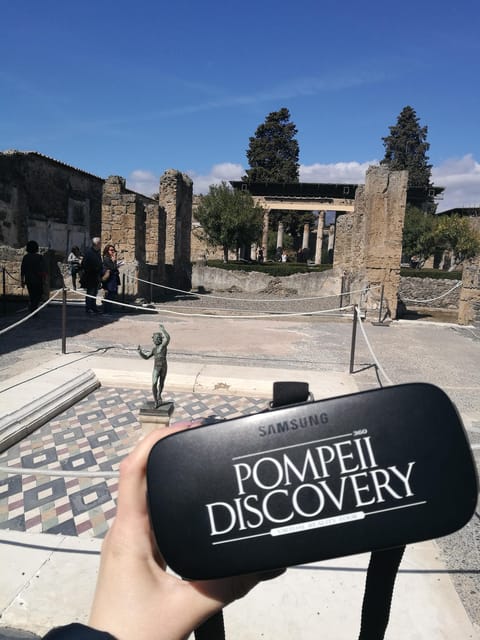
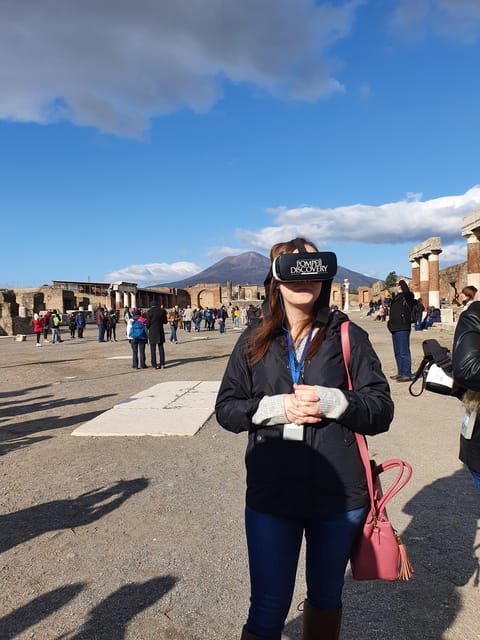
This is a guided tour with a local storyteller, strengthened by a 3D virtual reality segment. The VR component is designed to show you nine famous places, giving you a guided path through Pompeii as it functioned before the 79 A.D. eruption.
Here’s the important practical idea: you’ll be alternating attention between the actual site and what the headset reconstructs. That matters because Pompeii isn’t just one view—it’s a sequence of spaces. The tour is built to keep that sequence coherent, instead of letting you wander into spots without understanding why they matter.
You’ll also get moments beyond “walk-and-look.” The experience includes opportunities to assist to activities of shops and to a theatrical performance, plus special scenes like gladiators’ training and the nighttime atmosphere around the Lupanar. Those added elements help the ruins feel inhabited, even though you’re standing in a quiet archaeological site.
Stop 1: The Forum and Basilica—your mental map starts here
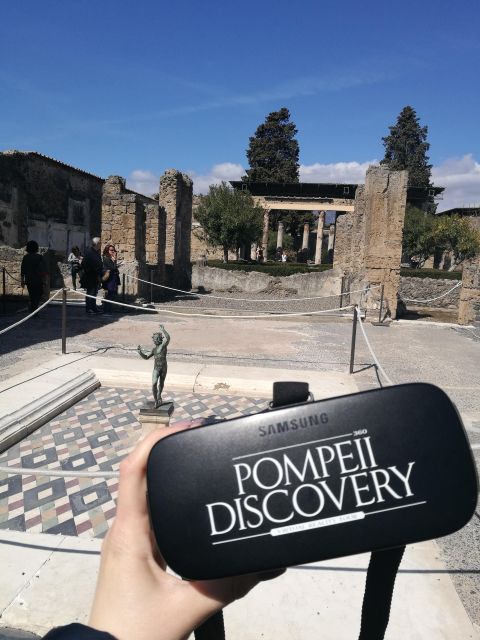
The Forum is the center of city life, so it’s a smart place to begin. When you see it described as civic space, it can still feel abstract. With VR added, you get help imagining how people moved through the area and how the city’s public energy worked.
Right alongside, you’ll also get the Basilica. This is one of those buildings where scale and function are easier to grasp when you can visualize how it would have been used. VR helps you connect the Basilica to public life rather than treating it as just another impressive shell of ancient architecture.
What to watch for during this part: try to keep your eye on relationships—how the Forum connects to surrounding spaces. Even a short glance at how entrances and open areas line up makes everything feel less random later in the tour.
Stop 2: Pompeii’s Baths—when cleanliness and social life overlap
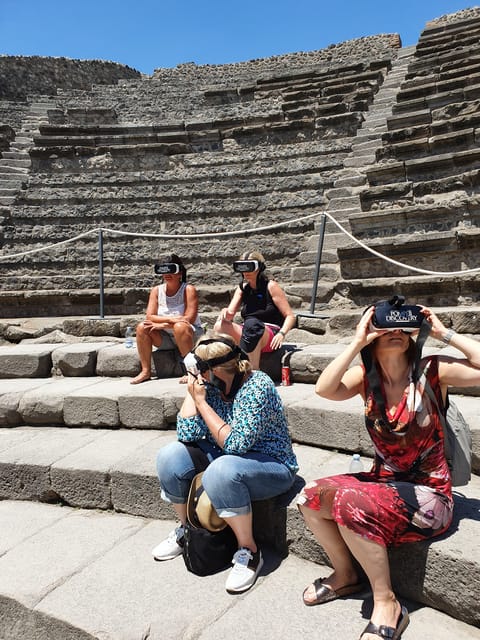
The Baths show you another layer of Roman daily life: not just routines, but social rhythms. Pompeii’s ruins can make you think everything is strictly “monument + street,” but the baths remind you that leisure and community were part of ordinary life.
With the VR portion, you’re able to admire the Baths in a way that goes beyond what you can infer from the stone alone. It’s one of the locations where reconstruction helps you understand where people would have gathered, moved, and spent time.
A practical tip: at this stage, you’ll likely feel the tour’s pace shift into more scene-based storytelling. If you prefer breaks, take them—momentary pauses from the headset can help you absorb what’s right in front of you.
See the city put back together in 3D
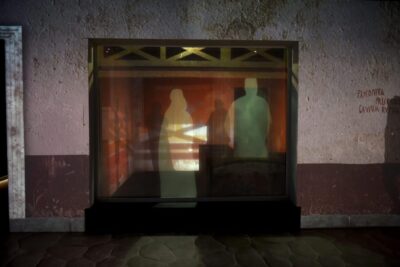
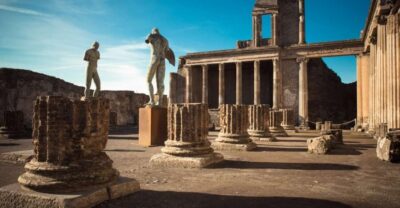
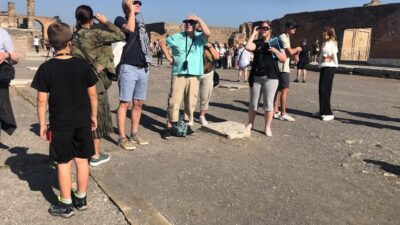
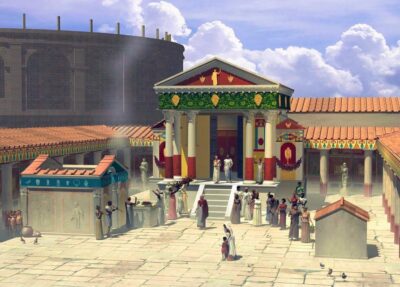
Stop 3: The House of the Faun and the House of Menander
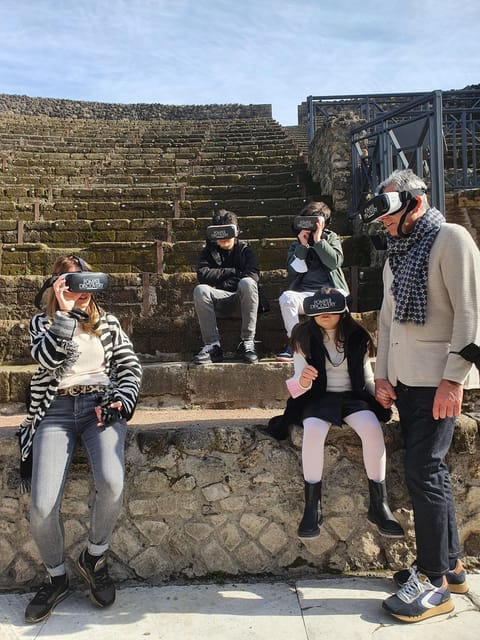
Private homes in Pompeii can be difficult to read when you only see fragments. That’s why the VR approach works so well here: the House of the Faun and the House of Menander are two of the notable homes the tour includes, and VR can help you connect layout to lifestyle.
These houses aren’t just “cool rooms.” They’re teaching tools for how status, space, and everyday domestic routines worked. The VR segments are meant to take you beyond guessing based on walls and courtyards, and instead show you what these places might have felt like before the eruption froze life in place.
One consideration: if you’re the kind of visitor who gets restless with headsets, the home stops might require extra patience. They can be the most visually detailed parts, and that’s when headset time matters most.
Stop 4: The Bakery and shop activities—food and work made visible
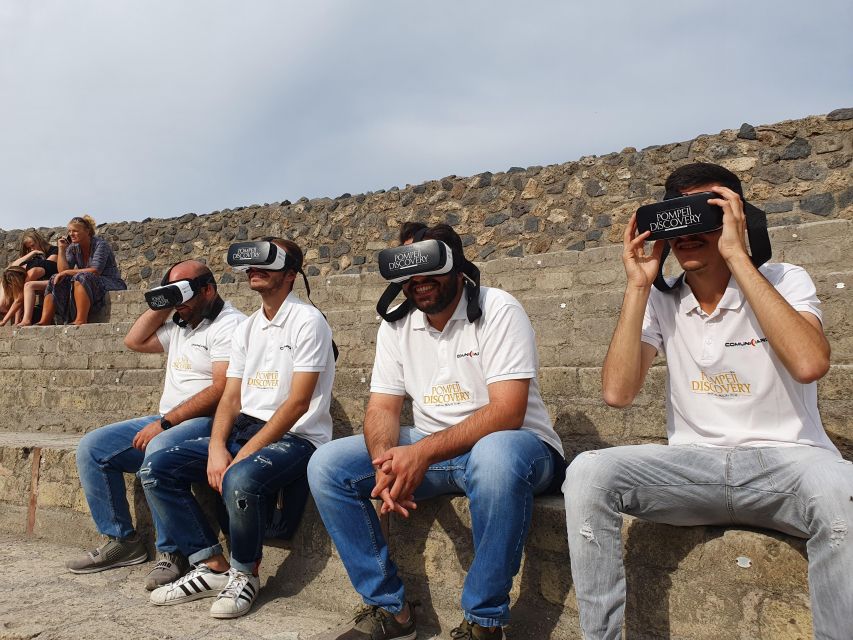
The tour includes the Bakery, plus an extra layer through activities of shops. This is where Pompeii becomes less like a museum and more like a working town.
The Bakery is a key Pompeii stop because food production was essential. Seeing it through VR helps you understand how production connects to everyday demand, not just the building as a static structure. When the experience adds shop activity, it reinforces the idea that these streets held regular labor and regular commerce.
This is also a place where the live guide’s framing counts. VR can show you the scene, but the storyteller ties it to meaning—what you’re looking at and why it mattered.
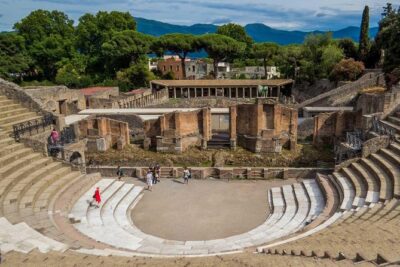
Stop 5: The Large Theatre and a theatrical performance
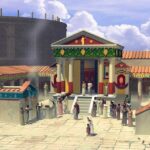
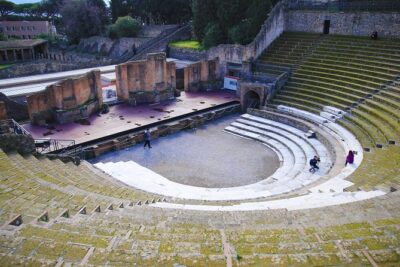
The Large Theatre is an entertainment anchor. It also changes your perspective because it shows Pompeii wasn’t only about commerce and homes. People gathered for performance, for attention, and for shared moments.
The tour includes a theatrical performance element within the VR storytelling. That matters because theatre spaces are hard to fully appreciate from ruins alone. VR helps you “hear” the intention of the space even if you’re silent in the archaeological area.
If you’re deciding whether this kind of experience is for you, this section is a good test. If you enjoy the idea of ancient sites with performance-based interpretation, you’ll likely find this stop satisfying.
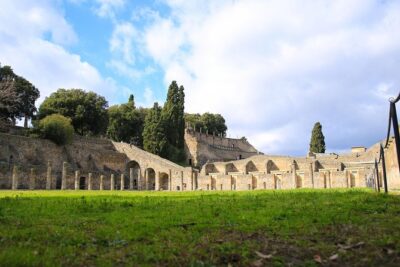
Stop 6: Quadriporticus—gladiator training and the edge of spectacle
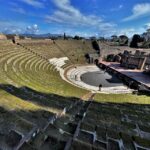
The Quadriporticus is where you shift toward spectacle. The tour includes a chance to experience gladiators’ training in this area, again using VR to portray action that the stones can’t show on their own.
This is valuable because it addresses a common frustration: you may know Pompeii had entertainment, but it’s easy to keep that knowledge general. Gladiator training scenes give you something specific and visual, so the entertainment layer becomes part of the city’s daily system rather than a random fact.
Practical advice: if you tend to get focused on the story and forget where you are on the ground, keep one quick check habit. Periodically glance at the real structure boundaries while you watch the VR overlay. It helps your brain keep both versions connected.
Stop 7: The Lupanar—nightlife, learning, and a harder subject
The tour’s final named stop is the Lupanar (a brothel), and it also includes nightlife around and inside it through VR. This is not a “cute” or simple topic, and Pompeii rarely is. But it’s one of the reasons Pompeii feels so human: people had complicated lives, including sex work and the social systems around it.
VR here is meant to help you understand the environment and the atmosphere of a nightlife zone. You’re guided through the space so you can connect architecture to function. The value is in clarity—seeing how the layout supports the idea of what happened there.
One consideration: this subject may feel uncomfortable for some visitors. If you prefer tours that keep things strictly monumental and avoid adult themes, this part could be a deciding factor.
The role of the storyteller: the difference between info and meaning
A lot of tours say they have a guide. This one leans on a specific kind of guide work: the authorized storyteller acts as the thread tying ruins, VR scenes, shops, theatre, and gladiator training into one story.
In particular, the name Maria Novella comes up with strong praise for professionalism. Another comment highlights how the augmented reality device complements the guide’s explanations and adds real value. That combination is the key: you’re not just watching a video. You’re getting interpretation that keeps the VR grounded in explanation.
If you learn best by hearing a narrative as you look, this format tends to work well. If you only want to move quickly from sight to sight, you might find yourself waiting through storytelling segments to get your next headset scene.
Skip the ticket line, but plan for the ticket itself
This tour includes skip-the-ticket-line, which is a real time-saver when the site has crowds. Just remember the important detail: the ruins entrance ticket isn’t included.
So the smartest move is to handle the entrance ticket first, then show up ready to use the skip-the-line benefit. That way you get to spend more of your limited time in the actual ruins rather than stuck at ticket queues.
And because you’ll be moving between stops with headset moments, smoother entry can mean fewer rushed transitions.
Who should book this Pompeii VR tour (and who might not)
This tour fits best if you want Pompeii to feel alive. You’ll likely enjoy it if you like guided storytelling, want structure (nine major locations), and don’t mind wearing a headset for parts of the experience.
You’ll also appreciate the VR emphasis if your brain works visually. Pompeii can be hard to visualize in your head, and VR reduces that blank-page problem. If you’re someone who wants to understand not just what’s there, but how people might have lived and spent time, this style has clear appeal.
It may not fit if you’re very sensitive to headsets or prefer minimal tech. Also note the stated limits: it’s not suitable for people with epilepsy and not suitable for children under 8. If you’re traveling with a young child, you’ll need a different Pompeii plan.
On the other hand, the tour is listed as wheelchair accessible, so it’s worth considering if you need that option.
Booking-smart checklist before you go
To get the most out of this experience, focus on the basics that affect comfort and flow.
- Wear comfortable shoes. You’ll be on your feet for a guided ruin tour.
- Bring an ID card or passport for children (if applicable).
- Plan your expectations: this is a guided ruins visit plus VR scenes, not a purely physical walk-through.
- If the Lupanar topic concerns you, decide before booking so you can match the tour to your personal comfort.
Final verdict: should you book this Pompeii VR tour?
I’d book this Pompeii VR tour if you’re excited by interpretation that goes beyond labels. The mix of a local authorized guide and 360° VR across the Forum, Basilica, Baths, two major houses, the Bakery, the Large Theatre, Quadriporticus, and the Lupanar makes it easy to track the city as a lived-in place. Add the praised guidance—like Maria Novella’s professionalism—and you’ve got a strong recipe for a memorable experience.
I would think twice if you hate headsets, want a purely traditional walk with minimal tech, or are traveling with someone who falls under the stated limitations. Also factor in the entrance ticket cost since it’s not included.
If you want Pompeii to feel like a town rather than a set of stones, this is a smart way to see it.
FAQ
Is the entrance ticket to the Pompeii ruins included?
No. The entrance ticket is not included, though the experience includes skip-the-ticket-line.
Does the tour include a live guide?
Yes. You’ll have a local and authorized guide in your language.
What languages are available for the live tour?
The live guide is available in English and Italian.
Are virtual reality headsets provided?
Yes. Virtual reality headsets are provided for each participant.
Is this a private group?
Yes. The experience is listed as a private group.
Is it suitable for children?
It is not suitable for children under 8 years.
Is it suitable for people with epilepsy?
No. It is listed as not suitable for people with epilepsy.
Is the experience wheelchair accessible?
Yes, it’s listed as wheelchair accessible.
More Tour Reviews in Pompei Campania
- Pompeii: Entry Ticket and Guided Tour with an Archaeologist★ 4.8 · 19,459 reviews
- Pompeii: Small Group Tour with an Archaeologist★ 4.8 · 12,264 reviews
- Pompeii: Skip-the-Line Entrance Ticket with Audio Guide★ 4.0 · 2,509 reviews
- Naples: Pompeii and Mt. Vesuvius with Lunch and Wine Tasting★ 4.5 · 2,454 reviews
- Pompeii: Skip-the-line-Ticket and Guided Tour★ 4.6 · 1,152 reviews
Pompeii Rebuilt, More 3D Tours
- Pompeii: 3D Walking Tour with Entry Ticket★ 4.3 · 102 reviews
- Pompeii: Virtual Museum ticket★ 4.5 · 37 reviews
- Pompeii & Virtual Museum Private 2-in-1 Kid’s Tour★ 4.9 · 9 reviews
- Pompeii: Family-Friendly Augmented Reality Tour with Ticket★ 3.6 · 5 reviews
- Pompeii: AR Glasses Augmented Reality Tour★ 5.0 · 3 reviews
The Story of the City, More Ways In
- Discover Pompeii: French Walking Tour of the Buried City★ 4.8 · 253 reviews
- Discover Pompeii: English Walking Tour of the Buried City★ 4.2 · 24 reviews
- Discover Pompeii: Spanish Walking Tour of the Buried City★ 5.0 · 5 reviews
- Pompeii: Entry Ticket & Guided Tour with an Expert Historian★ 5.0 · 4 reviews
Just reviewed: more Pompei Campania tours and day trips



Ancient Pompeii History Tours, compared.
 ★ 3.5Discover the Ancient Ruins of Pompeii: Day Trip from Rome2,247 reviews
 ★ 5.02 hours Pompeii Tour with Local Historian – Ticket IncludedFrom $48335 reviews
 ★ 4.8Discover Pompeii: French Walking Tour of the Buried CityFrom $41253 reviews
 ★ 5.0Stories of Pompeii: Small Group tour with archeology expert guideFrom $54191 reviews
 ★ 5.0Ancient Pompeii Private Tour: Skip the Line & Kid-Friendly OptionFrom $165167 reviews
 ★ 5.0Skip-the-Line Half-Day Private Tour Ancient Pompeii Highlights with Native GuideFrom $83146 reviews
 ★ 5.0Ancient Pompei in the afternoonFrom $254140 reviews
 ★ 5.0Fast Access Exclusive Private Ancient Pompeii Half Day Tour with Local GuideFrom $20354 reviews
Browse the lists this tour appears in