
Reviewed · POMPEII ARCHAEOLOGIST-LED TOURS
Pompeii: Group Tour with an Archeologist Guide
Pompeii is easy to miss without a guide. This 2-hour group tour takes you through the western highlights of the ancient city and explains what you’re seeing as you walk. Two big wins for me are the skip-the-line tickets and the way an archaeologist guide turns ruins into real Roman life. One thing to consider: you’re on a set route for only two hours, so you won’t cover every corner of Pompeii.
The stops are the ones that help you understand the city fast. You’ll move from Porta Marina into major public spaces like the Forum and Basilica, then onward to everyday places such as baths, the Lupanar brothel, and the main street. Guides I’ve seen mentioned by name, like Ernaldo, Alfonso, Lena, Laura, and Giuseppe, are praised for keeping the pacing clear and the stories focused.
It’s not a sit-and-watch tour, and Pompeii isn’t flat. Expect real walking over uneven ground, and the tour isn’t suitable for people with mobility impairments. If you hate crowds, you’ll still be in a group, but you’ll be able to hear thanks to whisper headsets for large groups.
In This Review
- Key highlights to look forward to
- From Tempio Travel to Porta Marina: your fast start
- Why this 2-hour route feels like the right amount
- Skip-the-line: what it changes once you’re standing at the gates
- The western Pompeii core: Basilica, Forum, and the city center
- Basilica and the Forum: politics, business, and public space
- The main street: walking the same routes
- Baths, the Lupanar, and daily life you can actually picture
- Baths: hygiene, social time, and Roman routine
- Lupanar brothel: sex work in stone
- Theaters and public entertainment: where crowds gathered
- Garden of the Fugitives and named houses: the private city
- Garden of the Fugitives
- House of the Tragic Poet and House of the Golden Cupid
- Frescoes and the houses as “evidence”
- Plaster casts: why this stop lands emotionally
- What the guide adds: suggestions for modern Pompeii
- Groups, headsets, and the reality of walking in Pompeii
- Price and value: is $50.11 a smart spend?
- Who this Pompeii group tour fits best
- Tips to get more out of your 2 hours
- Should you book this Pompeii archaeologist group tour?
- FAQ
- How long is the Pompeii tour?
- Where do I meet for the tour?
- What’s included in the price?
- What language is the guide in?
- Is the tour suitable for mobility impairments?
- What should I bring, and are bags allowed?
Key highlights to look forward to
- Skip-the-line entry: You get quicker access into the archaeological area.
- Archaeologist-led storytelling: Guides connect ruins to how Romans lived in 79 AD.
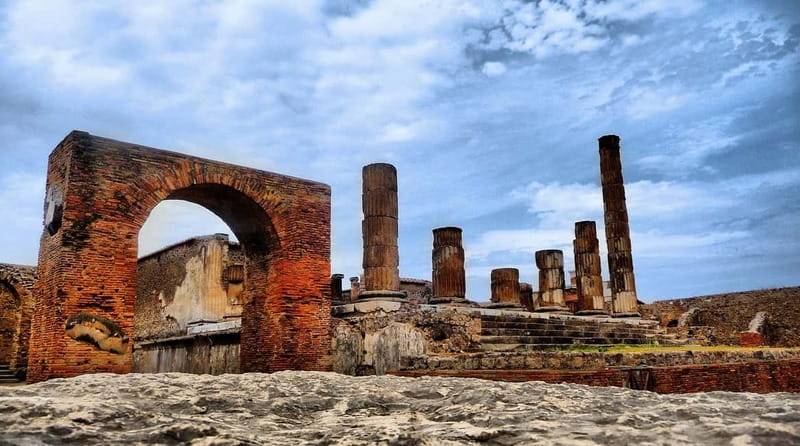
- Western Pompeii route: A tight, high-impact plan focused on major buildings.
- Named houses and special areas: Like the Garden of the Fugitives and houses with recognizable names.
- Plaster casts of victims: A gut-punch stop that makes the tragedy harder to ignore.
- Headsets for big groups: Whisper-style receivers help you follow the guide without craning.
From Tempio Travel to Porta Marina: your fast start

The tour meets at the Tempio Travel office inside the Vircumvesuviana train station, on the first floor. One review detail that helps: you’re meant to take the stairs to the second floor to reach the office with the red logo. After that, you head as a group toward the entrance.
Your first big landmark is Porta Marina. This gate works as a practical starting point because it sets the direction of the walk and gives you a clear sense of the city’s layout. It also avoids the most common Pompeii problem: wandering in circles, looking at walls, and missing the spaces that explain the whole place.
Porta Marina is also a good “calibration” moment. You get oriented early, so when you start seeing the Forum, baths, and theaters later, you understand how the pieces connect.
More of the site walked with an archaeologist
- Pompeii: Group Tour with an Archeologist Guide
★ 4.4 · 490 reviews - Pompeii: Skip-the-Line Tickets and Tour with Archaeologist
★ 4.9 · 467 reviews - Pompeii: Skip-the-Line Guided Tour with Expert Archaeologist
★ 4.8 · 196 reviews
Why this 2-hour route feels like the right amount
Pompeii is huge, and two hours is honest about what’s realistic. This tour doesn’t pretend it covers everything. Instead, it focuses on the western part of town where many of the most important buildings are concentrated.
That matters because Pompeii is dense. Without a plan, it’s easy to burn your time on “pretty walls” and leave without feeling the city’s structure—public life, private life, and daily routines. With a guide, you can pick up the big themes while your legs still work.
The tour is also designed for people with limited time—cruise day visitors and anyone who wants a strong overview without turning the day into a logistics project. A lot of praise in the reviews is basically this: you see the key places, and the guide keeps the group moving at a pace that still leaves time to absorb what you’re looking at.
Skip-the-line: what it changes once you’re standing at the gates
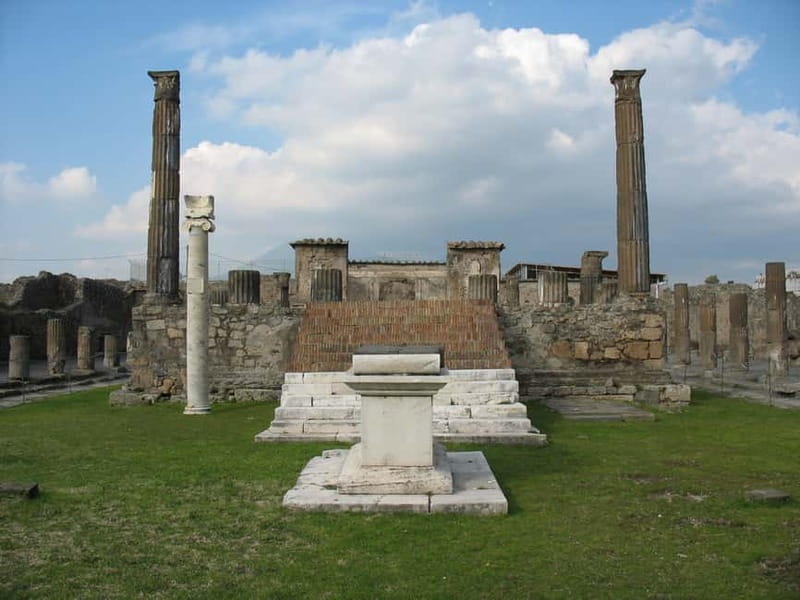
Pompeii’s popularity is real, and lines can swallow your time. This tour includes skip-the-line entrance tickets, plus access handling for large groups. Reviews mention processing through security and getting underway efficiently, which is what you want when you’re working inside a tight two-hour window.
There’s also a hearing upgrade that’s more important than it sounds: whisper headsets. In a big group, you don’t want to keep saying What? every ten minutes. The headsets help you stay in the conversation with the guide while still looking at the site, not constantly searching for voice cues.
If you’re someone who gets frustrated when you can’t hear, this is a big quality-of-life feature. It’s one of the reasons the tour feels smoother than doing everything solo.
The western Pompeii core: Basilica, Forum, and the city center
Once you’re into the main areas, you hit the places that explain how Pompeii worked.
Basilica and the Forum: politics, business, and public space
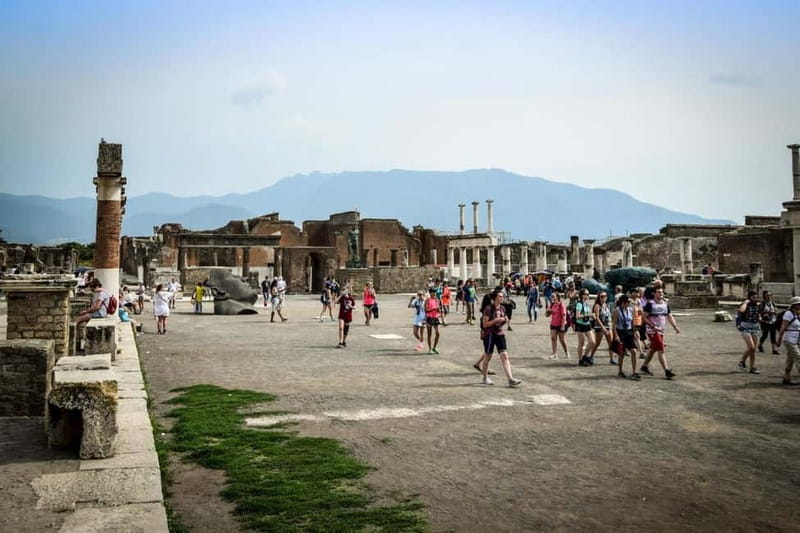
You’ll see the Basilica and the Forum. These are not just impressive ruins—they’re the stage for civic life. In plain terms, this is where people gathered for decisions, commerce, and official activities.
A guide helps you read the geometry. You start seeing why certain buildings faced certain streets, why the space felt public, and how daily movement shaped what people experienced. Without that context, it’s easy to get stuck on details like columns but miss the bigger purpose of the space.
More guided visits to choose
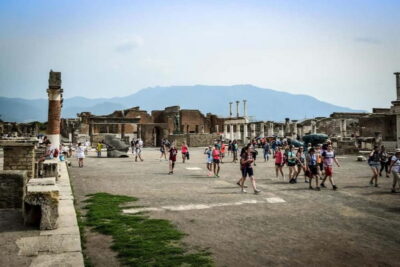
The main street: walking the same routes
You’ll also pass through the main street, which helps you connect the city center to other districts. This is where Pompeii stops being a collection of buildings and becomes a place you can navigate in your head.
The main street stop is especially useful if you plan to explore on your own afterward. You’ll have a mental map instead of starting from scratch.
Baths, the Lupanar, and daily life you can actually picture

Pompeii is famous for big public monuments, but the tour is smart to include daily-life stops too.
Baths: hygiene, social time, and Roman routine
You’ll visit the baths. Even in ruin form, baths are easier to “understand” than many other structures because they relate to routines you recognize. This is where the guide’s storytelling matters most: you learn how bathing fit into social life, not just cleanliness.
It’s a strong balance after the Forum and Basilica. The tour changes pace from formal public space to something more human-scaled.
Lupanar brothel: sex work in stone
You’ll also see the Lupanar, the brothel area. It’s one of Pompeii’s most talked-about sites, and the guide’s role is to keep it factual and anchored in context rather than sensational.
This stop can surprise people. It’s not just a shock factor; it’s a window into the economy and street life of a working city. If you want Pompeii to feel like real history and not only tragedy, this is part of the reason the tour lands well.
Theaters and public entertainment: where crowds gathered
The tour includes the theaters, which round out the city feel. After you’ve seen public governance (Forum/Basilica) and private daily routines (baths and residential areas), entertainment ties it together.
The theaters are also a practical “use-your-eyes” stop. You can look at how spaces were designed for crowds and imagine how sound and movement would work. With a guide explaining what you’re seeing, it becomes easier to picture a full day in Pompeii rather than thinking of the ruins as static scenery.
Garden of the Fugitives and named houses: the private city
This is where the tour turns more emotional and more personal.
Garden of the Fugitives
You’ll visit the Garden of the Fugitives, an area tied to the story of people trapped during the eruption. It’s not the kind of stop you forget quickly. The guide’s explanations help you connect the location to what happened there.
If you’re sensitive to heavy topics, take it slower here. You’ll feel the weight, and that’s the point.
House of the Tragic Poet and House of the Golden Cupid
You’ll also see named homes like the House of the Tragic Poet and the House of the Golden Cupid. These labels matter because they give you something to anchor to. Instead of walking past nameless rooms, you’re following stories connected to art and household life.
The tour also includes other famous named houses (not just one or two). That helps you understand that Pompeii wasn’t only streets and public buildings—it had personalities, tastes, and everyday domestic culture.
Frescoes and the houses as “evidence”
One listed highlight is frescoes. Pompeii is famous for paintings that survived, and that changes how you experience a ruin. It’s not just architecture. It’s people decorating their lives.
A strong guide will help you notice what frescoes and house layouts are telling you. Even if the art is damaged or incomplete, you can still learn what mattered to Pompeians—style, status, symbolism, and storytelling.
Plaster casts: why this stop lands emotionally
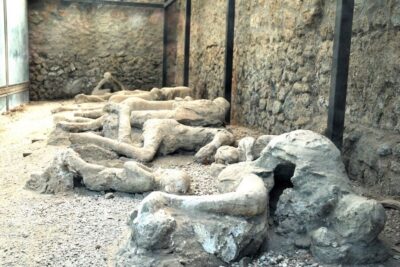
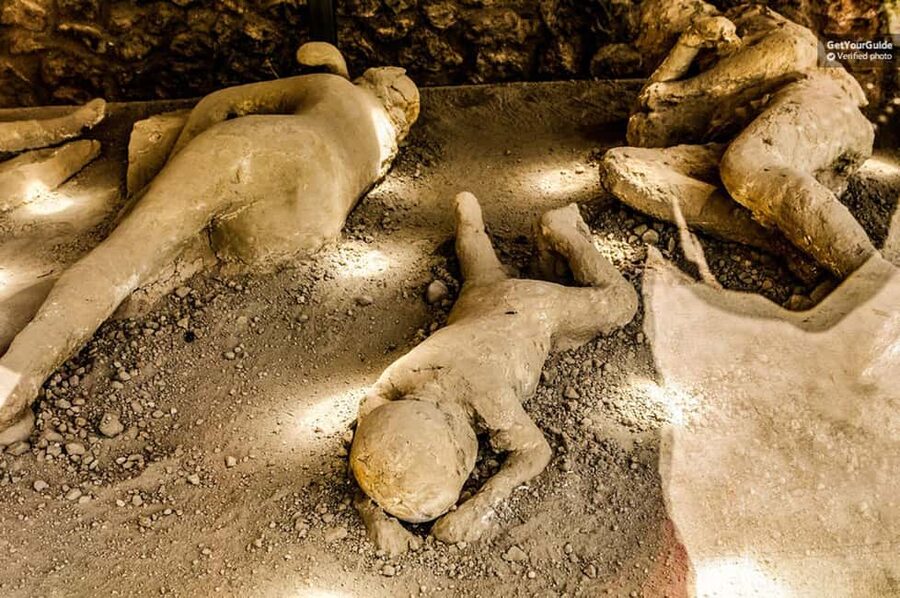
A signature part of this tour is seeing plaster casts of Pompeii’s tragic citizens. These casts turn disaster archaeology into something you can understand as human bodies, not only history text.
This isn’t just about emotion, though that’s part of it. It also makes the event harder to treat like a distant event. You stop thinking about 79 AD as a date and start thinking about it as a lived moment interrupted.
In reviews, people repeatedly praise the guide’s balance—enough context to understand what’s happening, plus a pace that doesn’t run you through the tragedy like it’s a checklist. If you’re doing Pompeii for meaning, not only photos, this is a key reason to book a guided option.
What the guide adds: suggestions for modern Pompeii
At the end, your guide doesn’t just drop you and vanish. You’ll get suggestions for what to do next in modern Pompeii, including a direction toward the Sanctuary Dedicated to Our Lady of the Holy Rosary, which is just a few steps from the archaeological site.
That’s useful because after a guided tour, your brain is full and you need a practical next move. You also get a head start on how to fill the rest of your day without guessing from scratch.
Groups, headsets, and the reality of walking in Pompeii
The tour is not private. You’ll be in a group, and reviews mention it can be fairly big. The headsets help a lot, and many people say the guide keeps everyone together without losing the thread of the story.
Still, Pompeii is rugged. Plan for uneven ground and lots of steps. The tour is not suitable for people with mobility impairments, so choose accordingly if walking long distances is an issue for you.
Weather matters too. One review notes it can get very hot in the afternoon and suggests buying a paper umbrella outside the site for sun cover. Another mentions rainy conditions and advises bringing your own umbrella or raincoat since on-site options may be limited. Pompeii doesn’t pause for the weather, so pack for discomfort, not just sunshine.
Price and value: is $50.11 a smart spend?
At $50.11 per person, this tour sits in a reasonable range for a guided Pompeii experience, especially because it bundles several “time savers” that cost you energy if you do them separately.
Here’s what you’re paying for beyond a normal walking tour:
- Skip-the-line tickets, so you start the experience faster.
- An archaeologist guide with English or Italian narration.
- Whisper headsets to keep the guide audible in a larger group.
- Free parking if open and available, which can matter if you’re driving.
If you’re short on time, skip-the-line access alone can feel worth it because Pompeii waits for nobody. For people who want a clean overview of major spots like the Forum, baths, theaters, and the Lupanar without getting lost, the price feels fair for what you get.
If you’re the type who likes slow roaming, repeated visits, or deep house-by-house study, you might find two hours too short. That’s not a defect—it’s a match question.
Who this Pompeii group tour fits best
This tour is a strong fit if:
- You want an efficient overview of western Pompeii with major stops.
- You value context and want someone to connect buildings to how people lived.
- You’re visiting with limited time, like a cruise port day.
- You don’t want to wrestle with crowd flow and ticket lines.
You might look for something else if:
- You need step-free access or mobility support, since the tour isn’t suitable for mobility impairments.
- You’re hoping to see everything Pompeii has to offer, because the route is intentionally focused and limited to two hours.
Tips to get more out of your 2 hours
- Wear comfortable shoes. Pompeii’s surfaces aren’t forgiving.
- Bring your passport or ID card.
- Plan to travel light. Luggage or large bags aren’t allowed.
- If you’re visiting during hot hours, think sun protection. People have used paper umbrellas outside the site in warm weather.
- Keep an open mind at the plaster casts. It’s intense, and that intensity is part of the reason Pompeii hits.
Should you book this Pompeii archaeologist group tour?
Yes, if you want the best shot at understanding Pompeii in a tight time window. The combination of skip-the-line entry, whisper headsets, and a route that hits the Forum/Basilica core, baths and the Lupanar, theaters, named houses, and the plaster casts makes this tour feel purposeful rather than rushed.
Book it if you’d rather spend your time learning what you’re seeing than figuring it out alone. If you crave maximum coverage and are prepared to navigate Pompeii without a guide, then you might choose a longer, more flexible option instead. But for a focused, high-impact first look at Pompeii, this one is a solid choice.
FAQ
How long is the Pompeii tour?
The guided portion lasts 2 hours.
Where do I meet for the tour?
Meet at the Tempio Travel office on the first floor of the Vircumvesuviana train station. The meeting is set to start there, and the tour ends back at the meeting point.
What’s included in the price?
You get a 2-hour guided tour, skip-the-line entrance tickets, and whisper headsets for large groups. If parking is open and available, free parking is also included.
What language is the guide in?
The live guide offers English and Italian.
Is the tour suitable for mobility impairments?
No. The tour is not suitable for people with mobility impairments.
What should I bring, and are bags allowed?
Bring a passport or ID card and comfortable shoes. Luggage or large bags are not allowed.
If it helps, tell me your travel month and whether you’re coming from Naples or a cruise port, and I’ll suggest a good time-of-day strategy for fitting Pompeii into your schedule.
More Guided in Pompeii Archaeological Site
- Pompeii: Entry Ticket with Optional Audio Guide★ 4.2 · 12,360 reviews
- Pompeii: Skip-the-Line Guided Tour with Expert Archaeologist★ 4.8 · 196 reviews
- Pompeii: Skip-the-Line Guided Archaeological Discovery Tour★ 4.2 · 13 reviews
More Tour Reviews in Pompeii Archaeological Site
- Pompeii: Entry Ticket with Optional Audio Guide★ 4.2 · 12,360 reviews
- Pompeii: Archaeological Park Tour with Ticket on request★ 4.5 · 2,283 reviews
- Pompeii Ruins Private Tour with Optional Skip-the-Line Entry★ 4.9 · 732 reviews
- Pompeii: Exclusive Tour with Archaeologist and Entry Tickets★ 4.9 · 634 reviews
- Pompeii: Skip-the-Line Tickets and Tour with Archaeologist★ 4.9 · 467 reviews
More Tours Led by an Archaeologist
- Pompeii: Exclusive Tour with Archaeologist and Entry Tickets★ 4.9 · 634 reviews
- Pompeii: Skip-the-Line Tickets and Tour with Archaeologist★ 4.9 · 467 reviews
- Pompeii: Skip-the-Line Guided Tour with Expert Archaeologist★ 4.8 · 196 reviews
Just reviewed: more Pompeii Archaeological Site tours and day trips


Pompeii Archaeologist-Led Tours, compared.
 ★ 4.8Entry Ticket and Guided Tour with an ArchaeologistFrom $3519,459 reviews
 ★ 4.8Small Group Tour with an ArchaeologistFrom $4012,264 reviews
★ 5.0Pompeii Small Group Tour with an ArchaeologistFrom $356,593 reviews
★ 4.8Small Group Tour with an ArchaeologistFrom $4012,264 reviews
★ 5.0Pompeii Small Group Tour with an ArchaeologistFrom $356,593 reviews
 ★ 5.0Pompeii and Herculaneum Small Group Tour with an ArchaeologistFrom $771,350 reviews
 ★ 5.0Skip the Line Guided Tour of Pompeii led by an ArchaeologistFrom $95703 reviews
 ★ 4.9Exclusive Tour with Archaeologist and Entry TicketsFrom $50634 reviews
 ★ 5.0Pompeii Private Tour with an Archaeologist and Skip The Line – 3 hoursFrom $302564 reviews
 ★ 5.0Pompeii Skip-the-line Tour with Archaeologist GuideFrom $71559 reviews
Browse the lists this tour appears in