
Reviewed · POMPEII ARCHAEOLOGIST-LED TOURS
Small-Group Tour in Pompeii with a Real Archeologist, ticket included
Pompeii moves fast in the heat. This small-group, English-language tour pairs priority ticket entry with an archaeologist guide, so you get context as you walk through Pompeii’s streets and houses. I like that the archaeologist-led explanations focus on how people lived, not just the big disaster story. One drawback: the tour is tightly timed, with about 15 minutes at each stop, so serious site lovers may want extra time after.
At $66.23 per person for about 2 hours 30 minutes, the value comes from the mix of access and guidance. You get a headset for clearer listening in a loud, crowded park, plus a priority entry window that helps you waste less time staring at ticket lines. Most of the stop admissions are included, which matters because Pompeii add-ons can add up quickly.
Do plan for walking and sun. Even with stops that are well paced, you’ll feel the summer temperatures, and a quick water habit pays off. Also double-check the meeting point—starting location confusion can happen, and it’s best to sort it out early rather than late.
In This Review
- Key things that make this Pompeii tour worth your time
- Why priority entry matters at Pompeii
- The real advantage: an archaeologist guide plus headsets
- 2.5 hours and 9 stops: how the pace really works
- Stop 1: Casa del Poeta Tragico and the Cave Canem mosaic
- Stop 2: Casa dei Vettii (House of the Vettii) and luxury on a small street
- Stop 3: Lupanar and what the building tells you about sex work
- Stop 4: The Forum in Pompeii and Roman public space rules
- Stop 5: Suburban Baths and the idea of Pompeii as a travel destination
- Stop 6: Casa del Fauno and the bronze faun in the impluvium
- Stop 7: Casa del Menandro with 118 silver objects and Trojan War frescoes
- Stop 8: Amphitheatre culture and gymnasium next door (ticket note)
- Stop 9: Temple of Apollo, plus the Apollo vs Jupiter story
- What the best guides do with Pompeii’s details
- Price and value: what you’re really paying for
- Who this tour suits best (and who should plan differently)
- Should you book this Pompeii small-group tour?
- FAQ
- How long is the Pompeii small-group tour?
- Is the tour in English?
- How many people are in the group?
- Does the tour include priority ticket entrance?
- Are admission tickets included for the stops?
- Will I need a headset to hear the guide?
- Where does the tour start and end?
- What if I need help finding the meeting point?
- Is there mobile ticketing?
- Is cancellation free?
- Is the tour affected by weather?
Key things that make this Pompeii tour worth your time
- Priority entrance helps you get inside and start seeing things sooner
- Maximum 15 travelers keeps the group small enough for real questions
- Headset included so you can hear your archaeologist guide clearly
- Top house stops: mosaics, villas, and famous rooms like the House of the Faun
- A day ticket approach lets you keep exploring on your own after the guided portion
Why priority entry matters at Pompeii
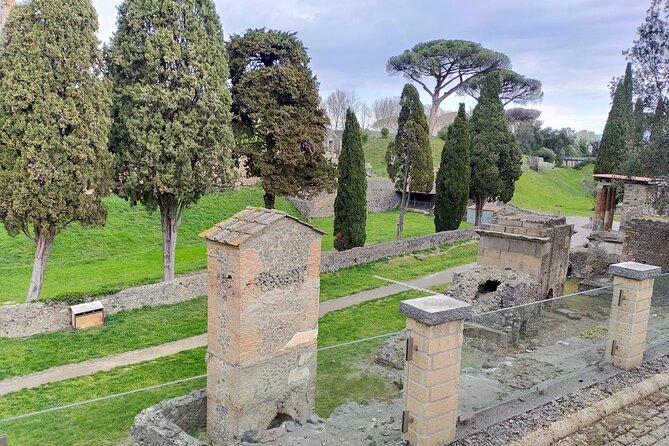
Pompeii is famous for a reason, but it also gets busy. A priority ticket isn’t just a perk. It’s what helps you spend your limited time actually looking, instead of shuffling along with everyone else trying to get past the same gate.
Your tour starts and ends back at the meeting point near Piazza Esedra at Hotel Vittoria. That’s convenient because it keeps the day simple: no complicated pickup routes, no worrying about getting back to a distant station. And since the tour is about 2 hours 30 minutes, priority access helps you stay on schedule—especially if you want to see more of Pompeii later on your own.
More of the site walked with an archaeologist
- Pompeii and Herculaneum Small Group Tour with an Archaeologist
★ 5.0 · 1,350 reviews - Skip the Line Guided Tour of Pompeii led by an Archaeologist
★ 5.0 · 703 reviews - Pompeii Private Tour with an Archaeologist and Skip The Line – 3 hours
★ 5.0 · 564 reviews
The real advantage: an archaeologist guide plus headsets
This isn’t a generic “here’s a wall” walkthrough. The guide is an archaeologist, and that shows in the way the sites get dated and explained. You’ll hear how Pompeii fits into Roman life and how different discoveries are interpreted.
The headset is more important than it sounds. Pompeii is open-air, so sound carries oddly, and people talk while they wait. With the headset, your guide’s explanations stay usable, even when you’re standing in a busy pocket of ruins. In a small group, that makes the whole experience feel less rushed and more like guided museum time.
2.5 hours and 9 stops: how the pace really works
Think of this as a curated sampler. Each major stop is around 15 minutes, which means you’ll see a lot of Pompeii in one run—especially the famous houses and street-side highlights.
Here’s how the flow works:
- You’ll start with elite home life (mosaics and luxury houses).
- You’ll move into public and semi-public spaces (like baths and the Forum).
- You’ll end with religious and entertainment places tied to daily Roman culture.
That format is great if Pompeii is your first stop in the area or you’re short on time. If you’re the type who wants to sit with one mosaic for ten minutes and read every panel, you’ll likely want a longer self-guided follow-up after the tour ends.
Stop 1: Casa del Poeta Tragico and the Cave Canem mosaic
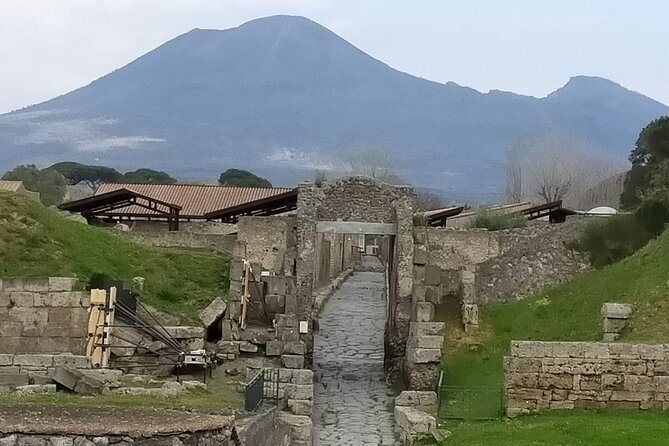
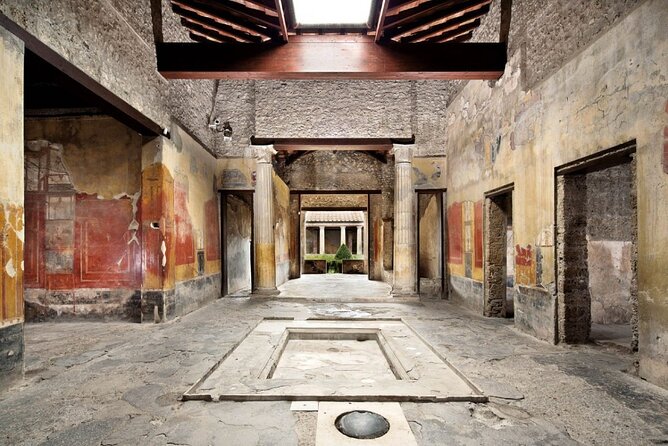
You begin at the House of the Poeta tragico, an elegant imperial-era home. The big draw here is the famous floor mosaic Cave Canem, the warning against dogs.
What I like about starting here is the immediate “how to read Pompeii” lesson. You’re not just looking at pretty stone. You’re seeing how Romans used art and everyday messages to shape the experience of a home—almost like the house had a personality before you even stepped inside.
This stop is about 15 minutes and includes the admission ticket for that part of the visit. The timing is short, but the mosaic is exactly the kind of visual hook that makes Pompeii feel tangible fast.
Stop 2: Casa dei Vettii (House of the Vettii) and luxury on a small street
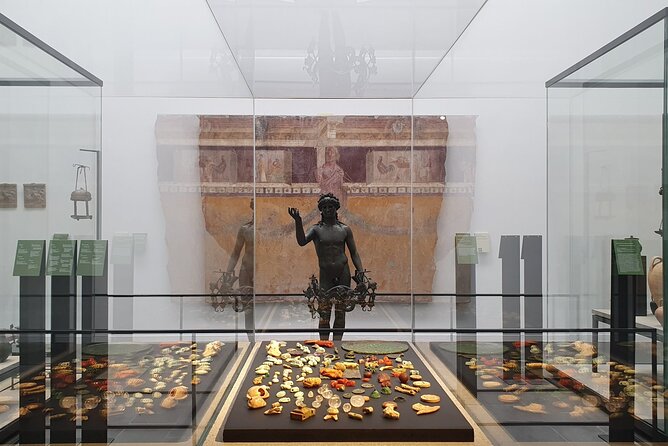
Next is the House of the Vettii in vicolo dei Vettii. It’s one of Pompeii’s best-known luxury homes, named for its owners, Aulo Vettio Restituto and Aulo Vettio Conviva.
This stop is also about 15 minutes with admission included. The value here is seeing how the “rich house” idea isn’t a vague concept—it’s tied to specific rooms, decoration, and the way a home displays status.
If you like architecture and symbolism, this is a good moment to train your eye. Luxury here isn’t just size. It’s in the details that were meant to be seen.
More tickets to the site



Stop 3: Lupanar and what the building tells you about sex work
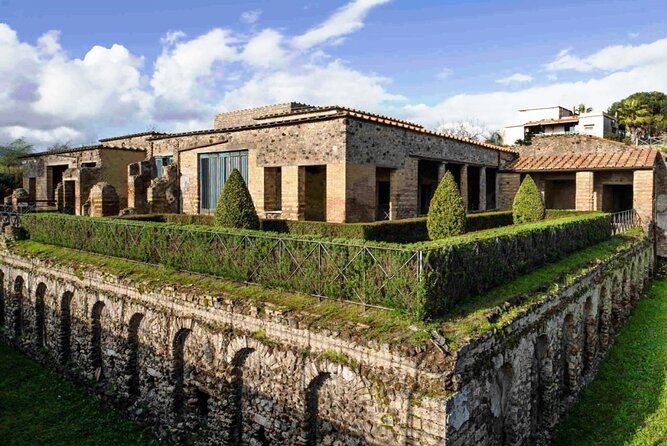
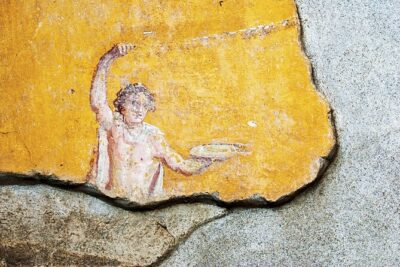
From elite households to the Lupanar, the two-storey building associated with prostitution. This is one of the most visited sites in Pompeii, and it’s easy to understand why.
The building is described as having five rooms on the ground floor and five on the upper level. Each room had a concrete bed, and you could picture what a worker’s daily routine might have looked like in a tight, functional space.
A fair caution: this stop is not subtle. It’s direct about the commercial side of Roman life. If you’re sensitive to that, you can treat it as a history lesson and move through quickly. If you’re curious, it’s an honest look at how structured some aspects of daily commerce were.
Admission is included for this stop, and the time stays short so you don’t linger in the wrong headspace.
Stop 4: The Forum in Pompeii and Roman public space rules
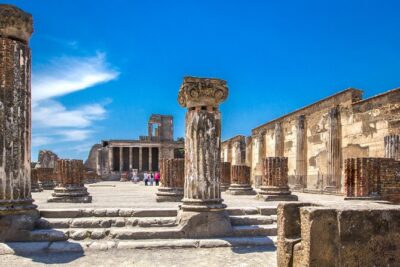
Then you step into the Pompeian Forum. This is the kind of place where rules matter: the Forum was reserved for pedestrians, and carts weren’t allowed. Public buildings overlooked the space, which gives you a sense of how this was designed for civic life.
The Forum measures about 142 metres long and 38 metres wide. After the eruption, the area was dug up, and materials were reused in later works—so you’re seeing layers of history, not a single moment frozen in time.
This stop is about 15 minutes and includes admission. It’s short, but it works well because your guide can help you understand what you’re seeing without needing you to become an expert before you arrive.
Stop 5: Suburban Baths and the idea of Pompeii as a travel destination
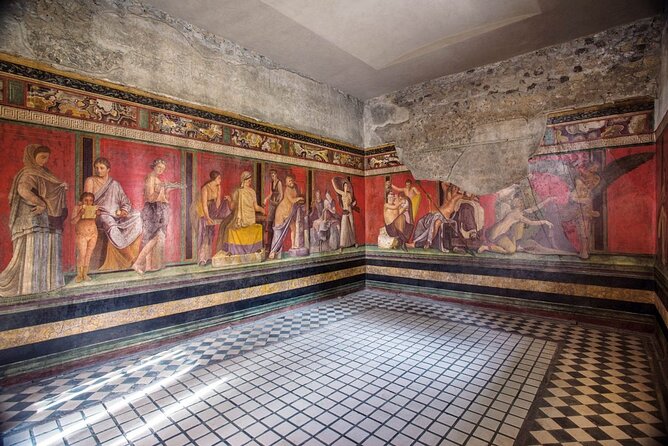
Outside the city walls, you’ll visit the Suburban Baths. These thermal baths were located beyond the urban core, near rocks where boats could moor—so the area likely served travelers, not only locals.
This stop helps correct a common misconception. Pompeii isn’t only a town of residents living and dying there. It was part of a larger movement of people and trade, and the bath setting points to that wider connection.
Admission is included for this stop, and the time window stays around 15 minutes. That’s enough for the big picture: Romans built leisure spaces as social infrastructure, and Pompeii’s location supported that.
Stop 6: Casa del Fauno and the bronze faun in the impluvium
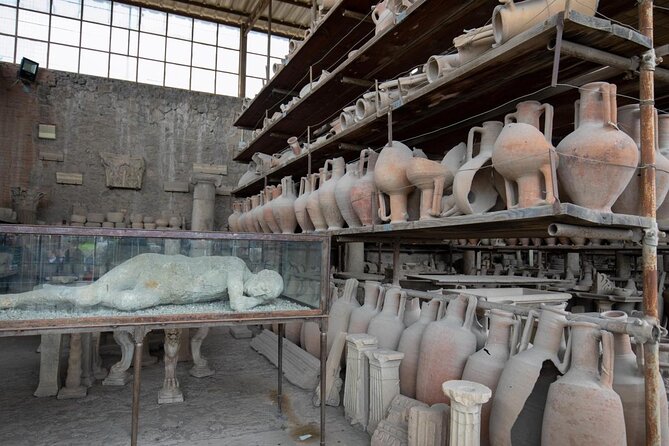
Next is the House of the Faun, known for a bronze statue of a faun located in the impluvium. The impluvium is the basin area that collects water—so you can imagine how the home’s layout directed attention to key decorative features.
This stop is famous for a reason. It’s not only art; it’s placement. You’re seeing how Romans choreographed the experience of a space: enter, collect water, and meet the household’s centerpiece.
Admission is included and the stop runs about 15 minutes. If you take one thing from this segment, let it be this: Pompeii is full of design choices meant to guide your eye and your movement.
Stop 7: Casa del Menandro with 118 silver objects and Trojan War frescoes
Now comes a major change in scale and storytelling. The prestigious House of Menandro is about 2,000 square metres and takes its name from an affresco of the poet Menandro.
One of the standout details: around 118 objects in silver were found here, described as tableware of great interest. That gives you a concrete feel for wealth and daily ritual—what people served and how they displayed status at the table.
The house is also associated with frescoes of the Trojan War, including scenes of the death of Laocoonte, and images connected with Cassandra and Ulysses. This isn’t random decoration. It’s a window into literary taste and cultural identity.
Admission is included, and you’ll have about 15 minutes. It’s short, but if your guide points out the story and the emotional tone of those scenes, you’ll feel how the Romans used myth to talk about values and drama.
Stop 8: Amphitheatre culture and gymnasium next door (ticket note)
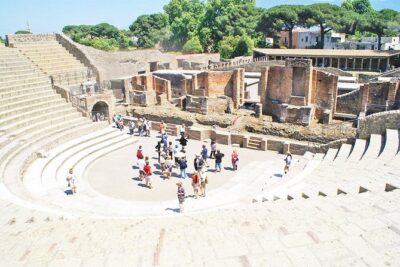
The tour then heads into the Archaeological Park area, touching on Roman entertainment. Pompeii had an amphitheatre for gladiators and similar fights, with capacity described as up to 20,000 people across three levels.
A fascinating detail is the note that during hot summer months, spectators were protected by a type of dark linen covering. Next to the arena, you can also see the gymnasium area where young athletes worked out.
Here’s the practical part: this stop is listed with admission ticket not included. At the same time, your tour includes priority ticket entrance for the archaeological park. So expect that your guided time here covers the area, but if a specific timed or separately ticketed component is required for the amphitheatre/gym area, you may need to handle that on your end.
Time stays tight at about 15 minutes, which means you’ll leave wanting more. Good. That’s a reason to plan self-guided time afterward if amphitheatre culture is your thing.
Stop 9: Temple of Apollo, plus the Apollo vs Jupiter story
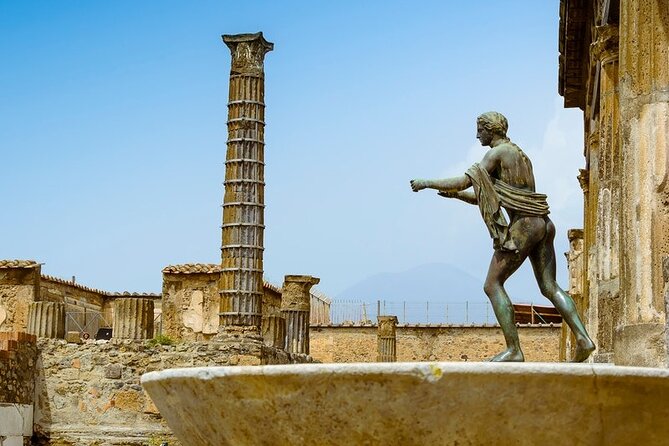
You finish with the Temple of Apollo. The worship of Apollo arrived before the eruption of 79 A.C., but over time Apollo’s followers lost ground because Jupiter became stronger in the Roman religious picture.
This stop includes a bronze statue of Apollo represented with his bow and arrow, plus a statue of Diana. It’s a compact ending, but it lands well because it connects art and belief to the same Roman worldview you saw in the homes and public areas.
Admission is included for this stop. And by this point, the tour has already trained your eye to ask questions like: Who was this for? What did it signal? What did it mean day to day?
What the best guides do with Pompeii’s details
The strongest tours don’t treat Pompeii like a postcard. They treat it like a living city with systems—homes that announce status, public spaces with rules, and entertainment designed for crowds.
On this kind of route, guides often keep coming back to human scale: the rooms where people ate, the mosaic messages at entryways, and the way a city creates routines. Even the darker topics, like the Lupanar, get framed as part of how Pompeii functioned.
The pace also matters. In the examples you’ll see associated with this tour, guides like Paolo and Alfredo are praised for detailed explanations and good pacing that keeps the group moving without losing context. Another guide name you may see is Teresa, noted for staying extra time to answer questions after the group portion ends.
Price and value: what you’re really paying for
At $66.23 per person for around 2.5 hours, the real value isn’t the time alone. It’s what’s bundled:
- Priority ticket entrance for the archaeological park
- Admission tickets included for many of the listed sites
- A small group capped at 15
- Headsets so you can hear clearly
- English-language archaeologist guidance
If you were to piece together priority access, a guided interpretation session, and multiple site admissions on your own, you’d likely spend more in time and money. And Pompeii punishes slow planning with queues and fatigue.
So yes, it’s not a bargain tour. But it’s also not a barebones “walk and point” situation. You’re paying for meaning plus access.
Who this tour suits best (and who should plan differently)
This tour is a great match if:
- You want a first pass through Pompeii that makes the city feel understandable
- You’d rather ask questions than wander with a phone and guess
- You have limited time and want high-impact stops
- You appreciate hearing why things look the way they do, not just what they are
You might want a different approach if:
- You want long stays inside a few rooms or you learn by reading slowly
- You’re hoping for a deep, site-by-site archaeological walkthrough at one location
- You’re traveling at a time when you know heat will knock you down quickly, and you prefer longer breaks
The smart move is to do this tour, then plan your own follow-up. Your day access approach (ticket valid for the day) means you can return to the spots that grabbed you.
Should you book this Pompeii small-group tour?
If you’re standing in Pompeii thinking, I need structure, this is a strong booking. The priority entry helps you start sooner, the archaeologist guidance turns ruins into context, and the small group keeps it interactive.
I’d especially recommend it for first-timers and for travelers who want a plan that doesn’t turn into a stress sprint. Just do two things: wear good walking shoes, and bring water. Pompeii will not feel gentle in the afternoon sun.
FAQ
How long is the Pompeii small-group tour?
It’s about 2 hours 30 minutes.
Is the tour in English?
Yes, the tour is offered in English.
How many people are in the group?
The group maximum is 15 travelers.
Does the tour include priority ticket entrance?
Yes. Priority ticket entrance for the Archaeological Park of Pompeii is included.
Are admission tickets included for the stops?
Admission tickets are included for most listed stops, but the Archaeological Park stop (Stop 8) is specifically listed with admission ticket not included.
Will I need a headset to hear the guide?
Yes, a headset is included.
Where does the tour start and end?
It starts and ends back at Hotel Vittoria, Piazza Esedra, 80045 Pompei NA, Italy.
What if I need help finding the meeting point?
Confirmation is received at the time of booking, and the tour includes a fixed meeting point. If you’re early and the group isn’t there, you’ll want to contact the provider so you can meet up before the tour starts.
Is there mobile ticketing?
Yes, the tour uses a mobile ticket.
Is cancellation free?
Cancellation is free. You can cancel up to 24 hours in advance for a full refund.
Is the tour affected by weather?
Yes. The experience requires good weather, and if it’s canceled due to poor weather, you’ll be offered a different date or a full refund.
More Tickets in Pompeii
- Pompeii Ticket + Tour with Optional Tasting Experience at Pompeii★ 5.0 · 663 reviews
- 2 hours Pompeii Tour with Local Historian – Ticket Included★ 5.0 · 335 reviews
- Pompeii Guided Group Tour with Entry Ticket and Archaeologist★ 4.5 · 269 reviews
- Pompeii 2-hour Private Tour with an Archaeologist-Ticket included★ 5.0 · 181 reviews
- Pompeii: Skip the line ticket (art) + audioguide + map★ 3.5 · 155 reviews
More Tour Reviews in Pompeii
- Pompeii Small Group Tour with an Archaeologist★ 5.0 · 6,593 reviews
- Discover the Ancient Ruins of Pompeii: Day Trip from Rome★ 3.5 · 2,247 reviews
- Pompeii and Herculaneum Small Group Tour with an Archaeologist★ 5.0 · 1,350 reviews
- Skip the Line Guided Tour of Pompeii led by an Archaeologist★ 5.0 · 703 reviews
- Pompeii Ticket + Tour with Optional Tasting Experience at Pompeii★ 5.0 · 663 reviews
More Tours Led by an Archaeologist
- Pompeii Small Group Tour with an Archaeologist★ 5.0 · 6,593 reviews
- Pompeii and Herculaneum Small Group Tour with an Archaeologist★ 5.0 · 1,350 reviews
- Skip the Line Guided Tour of Pompeii led by an Archaeologist★ 5.0 · 703 reviews
- Pompeii Private Tour with an Archaeologist and Skip The Line – 3 hours★ 5.0 · 564 reviews
- Pompeii Skip-the-line Tour with Archaeologist Guide★ 5.0 · 559 reviews
Just reviewed: more Pompeii tours and day trips






Pompeii Archaeologist-Led Tours, compared.
 ★ 4.8Entry Ticket and Guided Tour with an ArchaeologistFrom $3519,459 reviews
 ★ 4.8Small Group Tour with an ArchaeologistFrom $4012,264 reviews
★ 5.0Pompeii Small Group Tour with an ArchaeologistFrom $356,593 reviews
 ★ 5.0Pompeii and Herculaneum Small Group Tour with an ArchaeologistFrom $771,350 reviews
 ★ 5.0Skip the Line Guided Tour of Pompeii led by an ArchaeologistFrom $95703 reviews
 ★ 4.9Exclusive Tour with Archaeologist and Entry TicketsFrom $50634 reviews
 ★ 5.0Pompeii Private Tour with an Archaeologist and Skip The Line – 3 hoursFrom $302564 reviews
 ★ 5.0Pompeii Skip-the-line Tour with Archaeologist GuideFrom $71559 reviews
Browse the lists this tour appears in