
Reviewed · POMPEII ARCHAEOLOGIST-LED TOURS
Pompeii 2-hour Private Tour with an Archaeologist-Ticket included
Two hours in Pompeii can feel like a time machine. This private Pompeii tour pairs an archaeologist guide with a tight, walkable circuit, so you spend your limited time on the parts that usually take first-timers forever to sort out.
I love how the guide steers the visit. Names I’ve seen mentioned include Silvia (PhD archaeologist) and Alessandra (PhD archaeologist), and the common thread is simple: you get answers, not just dates. I also like that your Pompeii admission is included, so you’re not juggling separate ticket purchases while trying to enjoy your day.
One thing to keep in mind: this is a 2-hour route. You’ll hit major highlights, but it’s still a focused sprint—so if you’re the type who wants to linger in every corner, you’ll need to plan for extra time on your own.
In This Review
- Quick reasons this private Pompeii tour works
- Price and value: what you’re really paying for
- How the tour keeps your day from getting messy
- Porta Marina Superiore to the Basilica: your first 25 minutes
- The Forum area: Basilica to the ancient square
- Granaries of the Forum: marble tables, fountains, and the casts
- House of Menander: why one rich home is worth your time
- Stabian Baths and Lupanar: a city of bodies, routines, and boundaries
- Stabian Baths (Terme Stabiane)
- Lupanar
- House of the Faun and the two theaters: big spaces for status and spectacle
- Pacing, fitness, and comfort tips that actually matter
- Who this tour suits best (and who should consider something else)
- Should you book this Pompeii 2-hour private tour with Askos Tours?
- FAQ
- How long is the Pompeii private tour?
- Is the Pompeii admission ticket included?
- Is this tour private or shared?
- What language is the tour offered in?
- Where do we meet and where does the tour end?
- Is a mobile ticket provided?
- Is the tour cancelled if the weather is bad?
- Can I cancel for a full refund?
Quick reasons this private Pompeii tour works
- Archaeologist-led, question-friendly guidance that explains what you’re actually looking at
- Pompeii admission included, so you can start exploring without ticket hassle
- Private format (only your group), which means fewer bottlenecks and a real pace choice
- A smart highlight route through the Forum area, baths, a brothel, major homes, and theaters
- Meet at Porta Marina Superiore and end at Piazza Esedra, with help getting back
Price and value: what you’re really paying for
At $214.75 per person, this tour is priced for comfort and time. The big value isn’t just that it’s private. It’s that you’re getting a professional archaeological guide plus admission fees to Pompeii folded into the price.
That matters because Pompeii can be overwhelming even when the site is beautiful. A guide helps you connect scenes in your head: where you are, what you’re seeing, and why that spot matters. And since this is only about 2 hours, you’re paying to avoid wasting that window getting oriented.
Also, this is offered in English and uses a mobile ticket, which tends to make the start smoother. And the average booking lead time is about 41 days, which is a hint that this small-group style can be a popular slot, especially in peak travel windows.
More of the site walked with an archaeologist
- Pompeii and Herculaneum Small Group Tour with an Archaeologist
★ 5.0 · 1,350 reviews - Skip the Line Guided Tour of Pompeii led by an Archaeologist
★ 5.0 · 703 reviews - Pompeii Private Tour with an Archaeologist and Skip The Line – 3 hours
★ 5.0 · 564 reviews
How the tour keeps your day from getting messy
Pompeii runs on walking, and this tour is built for flow. You meet at the main entrance called Porta Marina Superiore. The guide holds a sign with the company name Askos Tours, so you should be able to spot them fast.
Your tour also ends in a practical place: Piazza Esedra. That’s helpful because you don’t want to spend your energy figuring out where you are after you finish. The guide can also point you toward how to get back to your accommodation or the closest train station.
The tour operates in all weather conditions, so it’s not “tentatively canceled if it rains.” Dress for the conditions on the day, and bring comfortable shoes—this site includes rough ground and slopes.
Finally, confirmation happens at booking time, and the tour is for one private group, not a shared bus-and-merge situation.
Porta Marina Superiore to the Basilica: your first 25 minutes
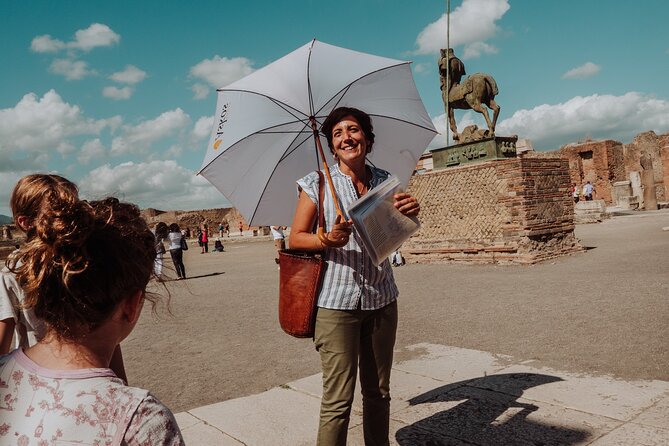
The visit begins at Archaeological Park of Pompeii, at Porta Marina Superiore, with about 10 minutes that includes the admission ticket. If you’ve ever wandered in and thought, Okay… where should I go first, this is exactly what the guide helps with.
Then the tour moves to the Basilica for about 15 minutes. Here you’re looking at an open portico that gave shelter to merchants and supported other activities. It’s a useful early stop because it frames Pompeii as a working city, not just a museum of ruins. You’re primed to notice “everyday infrastructure” as you move through the site.
What I like about starting with this kind of space is that it sets expectations. You quickly understand that the best photos come with context: trade, gathering, and movement.
The Forum area: Basilica to the ancient square
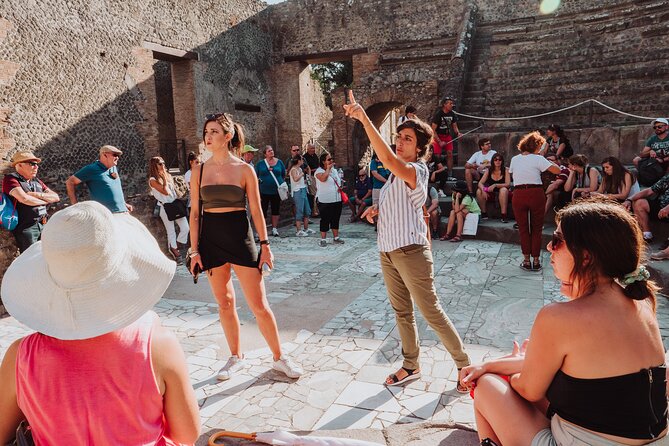
Next comes the Foro de Pompeya for about 10 minutes, where you can see Pompeii’s ancient main square. This is the kind of place where “I saw it” isn’t the real win. The real win is understanding why a main square matters in a city: it’s where life concentrates.
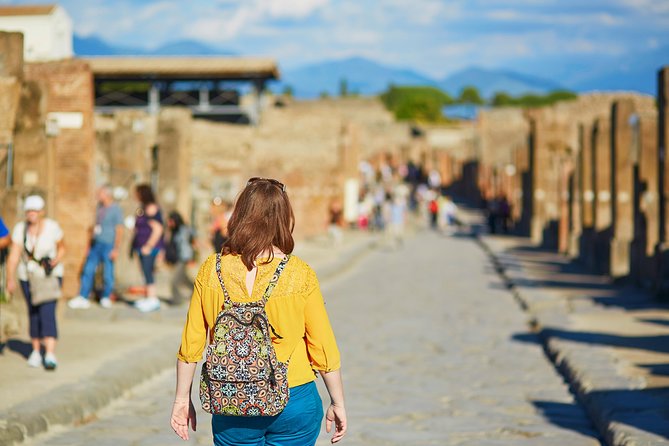
Between these larger stops, you also walk through the main street of Pompeii. Even if you don’t have a map memorized, that stretch helps you connect dots. You feel the direction of the city rather than hopping randomly from attraction to attraction.
This is where your guide’s style really pays off. In multiple accounts from guides associated with Askos Tours—like Giovanni, Luca, and Mena—the emphasis is often on day-to-day details: how people lived, how spaces functioned, and how art and design show up in daily life.
For you, that translates into better understanding with less effort. You don’t need to study guidebooks beforehand—you just need to ask questions and pay attention.
Granaries of the Forum: marble tables, fountains, and the casts
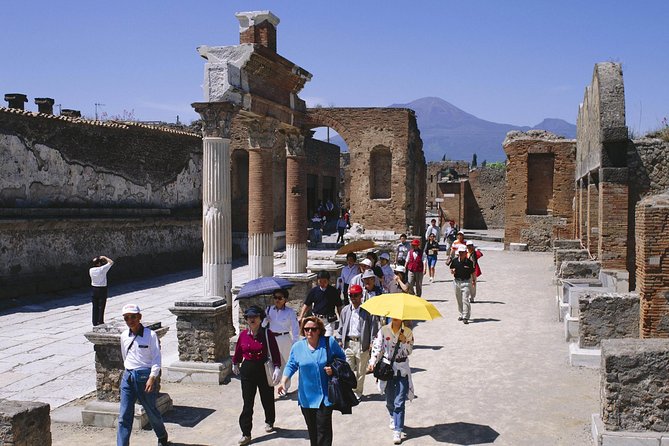
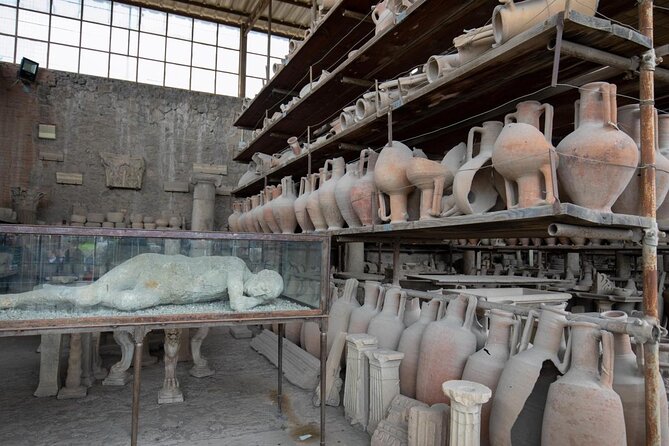
The Granaries of the Forum are a stop around 15 minutes. Admission there is free within the context of the tour stops, and this is one of the more emotionally and visually specific parts of the route.
You’ll see marble tables and baths for fountains that adorned entrances of houses. That detail matters because it shows how decorative “extras” were part of ordinary architecture—not something reserved for the elite alone.
Then comes something more intense: casts of victims of the eruption, plus casts connected to a dog and a tree. This stop tends to land hard for most people, and your guide’s job is to keep it grounded—what you’re seeing, what it represents, and how it fits into the site as evidence, not just tragedy for tragedy’s sake.
The good part of keeping this on a guided route is pacing. You’re not left to interpret by yourself, and you’re not rushed past it either.
Prefer your own guide? More private tours


House of Menander: why one rich home is worth your time
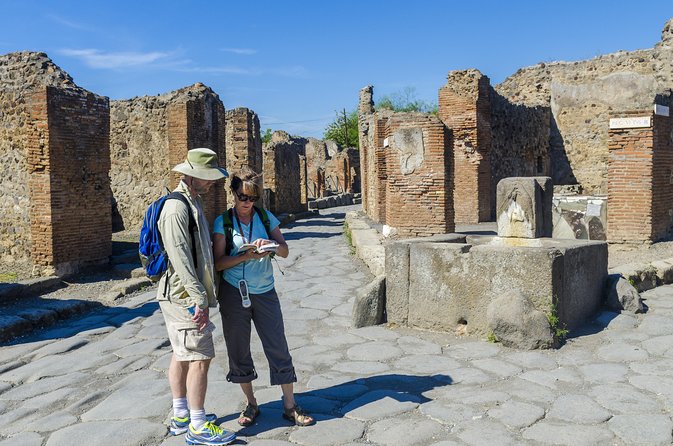
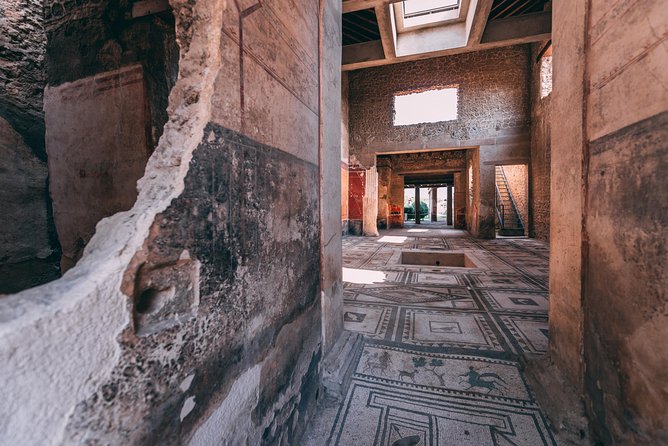
For about 15 minutes, you visit the House of Menander. This is described as one of Pompeii’s richest and most magnificent homes, especially in terms of architecture, decoration, and contents.
So what should you pay attention to? Not just big visuals—although there’s plenty to look at. Focus on how the space is organized and how decoration signals status. A guide can help you connect what you see to the idea of wealth expressed through layout and objects.
This stop is valuable because it gives your mind a “private life” counterpoint to the public spaces of the Forum. If you only visited squares and markets, Pompeii would feel like one long crowd scene. Add a top-tier home, and you start to get balance: work and leisure, public and private, street and home.
It’s also a great stop if you’re traveling with someone who wants something other than “streets and stones.”
Stabian Baths and Lupanar: a city of bodies, routines, and boundaries
Two stops, each about 15 minutes, can change how you understand the whole city:
Stabian Baths (Terme Stabiane)
You’ll visit the Stabian Baths, a vast thermal complex. It’s noted as the oldest thermal complex in the city, located between areas including the Brothel lane, Holconius crossroads, and the Via Stabiana.
Even if you’re not a history nerd, baths are a smart lens because they describe routines—where people went to relax, socialize, and recover. And placing them next to other city zones gives you that “how neighborhoods actually function” feeling.
Lupanar
Then you head to the Lupanar, described as the most famous brothel in Pompeii, again with about 15 minutes on site.
This is one of those stops that can feel a little awkward if you don’t expect it. The guide’s context is what makes it usable: you’re not just viewing scandal. You’re seeing how a city provided services, how spaces were designed, and how daily life could be structured in surprising ways.
If you have teens or younger kids, you’ll want to use your judgment and decide whether this specific stop fits your family. The tour is private, so you can also set boundaries with your guide.
House of the Faun and the two theaters: big spaces for status and spectacle
The House of the Faun is another highlight, about 15 minutes. It’s described as one of Pompeii’s largest and most impressive private residences.
This stop helps you understand what “scale” means in a Pompeii home. It’s not just decoration—it’s the size of rooms and the impression of a household built to display taste and power.
Then you’ll have a look at the Teatro Piccolo. The itinerary keeps it brief, but it’s a useful stepping stone before the main theater.
Finally, you visit Teatro Grande, Pompeii’s most important theater, with about 10 minutes here. A theater is where a city stages ideas: entertainment, public culture, and mass gathering. If you’ve spent the last hour on homes and baths, the theater can feel like the city’s “public voice,” pulled into a single location.
For your photos, theaters are also forgiving. Even when you only catch parts of the structure, you still see the shape of communal life.
Pacing, fitness, and comfort tips that actually matter
This tour includes walking across several parts of Pompeii in a short time. The guidance recommends comfortable shoes, and it notes moderate physical fitness. That’s not a warning label—it’s a reality check.
If you’re with older family members or anyone who needs slower turns, this is the kind of situation where a good archaeologist guide can adjust. I’ve seen guidance described as being mindful of older family members and moving at a calmer pace on rough or steep ground. So if mobility is a concern, it’s worth telling the guide what you need at the start.
Also, remember this tour happens in all weather conditions. Pompeii doesn’t pause for rain. If it’s hot, you’ll appreciate shade breaks if your guide builds them in; if it’s wet, you’ll appreciate shoes with grip.
Who this tour suits best (and who should consider something else)
This private 2-hour format is a great fit if you want:
- A focused highlight route without spending your energy deciding where to start
- A guide who explains what you’re seeing in plain language
- Time to ask questions as you walk, especially about spaces like the Forum, baths, and homes
It’s also a strong choice for families when the guide engages kids. One account highlights that a guide kept kids (ages 7 and 9) actively engaged with stories, which is exactly what you want when time is limited.
Who might think twice:
- If you already know Pompeii well and you crave a longer, deeper route, this may feel like a fast scan.
- If your goal is to linger for hours in one or two areas, the fixed circuit can feel limiting.
Should you book this Pompeii 2-hour private tour with Askos Tours?
Yes—if you want your Pompeii day to be guided, structured, and efficient. The biggest selling point is that you’re paying for two things that usually cost you time separately: an archaeologist guide and admission fees. And because it’s private, your pace and priorities matter.
Before you book, match it to your travel style:
- If you want the highlights—Forum, key houses, baths, the brothel area, and the theaters—in a tight plan, this fits perfectly.
- If you’re the type who needs to go slow everywhere, plan extra time on your own before or after.
If you’re going for your one must-see Pompeii day, this is a smart way to spend it without feeling swept along.
FAQ
How long is the Pompeii private tour?
It’s about 2 hours (approx.).
Is the Pompeii admission ticket included?
Yes. The tour includes admission fees to Pompeii, and the first stop at Porta Marina Superiore includes the ticket.
Is this tour private or shared?
It’s private. Only your group will participate.
What language is the tour offered in?
The tour is offered in English.
Where do we meet and where does the tour end?
You meet at the main entrance called Porta Marina Superiore, with the guide holding an Askos Tours sign. The end point is Piazza Esedra.
Is a mobile ticket provided?
Yes. A mobile ticket is included.
Is the tour cancelled if the weather is bad?
No. It operates in all weather conditions, so you should dress appropriately for the day.
Can I cancel for a full refund?
Yes. You can cancel up to 24 hours in advance for a full refund.
More Tour Reviews in Pompeii
- Pompeii Small Group Tour with an Archaeologist★ 5.0 · 6,593 reviews
- Discover the Ancient Ruins of Pompeii: Day Trip from Rome★ 3.5 · 2,247 reviews
- Pompeii and Herculaneum Small Group Tour with an Archaeologist★ 5.0 · 1,350 reviews
- Skip the Line Guided Tour of Pompeii led by an Archaeologist★ 5.0 · 703 reviews
- Pompeii Ticket + Tour with Optional Tasting Experience at Pompeii★ 5.0 · 663 reviews
More Private Guides at the Site
- Pompeii private tour with an Official Guide★ 5.0 · 631 reviews
- Pompeii Private Tour with an Archaeologist and Skip The Line – 3 hours★ 5.0 · 564 reviews
- Visit in Pompeii – Pompeii Private Tour with Ada★ 5.0 · 436 reviews
- Pompeii Private Tour with an Archaeologist and Skip The Line★ 5.0 · 391 reviews
- Pompeii Vineyard Escape: Private Wine Tasting & Lunch★ 5.0 · 329 reviews
More Tours Led by an Archaeologist
- Pompeii Small Group Tour with an Archaeologist★ 5.0 · 6,593 reviews
- Pompeii and Herculaneum Small Group Tour with an Archaeologist★ 5.0 · 1,350 reviews
- Skip the Line Guided Tour of Pompeii led by an Archaeologist★ 5.0 · 703 reviews
- Pompeii Private Tour with an Archaeologist and Skip The Line – 3 hours★ 5.0 · 564 reviews
- Pompeii Skip-the-line Tour with Archaeologist Guide★ 5.0 · 559 reviews
Just reviewed: more Pompeii tours and day trips




Pompeii Archaeologist-Led Tours, compared.
 ★ 4.8Entry Ticket and Guided Tour with an ArchaeologistFrom $3519,459 reviews
 ★ 4.8Small Group Tour with an ArchaeologistFrom $4012,264 reviews
★ 5.0Pompeii Small Group Tour with an ArchaeologistFrom $356,593 reviews
★ 4.8Small Group Tour with an ArchaeologistFrom $4012,264 reviews
★ 5.0Pompeii Small Group Tour with an ArchaeologistFrom $356,593 reviews
 ★ 5.0Pompeii and Herculaneum Small Group Tour with an ArchaeologistFrom $771,350 reviews
 ★ 5.0Skip the Line Guided Tour of Pompeii led by an ArchaeologistFrom $95703 reviews
 ★ 4.9Exclusive Tour with Archaeologist and Entry TicketsFrom $50634 reviews
 ★ 5.0Pompeii Private Tour with an Archaeologist and Skip The Line – 3 hoursFrom $302564 reviews
 ★ 5.0Pompeii Skip-the-line Tour with Archaeologist GuideFrom $71559 reviews
Browse the lists this tour appears in