
Reviewed · POMPEII SKIP-THE-LINE ENTRY
Pompeii: Skip the line ticket (art) + audioguide + map
Pompeii rewards the people who can move at their own pace. This package is built around pre-booked priority access and a park-approved audioguide device that helps you read the city in real time as you walk.
What I like most is the control: you’re not stuck in a rigid group rhythm, so you can linger where the volcanic ash story gets vivid. The main thing to watch is the fine print of that skip-the-line promise: you may still deal with a voucher swap and a bit of queuing if directions or entrances get mismatched.
In This Review
- Key takeaways before you go
- What you’re really buying for about $44.31
- Entering Pompeii: the Porta Marina Inferiore shortcut (and its limits)
- Stop 1: Pompeii’s Archaeological Park at your own pace
- How the audioguide works (and why the phone format matters)
- The included map: how to use it without getting turned around
- Timing and pacing: how long 2 to 4 hours really feels
- What “volcanic ash preservation” feels like on the ground
- Practical details that can make or break the day
- Who this Pompeii package is best for
- Should you book this skip-the-line audio package?
- FAQ
- What’s included in this Pompeii experience?
- Do I need to bring headphones for the audioguide?
- Do I have to show an ID to use the audioguide device?
- Where do I enter the park with this ticket package?
- How long should I plan for Pompeii with this audioguide?
- Is this experience offered in English?
- Is parking included?
- Is the experience private?
Key takeaways before you go
- Priority entry is tied to one specific entrance: Porta Marina Inferiore in Piazza Esedra.
- Audioguide is park-authorized for tour operators, with a number-based system on the device.
- Self-guided pacing means you can slow down for houses, streets, temples, and theaters without waiting.
- It’s phone-based, so plan for headphones (not included) and be ready for the occasional awkward audio navigation.
- You’ll need an ID deposit for the device, returned when you bring it back.
- Expect a walk between the pickup point and the gate, especially if you’re coming via rail station.
What you’re really buying for about $44.31
At $44.31 per person, you’re not just paying for admission. You’re paying for a bundled approach: express entry via pre-booked access, an audioguide device rental, and a map that’s meant to connect what you see with what you hear.
That combination can be great value if:
- you’re visiting during a busy season and want to reduce waiting,
- you want narration but don’t want a live guide shouting over the crowds,
- you like to set your own pace inside a large site.
But here’s the reality check: if lines are short on the day you arrive, you might find ways to enter without paying extra for a package. Also, the “skip the line” part depends on using the correct entrance and following the voucher instructions closely.
More ways past the ticket queue
- Skip the Line Guided Tour of Pompeii led by an Archaeologist
★ 5.0 · 703 reviews - Pompeii Private Tour with an Archaeologist and Skip The Line – 3 hours
★ 5.0 · 564 reviews - Pompeii Skip-the-line Tour with Archaeologist Guide
★ 5.0 · 559 reviews
Entering Pompeii: the Porta Marina Inferiore shortcut (and its limits)
This ticket includes dedicated access from Porta Marina Inferiore, located in Piazza Esedra. That’s important, because priority entry is not a free-for-all. If you head to the wrong gate, you can lose the time you were trying to save.
In practice, the experience often works like this:
- You pick up your audioguide and related voucher materials at the operator’s office area.
- You then move to the entrance for the park access that matches your package.
- From there, you follow the normal on-site flow into the ruins.
Some visitors run into problems because they’re sent back to swap a voucher or told to change entrances. The quick lesson: don’t assume any gate will accept your voucher the same way. Follow the plan for Porta Marina Inferiore so you keep the day moving.
If you’re arriving via public transport, build in buffer time. Even when things go smoothly, you can still face security checks and pedestrian flow. And if you happen to get misdirected to a different pickup/exchange point, you may also spend time walking downhill between areas.
Stop 1: Pompeii’s Archaeological Park at your own pace
Your main stop is the Archaeological Park of Pompeii, using the audioguide to guide you through the parts of the city most visitors want—without forcing you into a fixed tour circuit.
Here’s what that means for your experience. Pompeii is spread out. If you only walk randomly, it’s easy to see impressive ruins but miss what makes them click as a city—how people lived, worked, worshiped, and gathered before the eruption.
With the self-guided approach, you can:
- stop and start as you wish,
- spend extra time in the areas that feel most meaningful to you,
- move past crowds when you spot a slower pocket of ruins,
- keep the pace comfortable (especially helpful if you’re traveling with kids, older relatives, or anyone who doesn’t do long guided marching).
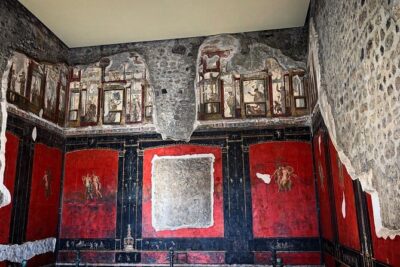
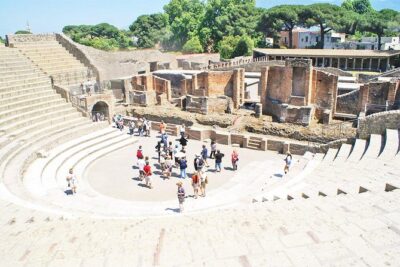
Most packages like this are built around the big categories of ancient life you’ll recognize instantly: houses, temples, theaters, and street life. You’re essentially building your own route through the city, supported by narration that maps to what you’re standing in front of.
A practical tip: give yourself enough time to do one “main sweep” plus one “wandering loop.” If you try to see everything in one pass, you’ll end up rushing the parts that are easiest to understand with the right audio prompts.
How the audioguide works (and why the phone format matters)
You get an audioguide device designed to play explanations using the numbers on the device. That’s a smart system in theory: you’re not guessing which track matches which wall, archway, or doorway.
You can use it hands-free, or with standard jack headphones—but headphones are not included. The deposit requirement also means you should keep your ID ready, because you’ll need it as security and you’ll get it back when you return the device.
Now the phone-based reality. Even when people like the audio content, the delivery can be a mixed bag:
- If you’re holding a phone, you’ll feel it in your hands over time.
- If your route gets confusing, the audio can feel harder to use because you’re also figuring out where you are.
- If you end up with the wrong language setting, you lose a lot of value fast.
My advice: before you hit the main ruins, take 2 minutes to get comfortable with the device controls, the numbering system, and how the map display helps you orient yourself. Then commit to listening only when you’re actually standing in front of the described spot.
If you want a smoother experience, bring your own wired headphones (standard jack). You’ll thank yourself once the walking starts.
The included map: how to use it without getting turned around
You get an informative map with the package. That sounds straightforward, but Pompeii can be disorienting in a hurry. There are multiple ways to move through the site, and your legs can feel like they’re doing one big loop even when you’re actually zigzagging.
Use the map like this:
- First, use it to understand the general layout and where the entrance puts you.
- Then, use the numbering cues from the audioguide to decide which areas are worth slowing down for.
- Finally, don’t treat the map like a strict route. Treat it like a compass.
One more practical thing: signage for skip-the-line access can be less obvious than you’d hope. The best way to protect your time is to focus on your entrance plan and meeting/exchange instructions rather than expecting the site to guide you.
Set your own pace with an audio guide

Timing and pacing: how long 2 to 4 hours really feels
The tour runs about 2 to 4 hours. That range matters because Pompeii rewards slow viewing, but time at the site is also limited by heat, crowds, and how quickly you can cover distances.
If you do 2 hours, you’ll likely:
- hit a handful of major highlights,
- follow the audioguide enough to understand what you’re seeing,
- still feel like you didn’t cover the full city.
If you do closer to 4 hours, you’ll probably:
- get more meaning from the narration (because you’re not rushing between stops),
- linger in at least one or two areas with richer detail,
- manage the physical effort better.
Pick your target based on your travel style. If you’re the type who likes photos, readings, and stops for context, lean toward the longer end.
What “volcanic ash preservation” feels like on the ground
It’s easy to read that volcanic ash preserved Pompeii for centuries. What’s harder is understanding why that matters while you walk.
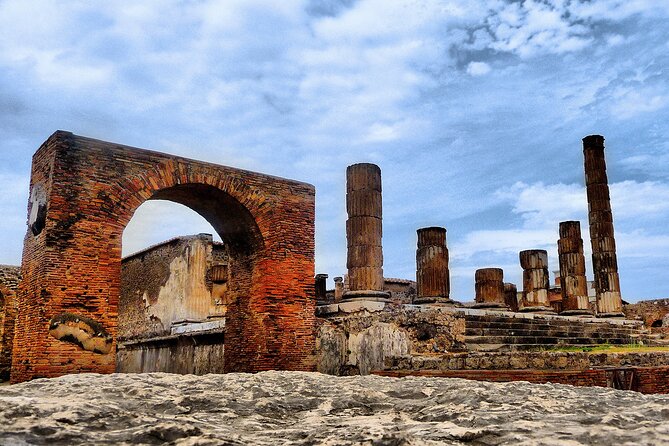
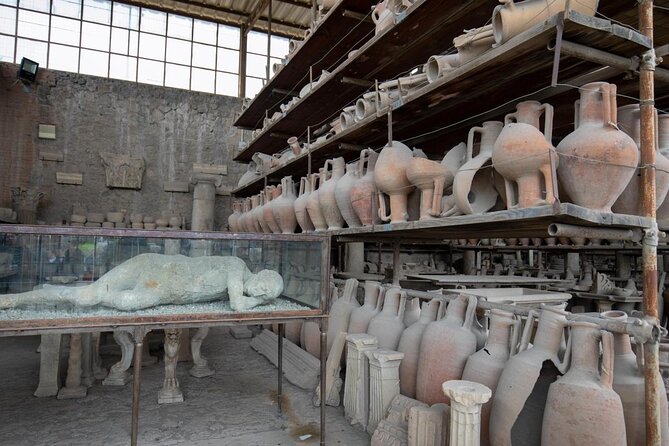
In real life, the preservation effect shows up in how intact so many structures feel—doorways, street layouts, and built-in spaces that make the city feel less like a ruin and more like a snapshot frozen in time. The audioguide is there to help connect the visuals to daily life, so you don’t just stare at stone blocks. You start picturing movement, routine, and social life—before and after the eruption.
That’s where the self-guided approach can shine. You can stop when something clicks emotionally or intellectually. Then the audio gives you the extra layer that turns seeing into understanding.
Practical details that can make or break the day
A few nuts-and-bolts points from what’s provided with the experience:
- Headphones are not included. If you don’t want to hold the device to your ear, bring your own wired headphones with a standard jack.
- You need an ID deposit to use the audioguide device. It’s returned when you hand the device back.
- English is available. The experience is offered in English.
- Service animals are allowed.
- It’s near public transportation, which helps if you’re using the Circumvesuviana or similar local transit.
- Free parking may be available from 01/04 at Osteria Nonna Cherubina, Via Andolfi 46, but it’s not gated.
- Private experience: only your group participates.
If you want my simple “avoid stress” checklist:
- Bring your ID.
- Bring headphones.
- Arrive with buffer time for exchange and security flow.
- Use the Porta Marina Inferiore entrance plan as your anchor, not guesswork.
Who this Pompeii package is best for
This experience fits best if you:
- want structured guidance but prefer not to follow a loud group,
- like to set your own pace in a huge site,
- are comfortable navigating with a map and a device,
- can handle the phone-format audioguide setup.
It may be less ideal if you:
- hate any device you have to manage while walking,
- need very clear, step-by-step directions at every junction,
- want the simplest possible entry with zero moving parts.
In those cases, you may end up spending too much energy on the logistics instead of the ruins.
Should you book this skip-the-line audio package?
I’d book it if you want a good middle path: pre-booked priority access plus narration that helps you make sense of what you see, without committing to a live guide for every minute.
I’d think twice if your top priority is a frictionless, single-location entry. The package can still involve voucher exchange and moving between pickup and gate areas. If directions aren’t clear for you on arrival, you can lose time fast—especially when crowds and heat rise.
My final advice: if you choose this, treat the entrance plan as non-negotiable. Stick with Porta Marina Inferiore (Piazza Esedra), arrive with your ID ready, and set up the audioguide before you start wandering. Do that, and Pompeii becomes exactly what you want it to be: a powerful place you can understand at your own speed.
FAQ
What’s included in this Pompeii experience?
You get an Archaeological Park entry express ticket (artecard), dedicated access from Porta Marina Inferiore in Piazza Esedra, an audioguide device, a map, and multilingual assistance at the office.
Do I need to bring headphones for the audioguide?
Yes. Headphones are not included. The audioguide can be used hands-free or with standard jack headphones.
Do I have to show an ID to use the audioguide device?
Yes. A valid ID is required as a deposit, and it’s returned when you give the device back.
Where do I enter the park with this ticket package?
Entry is via Porta Marina Inferiore, located in Piazza Esedra.
How long should I plan for Pompeii with this audioguide?
Expect about 2 to 4 hours.
Is this experience offered in English?
Yes, it’s offered in English.
Is parking included?
Free parking may be available (not gated) from 01/04 at Osteria Nonna Cherubina, Via Andolfi 46, if available.
Is the experience private?
Yes. It’s a private tour or activity, and only your group participates.
More Tour Reviews in Pompeii
- Pompeii Small Group Tour with an Archaeologist★ 5.0 · 6,593 reviews
- Discover the Ancient Ruins of Pompeii: Day Trip from Rome★ 3.5 · 2,247 reviews
- Pompeii and Herculaneum Small Group Tour with an Archaeologist★ 5.0 · 1,350 reviews
- Skip the Line Guided Tour of Pompeii led by an Archaeologist★ 5.0 · 703 reviews
- Pompeii Ticket + Tour with Optional Tasting Experience at Pompeii★ 5.0 · 663 reviews
More Audio-Guided Visits
- Pompei Archaeological Park Skip The Line ticket With audio Guide★ 3.0 · 10 reviews
Skip-the-Line Entries, More to Book
- Skip the Line Guided Tour of Pompeii led by an Archaeologist★ 5.0 · 703 reviews
- Pompeii Private Tour with an Archaeologist and Skip The Line – 3 hours★ 5.0 · 564 reviews
- Pompeii Skip-the-line Tour with Archaeologist Guide★ 5.0 · 559 reviews
- Pompeii Private Tour with an Archaeologist and Skip The Line★ 5.0 · 391 reviews
- Complete Pompeii Skip the Line Tour with Archaeologist Guide★ 4.5 · 379 reviews
Just reviewed: more Pompeii tours and day trips






Pompeii Skip-the-Line Entry, compared.
 ★ 4.0Skip-the-Line Entrance Ticket with Audio GuideFrom $392,509 reviews
 ★ 4.6Skip-the-line-Ticket and Guided TourFrom $641,152 reviews
 ★ 4.9Guided Tour with Skip-the-Line EntryFrom $58812 reviews
 ★ 4.1Skip-the-Line Entry Ticket with Digital Guide AppFrom $22770 reviews
 ★ 4.9Pompeii Ruins Private Tour with Optional Skip-the-Line EntryFrom $254732 reviews
 ★ 5.0Skip the Line Guided Tour of Pompeii led by an ArchaeologistFrom $95703 reviews
 ★ 5.0Pompeii Private Tour with an Archaeologist and Skip The Line – 3 hoursFrom $302564 reviews
 ★ 5.0Pompeii Skip-the-line Tour with Archaeologist GuideFrom $71559 reviews
Browse the lists this tour appears in