

Reviewed · POMPEII ARCHAEOLOGIST-LED TOURS
Pompeii: Tour with Archaeologist Guide & Skip-the-Line Entry
Pompeii hits you fast, even on a short tour. This archaeologist-led, skip-the-line visit helps you connect the big landmarks with the everyday life that vanished in 79 AD, all in about two hours. You’ll see the Forum and Forum-area sights with an expert guide, and you’ll get inside the story behind the famous casts—not just a quick photo stop.
I really liked how the route covers both public Pompeii and private Pompeii: the amphitheater, baths, and Forum sit beside domus homes with frescoes and the lupanare. That mix helps you understand what people did all day, not only what survived the eruption.
One thing to consider: it’s a moderate-walking experience, and because the tour is short, the stops move at a pace that might feel rushed if you want to linger.
In This Review
- Key points I’d bookmark
- Pompeii’s last day, explained in plain walking language
- Where the tour starts near Piazza Esedra (and why that helps)
- Skip-the-line entry: the best kind of convenience
- Teatro Grande start: get oriented before the ruins get loud
- Amphitheater and public life: more than just a backdrop
- Via dell’Abbondanza: the street that ties it all together
- Private Roman domus and frescoes: why these rooms feel human
- Stabian Baths: a look at routine, not just spectacle
- Lupanare: the city’s adult side, handled in context
- Forum, Basilica, and the civic core
- Fiorelli casts (1863): the moment history becomes personal
- How well does a 2-hour Pompeii tour actually work?
- Value check: about $57.84 for guided UNESCO time
- Who this Pompeii tour suits best (and who should pass)
- A few planning tips so you enjoy the walk
- Should you book this Pompeii archaeologist tour?
- FAQ
- How long is the Pompeii tour with the archaeologist guide?
- Is skip-the-line entry included?
- What’s included in the tour besides the entrance ticket?
- Where do I meet the tour?
- Where does the tour end?
- How big is the group?
- What fitness level do I need?
- Are service animals allowed?
- Is cancellation free, and how late can I cancel?
Key points I’d bookmark

- Skip-the-line entry handled by the guide, so you don’t burn time waiting at the ticket area
- Archaeologist guidance that links buildings to how Romans actually lived in Pompeii
- Stabian baths, the Lupanare, and the Forum/Basilica all in one compact route
- Fresco-filled domus stops and street context on Via dell’Abbondanza
- Fiorelli casts (1863) help explain what happened in the eruption in a very tangible way
- Maximum 25 travelers, which keeps the group from becoming a stampede
Pompeii’s last day, explained in plain walking language

Pompeii is one of those places where the ruins feel staged—until you learn what you’re actually looking at. This tour is built around that key idea: you’re not just collecting sights. You’re learning how the city worked, what mattered, and how the eruption changed everything.
In two hours, you’ll be guided through a sequence that goes from major public spaces to homes and then to the evidence of the catastrophe. That matters because Pompeii can feel overwhelming if you arrive with zero structure. With a guide, the stones start acting like a map.
And yes, you’ll still be awed. The surviving frescoes and everyday objects are impressive, but the real win is understanding what they meant. When you know what kind of room you’re standing in—or what the building served—you start noticing details that you would otherwise miss.
More ways past the ticket queue
- Skip the Line Guided Tour of Pompeii led by an Archaeologist
★ 5.0 · 703 reviews - Pompeii Private Tour with an Archaeologist and Skip The Line – 3 hours
★ 5.0 · 564 reviews - Pompeii Skip-the-line Tour with Archaeologist Guide
★ 5.0 · 559 reviews
Where the tour starts near Piazza Esedra (and why that helps)
You meet at Travelcampania, at Via Plinio, 107 in Pompei (near the park area), with the key tour redemption point listed at Tour & Audio Guide, Piazza Esedra, 2. The walk begins near the coffee shop Vittoria bar, so it’s easy to orient before you head into the site.
The tour duration is listed as about 2 hours, and the route is designed for that time window. That’s part of the value: you get a coherent story without turning your day into a half-marathon.
Group size is capped at 25 travelers, which makes a big difference on a site this large. You’re more likely to hear the guide clearly and ask questions than if you’re packed into a larger crowd.
Skip-the-line entry: the best kind of convenience
This is not a “try to be fast” skip-the-line situation. The format here is simple: once you’re with the archaeologist guide at the start point, the guide purchases the entrance tickets for the archaeological park as part of the service.
That means you spend less time stuck at the gate and more time learning and walking. Pompeii isn’t the place where you want to waste your prime hours in a queue.
Also, your day plan gets easier because the end point is different from the start. The tour finishes at the Foro di Pompei area (Via Villa dei Misteri, 2). If you want to keep exploring afterward, you can stay inside the archaeological park.
Teatro Grande start: get oriented before the ruins get loud
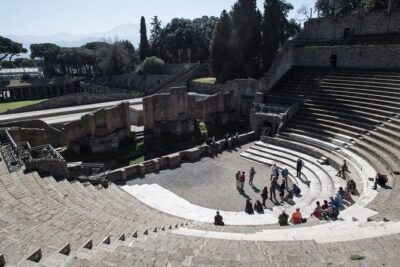
The first named stop is Teatro Grande, and starting there is a smart choice. It’s a good “big picture” anchor: you can see how Pompeii’s public spaces worked and how the city organized crowds, entertainment, and movement.
Even before you start sprinting down the main streets, you’ll receive the basics from your archaeologist guide. Think of this as learning the city’s vocabulary. From there, the tour can point out what you’re seeing instead of just naming it.
A good orientation is underrated. Pompeii is full of similar-looking arches, corridors, and walls. When you know what a place is for, you don’t keep wondering if you’ve ended up in the wrong neighborhood of a very ancient maze.
Amphitheater and public life: more than just a backdrop
One of the tour highlights is the amphitheater, and it’s included for a reason. In a city like Pompeii, arenas and performance spaces weren’t only entertainment. They were a social engine—where people gathered, followed status, and spent time together.
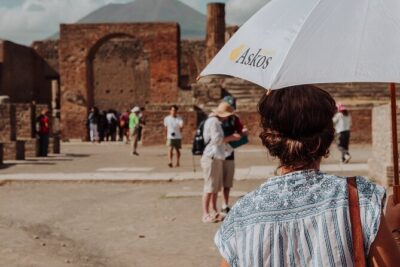
As you move through the key public areas, the guide connects buildings to the rhythm of everyday life. You’re not just looking at seats and stonework. You’re getting a feel for how Romans used these spaces, and what kinds of crowds showed up.
And when you pair the amphitheater with the next stops—streets like Via dell’Abbondanza and major civic buildings like the Forum—the city starts to feel like a system. Public life isn’t separate from daily life. It’s built into the same streets.
More of the site walked with an archaeologist
Via dell’Abbondanza: the street that ties it all together

The tour includes Via dell’Abbondanza, one of Pompeii’s most famous street segments. A street stop might sound minor compared with amphitheaters and frescoed villas, but it’s one of the best “connective tissue” points.
Streets are how you understand scale. They show how people moved between civic buildings, markets, homes, and leisure spots. Without a guide calling it out, it’s easy to treat a street as just a corridor between big attractions.
With guidance, you start noticing how entrances face the road, where services likely sat, and how the architecture supports the city’s daily flow. It’s the kind of detail that turns Pompeii from a ruin tour into a real place you can picture.
Private Roman domus and frescoes: why these rooms feel human
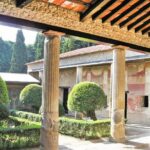
A major part of the experience focuses on the private houses (domus), including fresco-filled rooms. This is where Pompeii stops being mainly dramatic and becomes intimate.
Frescoes are more than decoration. They’re part of how wealth, taste, and identity showed up inside homes. They also help you imagine what daily life looked like on non-disaster days: conversations, meals, rest, and the quiet routines of a city household.
The guide’s job here is key: they connect what you see in the house to what it says about Roman life. When you understand that, the frescoes feel less like pretty wall art and more like social communication.
Stabian Baths: a look at routine, not just spectacle

The tour includes the Stabian baths, which is one of the best ways to understand Pompeii beyond politics and tragedy. Baths were daily life infrastructure. Even if you think of them as leisure, they were also part of hygiene, routine, and social time.
When a guide walks you through baths, you tend to notice layout more clearly—how spaces relate to temperature changes and movement. That helps you read the building in context instead of treating it like a set of leftover rooms.
This stop is also a nice balance after more intense moments later in the tour. Baths can feel calm, even in a ruined setting.
Lupanare: the city’s adult side, handled in context
The lupanare—an ancient brothel—is included as well. It can be a shock if you only associate Pompeii with catastrophe and art.
But seeing it on a guided walk usually helps keep it grounded. The guide can explain how the site fits into the city’s built environment and how businesses operated there. It turns the lupanare from a headline into a real piece of urban life.
This is also a good reminder that Pompeii wasn’t frozen in time. It was functioning up to the end—daily commerce, routine, and human behavior included.
Forum, Basilica, and the civic core
The tour takes you through the Forum and the Basilica as well. This is where you see the city’s civic heartbeat: the public authority spaces, the place for gatherings, and the kind of architecture that signals power and community.
The Forum area tends to be visually dramatic because it’s central and monumental. What makes this tour useful is that you’re not only looking at scale. You’re also learning what that scale meant in daily terms.
By the time you’re in the Forum and Basilica zone, you’ve already seen the amphitheater, streets, baths, and homes. So the civic stops click into place. You start understanding how everything connects: leisure, daily routine, and public life all share the same streets and institutions.
Fiorelli casts (1863): the moment history becomes personal
One of the most distinctive inclusions is the first casts made in 1863 by Arch. Giuseppe Fiorelli. You’re not just walking past an idea—you’re being shown evidence tied to how historians and archaeologists interpret the disaster.
These casts matter because they turn the eruption from a distant date into specific, physical proof. It’s still heartbreaking, but it’s also clarifying. You can better understand what the eruption meant for real people and real bodies.
If you’re the type who wants the story to have a concrete anchor, this stop will land. It’s also a reason this tour feels more than a quick circuit: the guide’s explanations give you a framework for why the casts exist and what they help reveal.
How well does a 2-hour Pompeii tour actually work?
Two hours is a tight window for a huge site, and that’s where pace becomes the whole experience. You’ll cover many major highlights, but you won’t get the luxury of slow wandering in every corner.
The upside is momentum. A short, structured walk helps you avoid the classic Pompeii problem: you see plenty, but you remember little because nothing had a clear story arc.
The requirement is moderate physical fitness, so comfortable shoes matter. You’re walking an active archaeological site, and the tour is designed to keep moving between key points like Teatro Grande, major public areas, and the Forum zone.
If you want a deep, slow study—this might feel too fast. But if you want a smart overview with expert context, it’s well matched.
Value check: about $57.84 for guided UNESCO time
At $57.84 per person for about 2 hours, the value here is less about “cheap ruins” and more about what you get packaged into that price.
You’re paying for:
- Skip-the-line entry handled by the guide
- A guided explanation from an archaeologist-type perspective
- A route that includes both public landmarks and everyday-life zones (homes, baths, adult life, civic core)
- A stop focused on the 1863 Fiorelli casts
If you’re the kind of traveler who reads labels slowly and wants context, a guide can save you from feeling like you paid for a walk-through. And with only about two hours, you don’t have to commit your entire day to “maybe I’ll understand it later.”
Also, this tour is often booked about 34 days in advance on average, which is a hint that many people treat Pompeii as an early-fixed plan. If you can, picking dates ahead helps you lock in time on your schedule.
Who this Pompeii tour suits best (and who should pass)
This is a strong fit if:
- You want a guided overview with key Pompeii sights in a tight timeline
- You’re curious about how Romans lived, not just the tragedy
- You prefer smaller groups (cap at 25 helps)
- You’d rather not waste time at the entrance thanks to skip-the-line handling
You might want to choose something else if:
- You plan to spend hours photographing every fresco-like surface up close
- You want maximum free time between stops
- You get stressed by moving schedules in walking tours
The tour ends at the Foro di Pompei area, so if you do want extra time afterward, you can keep exploring inside the park under your own pace.
A few planning tips so you enjoy the walk
- Wear shoes you trust. Pompeii is uneven and you’ll be moving between stops.
- Bring a light layer. Even in warm weather, stone ruins can feel cooler in shade.
- If you’re visiting Pompeii from elsewhere, plan your day so you don’t arrive exhausted. One review noted a Rome drive with tolls around $40, which is a reminder that timing matters even if you’re road-tripping.
And if you like your history human-sized, pay attention during the casts and the home/fresco portions. That’s where Pompeii becomes less like a museum and more like a place where people had routines right up until the end.
Should you book this Pompeii archaeologist tour?
I’d book it if you want the biggest Pompeii highlights with context in about two hours, and you value skip-the-line entry handled for you. The route covers the civic center, streets, houses with frescoes, baths, the lupanare, and the Fiorelli casts—so you get both public drama and daily life.
If you’re the type who needs long, quiet time in one area to really absorb details, you might feel a bit rushed. But for most visitors who want a smart, structured Pompeii experience, this is a practical way to see the essentials without turning the day into a waiting game.
FAQ
How long is the Pompeii tour with the archaeologist guide?
It lasts about 2 hours.
Is skip-the-line entry included?
Yes. The guide purchases the entrance tickets as part of the service.
What’s included in the tour besides the entrance ticket?
You’ll visit major Pompeii sights such as the amphitheater, private domus with frescoes, Via dell’Abbondanza, the Stabian baths, the lupanare, the Forum, the Basilica, and casts including the first casts made in 1863 by Arch. Giuseppe Fiorelli.
Where do I meet the tour?
The meeting point listed is Travelcampania, Via Plinio, 107, 80045 Pompei NA, Italy. The ticket redemption point is Tour & Audio Guide, Piazza Esedra, 2, 80045 Pompei NA, Italy, near the Coffee Shop Vittoria bar.
Where does the tour end?
It ends at Foro di Pompei, Via Villa dei Misteri, 2, 80045 Pompei NA, Italy.
How big is the group?
The maximum group size is 25 travelers.
What fitness level do I need?
The tour asks for a moderate physical fitness level.
Are service animals allowed?
Yes, service animals are allowed.
Is cancellation free, and how late can I cancel?
Free cancellation is allowed up to 24 hours in advance for a full refund.
More Tour Reviews in Pompeii
- Pompeii Small Group Tour with an Archaeologist★ 5.0 · 6,593 reviews
- Discover the Ancient Ruins of Pompeii: Day Trip from Rome★ 3.5 · 2,247 reviews
- Pompeii and Herculaneum Small Group Tour with an Archaeologist★ 5.0 · 1,350 reviews
- Skip the Line Guided Tour of Pompeii led by an Archaeologist★ 5.0 · 703 reviews
- Pompeii Ticket + Tour with Optional Tasting Experience at Pompeii★ 5.0 · 663 reviews
More Tours Led by an Archaeologist
- Pompeii Small Group Tour with an Archaeologist★ 5.0 · 6,593 reviews
- Pompeii and Herculaneum Small Group Tour with an Archaeologist★ 5.0 · 1,350 reviews
- Skip the Line Guided Tour of Pompeii led by an Archaeologist★ 5.0 · 703 reviews
- Pompeii Private Tour with an Archaeologist and Skip The Line – 3 hours★ 5.0 · 564 reviews
- Pompeii Skip-the-line Tour with Archaeologist Guide★ 5.0 · 559 reviews
Skip-the-Line Entries, More to Book
- Skip the Line Guided Tour of Pompeii led by an Archaeologist★ 5.0 · 703 reviews
- Pompeii Private Tour with an Archaeologist and Skip The Line – 3 hours★ 5.0 · 564 reviews
- Pompeii Skip-the-line Tour with Archaeologist Guide★ 5.0 · 559 reviews
- Pompeii Private Tour with an Archaeologist and Skip The Line★ 5.0 · 391 reviews
- Complete Pompeii Skip the Line Tour with Archaeologist Guide★ 4.5 · 379 reviews
Just reviewed: more Pompeii tours and day trips




Pompeii Archaeologist-Led Tours, compared.
 ★ 4.8Entry Ticket and Guided Tour with an ArchaeologistFrom $3519,459 reviews
 ★ 4.8Small Group Tour with an ArchaeologistFrom $4012,264 reviews
★ 5.0Pompeii Small Group Tour with an ArchaeologistFrom $356,593 reviews
 ★ 5.0Pompeii and Herculaneum Small Group Tour with an ArchaeologistFrom $771,350 reviews
 ★ 5.0Skip the Line Guided Tour of Pompeii led by an ArchaeologistFrom $95703 reviews
 ★ 4.9Exclusive Tour with Archaeologist and Entry TicketsFrom $50634 reviews
 ★ 5.0Pompeii Private Tour with an Archaeologist and Skip The Line – 3 hoursFrom $302564 reviews
 ★ 5.0Pompeii Skip-the-line Tour with Archaeologist GuideFrom $71559 reviews
Browse the lists this tour appears in