

Reviewed · POMPEII SKIP-THE-LINE ENTRY
Pompeii: Skip-the-line-Ticket with Guided Tour
Pompeii can feel like sensory overload.
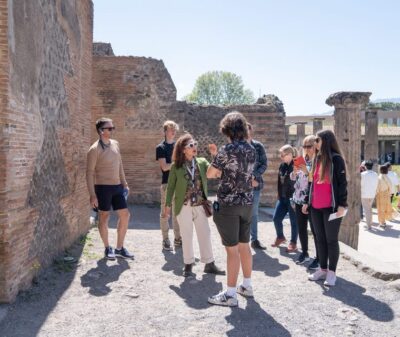
This skip-the-line guided visit makes it manageable, and I like the fact that an archaeologist guide provides context as you walk. You’ll get a headset feed for the commentary, so you aren’t stuck constantly trying to hear over the crowds and traffic of shoes on stone.
One thing to keep in mind: the tour is only about 2 hours, so you’ll see a lot—but not everything. If you want to linger for ages in every forum, villa, or side street, you’ll still need extra independent time before or after.
In This Review
- Key things to know before you go
- Pompeii feels huge—this ticket-and-guide combo keeps it fair
- The 2-hour walk: what you’ll see (and what you’ll miss)
- Where to meet: Piazza Esedra is correct, but you must be on time
- How headsets and small-group pacing change everything
- Pompeii facts you’ll actually use during your walk
- Price and value: $64.89 is not cheap, but it can be smart
- Who should book this tour—and who may want a different plan
- Should you book this Pompeii guided tour?
- FAQ
- Is admission to the Pompeii archaeological area included?
- Does the tour include a guided visit and how long is it?
- Will I be able to hear the guide clearly?
- Is Villa dei Misteri included in this tour?
- Where does the tour start and end?
- Is hotel pickup included?
Key things to know before you go
- Skip-the-line admission saves time at the Pompeii entrance.
- Headset audio lets you hear your guide clearly as you move.
- Small group limit (max 20) keeps the pace human.
- 2 hours on-site means a focused route, not a full-day wander.
- Villa dei Misteri is not included, so expect gaps if that’s on your must-see list.
- ID is required for all participants, so don’t travel with the wrong wallet.
Pompeii feels huge—this ticket-and-guide combo keeps it fair
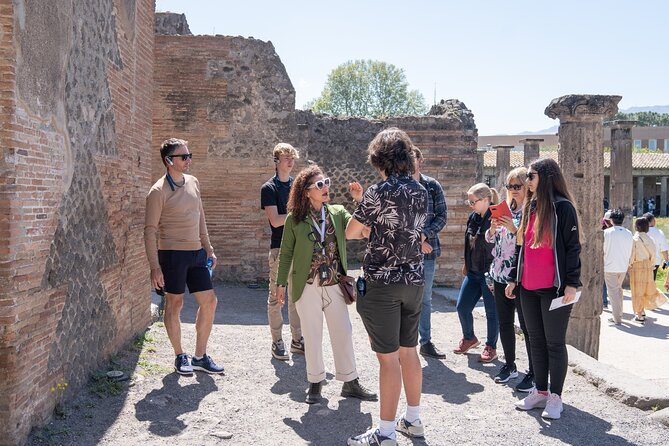
Pompeii is one of those places where “just show up and explore” can turn into a messy day. The ruins sprawl, the paths can be confusing, and it’s easy to bounce between sights without really understanding what you’re looking at. This tour is designed to solve the big problem: access plus interpretation.
You’re also buying something practical: skip-the-line admission. That matters because Pompeii’s entry lines can eat up the first part of your visit, when your energy is highest and you still haven’t found your rhythm. With the guided approach, that time is less likely to vanish into queues.
And I like that the guide isn’t just talking vaguely about “old Rome.” The tour is led by an archaeologist, which usually means the explanation is anchored to what the site can actually show you—construction details, how spaces were used, and what preservation can (and can’t) tell us. In a place where everything is broken, layered, and buried, that kind of framing helps.
That said, you’re still in Pompeii. Stones don’t magically get smaller, and you won’t see everything in two hours. Think of this as the fast, smart foundation for a later, deeper wander.
More ways past the ticket queue
- Skip the Line Guided Tour of Pompeii led by an Archaeologist
★ 5.0 · 703 reviews - Pompeii Private Tour with an Archaeologist and Skip The Line – 3 hours
★ 5.0 · 564 reviews - Pompeii Skip-the-line Tour with Archaeologist Guide
★ 5.0 · 559 reviews
The 2-hour walk: what you’ll see (and what you’ll miss)
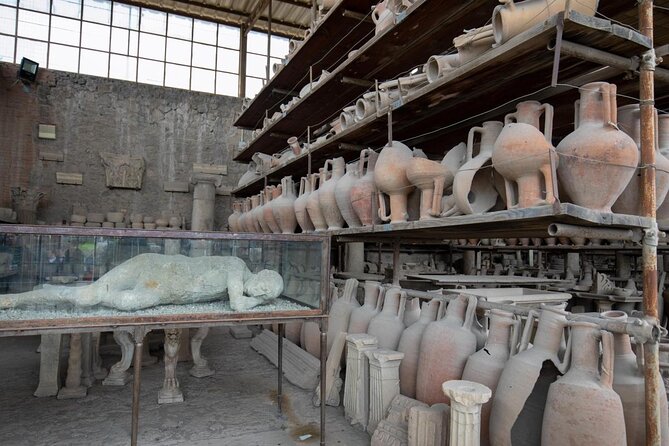
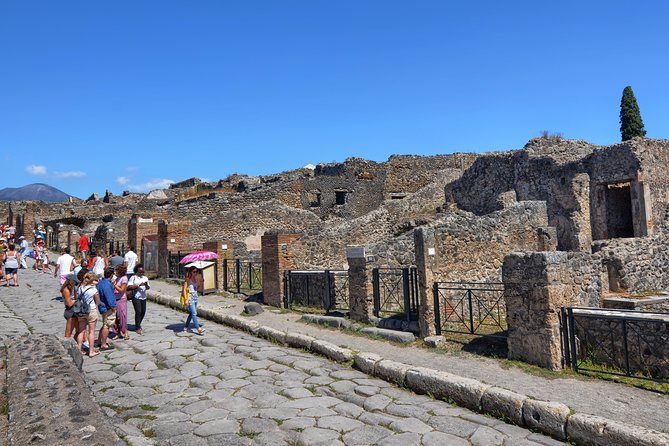
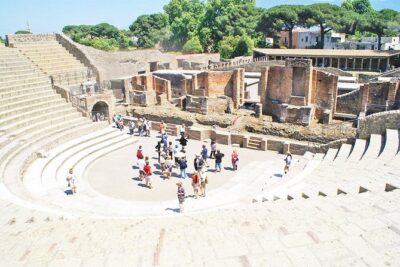
The on-the-ground goal here is a “highlights plus meaning” route through Pompeii Archaeological Park. You’ll move through preserved remains of buildings, artworks, artifacts, and even people frozen in time by the volcanic disaster. That description isn’t just dramatic marketing language—Pompeii is known for the way ash preserved textures and shapes that let guides point out real human-scale details.
In the better moments of this kind of tour, you come away with recognizable anchors:
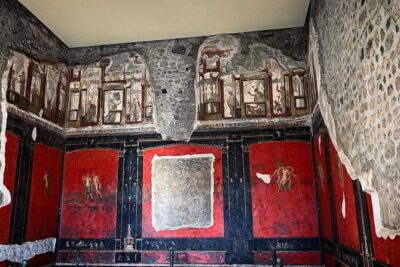
- frescos and painted surfaces people use to understand everyday life
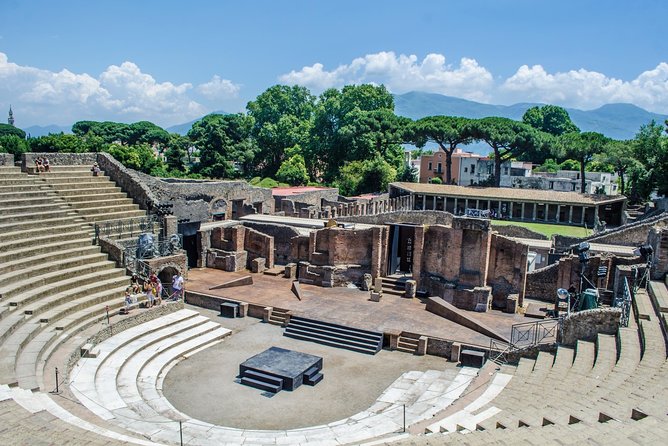
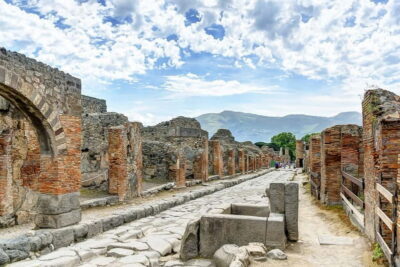
- preserved construction and layout that explain how houses and public spaces worked
- practical features people often miss when they’re rushing (like systems tied to daily water use)
You also get a real advantage from being in a group with audio: the guide can point at things while you’re still moving, instead of stopping every minute for people to catch up or to argue about what they’re seeing.
Now for the part you need to plan around: Villa dei Misteri is not included. That means if you have your heart set on that specific villa, you’ll likely need a separate plan before or after your guided session.
Also, one of the negative experiences tied to this tour format is simple: if the guide’s pacing or approach doesn’t match your expectations, the tour can feel like you skim past what you wanted most. The site is wide, so you’ll want a guide who explains and shows rather than only lecturing. The good versions of the tour are the ones where the guide actively points things out—frescos, bake ovens, and water-related features were specifically praised in past feedback.
Where to meet: Piazza Esedra is correct, but you must be on time
This tour starts and ends back at the meeting spot: Piazza Esedra, 11, 80045 Pompei NA, Italy. I consider that detail important because the most common failure mode for short guided tours is missing the start window—not because Pompeii is hard, but because meeting points can be awkward in real life.
The instructions are clear: arrive 15 minutes early. Do not treat that as a suggestion you can ignore. If you’re coming by public transportation, give yourself a buffer for walking time once you get near the area.
Another practical item: ID is required for all participants. If you forget it, you can end up delaying your group or getting turned away. This is one of those rules that’s easy to overlook until it becomes your problem.
And because this is a small-group experience (max 20 travelers), missing the correct meeting moment usually isn’t solved by waiting around. Short tours depend on everyone syncing up.
How headsets and small-group pacing change everything
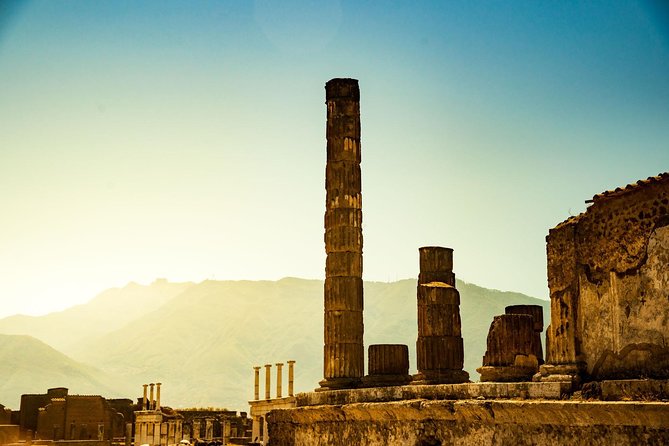
One of the strongest features here is the headset. Pompeii has its own soundscape: footsteps, people talking, and the occasional burst of noise when the group pauses. Without headsets, you spend half your time trying to hear instead of watching.
With headsets, you get a cleaner rhythm:
- the guide can keep moving while explaining
- you can look at details while still understanding the story
- you can ask questions without the whole group losing the audio thread
I also like that you’re not in a massive herd. With a maximum of 20, you usually get better control over the flow—your guide can pause, regroup, and handle the practical stuff without turning the tour into a line march.
You also receive a city map and Wi-Fi. Wi-Fi isn’t the reason to book, but it can help if you want to check your bearings or confirm the next step while you’re onsite.
A small caution from past experiences: some guides focus heavily on very technical points. One example mentioned a long explanation tied to rainwater collection systems and even Latin pronunciation. That can be fascinating if that’s your style, but if you prefer more story and human detail, you’ll want to ask for everyday-life connections early in the tour so the tone matches what you want.
Pompeii facts you’ll actually use during your walk
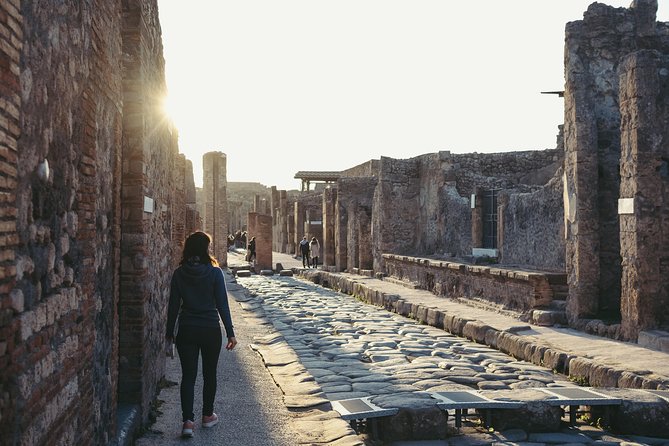
Pompeii is often sold as a spectacular ruin, but the best guided tours help you “read” what you’re seeing. Here are the kinds of things this tour approach is built to deliver, based on what the guide is tasked to cover and what good sessions have highlighted.
First, the disaster context matters. You’ll hear how Pompeii’s key feature is that it’s not just ruins—it’s a place that was buried under superheated ash in a way that preserved structures and impressions. When your guide ties a wall, a doorway, or a public space to that moment, the site stops feeling like random piles of stone.
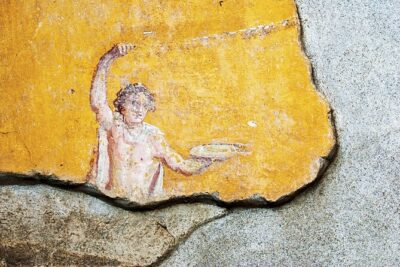
Second, the tour is designed to point out preserved construction and artworks. Frescos, for example, aren’t just decoration; they’re clues to themes residents cared about—status, myth, daily visual culture. Bake ovens and other domestic features help you understand that this wasn’t a museum town. People cooked, worked, and lived here.
Third, you’ll get help with the “what is this for?” questions that show up everywhere in Pompeii. Water systems can be a perfect example. One positive account highlighted water-related elements (including what was described as water sisters). Even if your interpretation differs, the point is the same: the guide can connect practical infrastructure to daily life, instead of leaving you to guess.
Finally, you get real two-way travel value from commentary. When the guide is active and approachable, it’s easy to ask follow-ups and get answers on the spot. That’s the difference between walking through a site and learning how to look at it.
More tickets to the site



Price and value: $64.89 is not cheap, but it can be smart
At $64.89 per person for about 2 hours, you’re paying for more than entry. You’re paying for:
- a skip-the-line ticket
- a guided interpretation session
- headsets, plus a city map
- a small group setup (max 20)
If you were to do Pompeii totally DIY, you’d save money on the guide. But DIY has a cost too: you spend time figuring out what to prioritize, and you might miss the context that makes the ruins click.
So the value question becomes simple:
- If Pompeii is your first major ruin stop and you want the fast orientation that makes later exploring easier, this price can be fair.
- If you already know Pompeii well and prefer to move at your own pace for longer than two hours, you might decide you’d rather spend the money on extra self-guided time or a different add-on.
Also, because Villa dei Misteri is not included, you may need a separate strategy if that villa is part of your personal checklist. That can affect the true value—what you’re buying is a guided highlights route, not a complete Pompeii package.
Who should book this tour—and who may want a different plan
This tour is a strong fit if:
- you want an English-speaking archaeologist guide
- you’d rather spend your energy looking and learning than solving logistics at the gate
- you like group pacing but still want the group to stay small
- you appreciate explanations delivered through headsets
It may not be the best match if:
- you hate structured timelines and want to roam until your feet stop working
- your must-see list is heavy on a specific add-on like Villa dei Misteri
- you’re highly sensitive to tour approaches. One past experience described a guide who did not show the visitor the key sights and focused on a very narrow technical topic. The site is too visual for that to work for everyone, so it’s smart to set your expectations around what a “guided highlight” should feel like.
One more practical tip: because the tour ends back at the meeting point, consider arriving early and planning a bit of extra time after you finish, so you can correct the itinerary in your own way—especially if there’s a fresco, courtyard, or street corner you want to linger near once you know what you’re looking at.
Should you book this Pompeii guided tour?
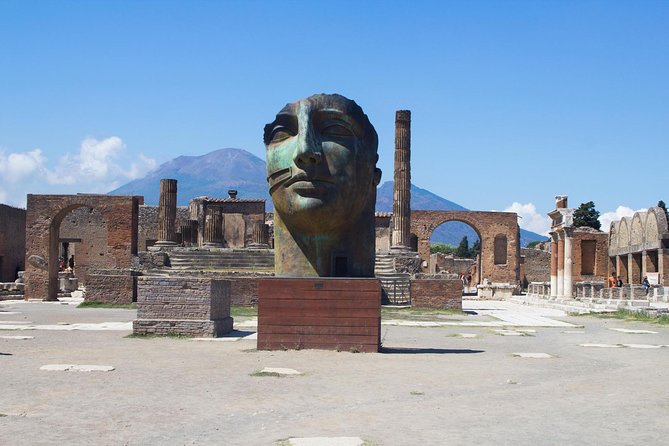
If your goal is to hit Pompeii hard and smart in a short window, I’d book it. The skip-the-line entry plus headset-guided commentary is the core win, and the small group size helps keep the experience workable.
But do yourself a favor: show up early to Piazza Esedra, 11, bring your ID, and set expectations that this is a two-hour highlights route, not the full park. If you’re the type who wants Villa dei Misteri included, plan that separately before you go.
If you meet those basics, this is the kind of Pompeii day that feels like learning, not just walking.
FAQ
Is admission to the Pompeii archaeological area included?
Yes. Your ticket to the Pompeii archaeological area is included with the tour price.
Does the tour include a guided visit and how long is it?
It includes a guided tour for about 2 hours.
Will I be able to hear the guide clearly?
Yes. You’ll receive headsets so you can hear the guide’s commentary throughout the tour.
Is Villa dei Misteri included in this tour?
No. Entrance to Villa dei Misteri is not included.
Where does the tour start and end?
The tour starts and ends at Piazza Esedra, 11, 80045 Pompei NA, Italy.
Is hotel pickup included?
No. Hotel pickup and drop-off are not included.
More Tickets in Pompeii
- Pompeii Ticket + Tour with Optional Tasting Experience at Pompeii★ 5.0 · 663 reviews
- 2 hours Pompeii Tour with Local Historian – Ticket Included★ 5.0 · 335 reviews
- Pompeii Guided Group Tour with Entry Ticket and Archaeologist★ 4.5 · 269 reviews
- Pompeii 2-hour Private Tour with an Archaeologist-Ticket included★ 5.0 · 181 reviews
- Pompeii: Skip the line ticket (art) + audioguide + map★ 3.5 · 155 reviews
More Tour Reviews in Pompeii
- Pompeii Small Group Tour with an Archaeologist★ 5.0 · 6,593 reviews
- Discover the Ancient Ruins of Pompeii: Day Trip from Rome★ 3.5 · 2,247 reviews
- Pompeii and Herculaneum Small Group Tour with an Archaeologist★ 5.0 · 1,350 reviews
- Skip the Line Guided Tour of Pompeii led by an Archaeologist★ 5.0 · 703 reviews
- Pompeii Ticket + Tour with Optional Tasting Experience at Pompeii★ 5.0 · 663 reviews
Skip-the-Line Entries, More to Book
- Skip the Line Guided Tour of Pompeii led by an Archaeologist★ 5.0 · 703 reviews
- Pompeii Private Tour with an Archaeologist and Skip The Line – 3 hours★ 5.0 · 564 reviews
- Pompeii Skip-the-line Tour with Archaeologist Guide★ 5.0 · 559 reviews
- Pompeii Private Tour with an Archaeologist and Skip The Line★ 5.0 · 391 reviews
- Complete Pompeii Skip the Line Tour with Archaeologist Guide★ 4.5 · 379 reviews
Just reviewed: more Pompeii tours and day trips






Pompeii Skip-the-Line Entry, compared.
 ★ 4.0Skip-the-Line Entrance Ticket with Audio GuideFrom $392,509 reviews
 ★ 4.6Skip-the-line-Ticket and Guided TourFrom $641,152 reviews
 ★ 4.9Guided Tour with Skip-the-Line EntryFrom $58812 reviews
 ★ 4.1Skip-the-Line Entry Ticket with Digital Guide AppFrom $22770 reviews
 ★ 4.9Pompeii Ruins Private Tour with Optional Skip-the-Line EntryFrom $254732 reviews
 ★ 5.0Skip the Line Guided Tour of Pompeii led by an ArchaeologistFrom $95703 reviews
 ★ 5.0Pompeii Private Tour with an Archaeologist and Skip The Line – 3 hoursFrom $302564 reviews
 ★ 5.0Pompeii Skip-the-line Tour with Archaeologist GuideFrom $71559 reviews
Browse the lists this tour appears in