
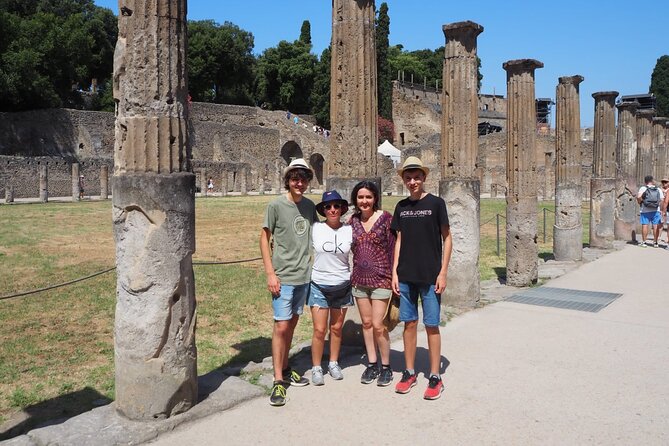
Reviewed · POMPEII ARCHAEOLOGIST-LED TOURS
2 Hours Pompeii Group Tour with Archaeologist Guide and Skip the Line
Pompeii hits different when someone reads it aloud. This 2-hour guided walk zeroes in on the town’s most recognizable sights, with an archaeologist guide to explain what you’re seeing as you go. I especially like the skip-the-line setup for buying your entrance tickets on site, so you spend less time stuck at the ticket window.
I also like the pacing and group size: it runs as a maximum of 15 people, which usually keeps questions flowing and prevents that herd-to-the-next-stop feeling. The guide approach leans on story + street-level context, and past groups have been led by archaeologist guides like Mariagrazia, Luciana, and Luisa (with the provider listed as Eliana Sandretti).
One possible drawback: you still pay the Pompeii entrance ticket separately (18 euros for adults, free for minors with an ID card), and the whole experience is only about two hours—so you cannot linger at every wall.
In This Review
- Key highlights worth planning for
- Skip-the-Line Entry at Ristorante Suisse in Piazza Esedra
- Two Hours in Pompeii: Why This Short Tour Works (and when it won’t)
- Vicolo di Gladiatori and Fullonica di Stephanus: Gladiators, Work, and Roman Routine
- Tempio di Giove Capitolino and the Odeon/Teatro Piccolo: Religion and Music in the Same City
- Teatro Grande and Casa del Menandro: Big Stage Drama Meets Fresco-Filled Luxury
- Lupanar and Temple of Venus: The City’s Tougher Stories in Real Space
- Basilica, Shop Streets, and the City Market: Pompeii as a Place of Work
- Stabian Baths and Pompeii 3D: Water, Everyday Comfort, and a Quick Reality Check
- Price and Value: What You’re Paying For (and What’s Not Included)
- Who This Tour Fits Best
- Should you book this 2-hour Pompeii guided tour?
- FAQ
- What’s included in the Pompeii 2-hour group tour?
- Where do we meet for the tour?
- Do I need to buy an entrance ticket?
- Is the tour offered in English?
- How long is the tour?
- How big is the group?
- What if the weather is bad?
Key highlights worth planning for
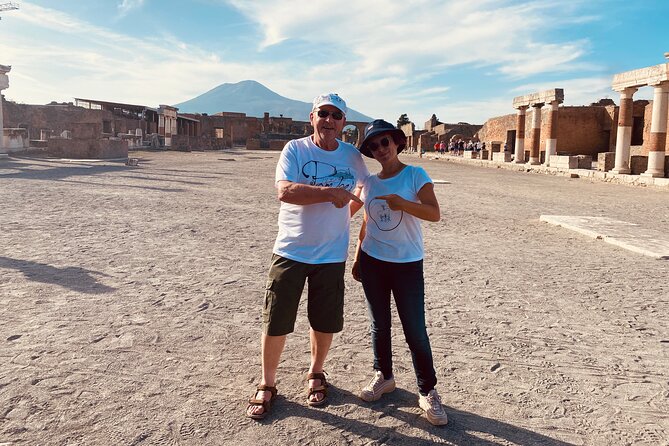
- Skip-the-line ticket purchase saves time at the ticket office, not just the gate
- Max 15 people keeps the tour manageable and easy to follow
- A tight circuit of major Pompeii landmarks in about two hours
- Frequent “what you’re looking at” explanations for frescoes, baths, theaters, and more
- Mobile ticket + English guide makes coordination simpler
- Outdoor walking between clusters of sites means comfortable shoes matter
Skip-the-Line Entry at Ristorante Suisse in Piazza Esedra
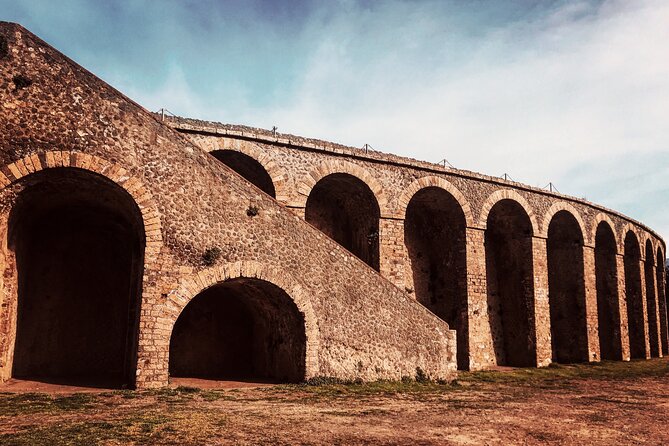
The tour starts at Ristorante Suisse, at Piazza Esedra (meeting point: 10/13). Getting your bearings here is half the battle, because Pompeii is huge and signage can feel chaotic when you’re arriving hot, tired, and hungry.
The real time-saver is the skip-the-line part. This tour is designed to help you get your entrance ticket without losing time in the long queue at the ticket office. That matters because Pompeii days often start with crowds at the gate area. When the line is long, you can lose the best part of your trip—your energy.
Also note the ticket basics. The entrance ticket costs 18 euros per adult and minors are free, but minors must bring an identity card. The tour itself does not include the entrance fee, so you’ll want to budget for that extra cost when you compare value.
More ways past the ticket queue
- Skip the Line Guided Tour of Pompeii led by an Archaeologist
★ 5.0 · 703 reviews - Pompeii Private Tour with an Archaeologist and Skip The Line – 3 hours
★ 5.0 · 564 reviews - Pompeii Skip-the-line Tour with Archaeologist Guide
★ 5.0 · 559 reviews
Two Hours in Pompeii: Why This Short Tour Works (and when it won’t)
This is an approx. 2-hour tour, and it moves. That sounds obvious, but it’s the key to understanding whether this fits you.
In a short guided loop, you get:
- a fast orientation to Pompeii’s layout
- a curated set of “main attraction” stops
- just enough time at each place to learn what to notice
That’s a big deal in Pompeii, where it’s easy to look at walls and think, Cool, but… now what? The guide helps you connect street-level features—like an ancient theater’s structure, or a bath’s surviving details—to daily life and social status.
The catch is also simple: two hours is not enough to read everything deeply. If you want long photo sessions, slow browsing, or time to sit with one mosaic for 20 minutes, you may feel rushed. If you’re visiting for the first time, though, this kind of short, structured tour is often the best way to get your bearings fast.
Group size is capped at 15, and that tends to make a difference. Smaller groups usually mean the guide can steer you around congestion and keep everyone together without constant repeating.
Vicolo di Gladiatori and Fullonica di Stephanus: Gladiators, Work, and Roman Routine
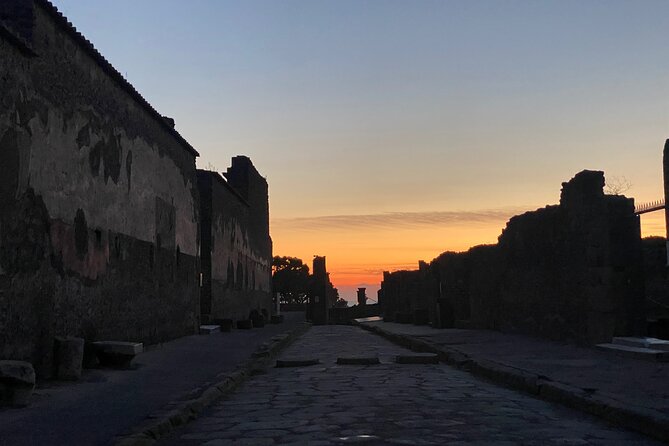
The first stop is Vicolo di Gladiatori, the gladiators’ barracks area—training and fighting ground that still feels intense even centuries after the smoke cleared. Pompeii has a way of mixing spectacle and routine, and this spot is a good example. You’re not just seeing “old buildings.” You’re standing in a place built for training, discipline, and performance.
Next comes Fullonica di Stephanus, famous as Pompeii’s laundry site. A fullonica was for washing clothes and roughing fabrics, and this stop helps you understand that Roman life wasn’t only about villas and banquets. Clothes mattered, materials mattered, and labor mattered. Even without going deep into chemistry, you can connect the space to a real job that would have been everywhere in a working town.
What I like about these two stops is the variety. You jump from a dramatic world (gladiators) to an everyday one (laundry). That keeps Pompeii from turning into a one-note experience.
Potential drawback here: you’ll only get around 10 minutes at each stop. So, if you plan to photograph everything in full resolution, factor in the time it takes to find the exact angle your camera needs.
Tempio di Giove Capitolino and the Odeon/Teatro Piccolo: Religion and Music in the Same City
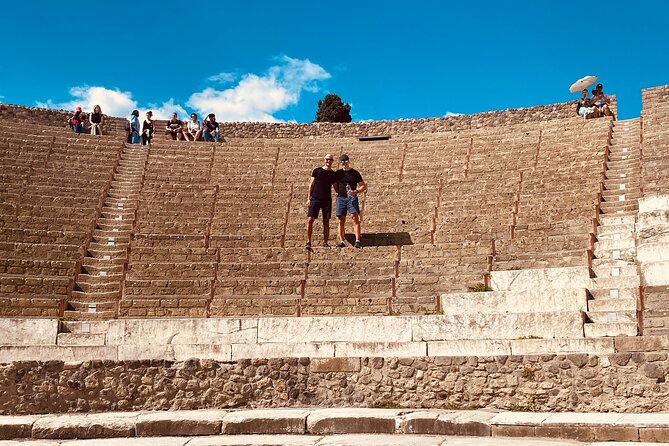
Then you move to Tempio di Giove Capitolino, the temple of Jupiter in the larger forum area. This temple is one of Pompeii’s symbols, and what makes it important is its location: religious worship tied into the daily flow of civic life.
Roman public space wasn’t neatly divided into religion vs. commerce vs. politics. In the forum area, mornings involved mercantile activity and cult activities side by side. That’s the kind of detail that helps your brain stop treating Pompeii like a museum display and start treating it like a city.
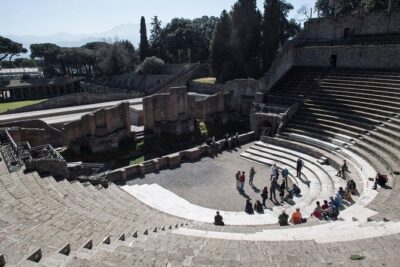
After that, the tour visits the Odeon—Teatro Piccolo, used for musical events. The neat part is that musical instruments have been found connected to this theater, and parts of the structure can still be visited. It’s a reminder that performances weren’t only big-stage spectacle. Smaller cultural events had a place too.
My advice: when you’re standing in these religious and performance spaces, look for the relationship between the space shape and the crowd. Even if you don’t know Roman architecture terms, you can usually guess how people gathered and where attention would have gone.
Teatro Grande and Casa del Menandro: Big Stage Drama Meets Fresco-Filled Luxury
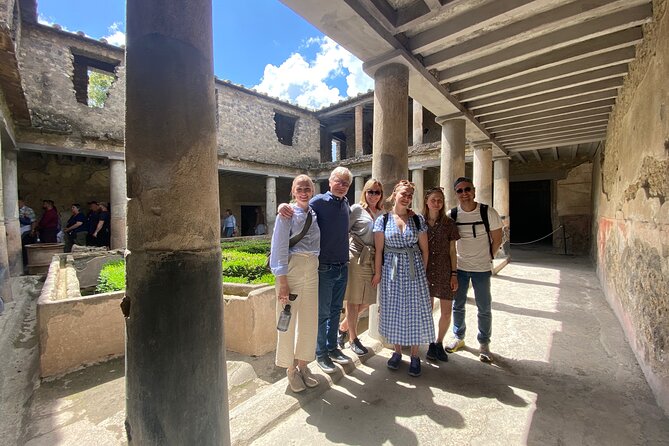
Next up is Teatro Grande, the largest theater in Pompeii. It hosted dramas and theatrical comedies, and it was renovated with grants from the Gens Holconia—an important reminder that elite families helped shape public life.
This stop pairs well with the earlier Odeon because it shows range. Pompeii could do small music gatherings and also major staged drama. The scale also makes it easier to imagine crowds arriving, looking for seats, and watching the performance with the full town as an audience.
From there, you step into Casa del Menandro, a luxury residence known for frescoes, decorations, and sculptures. This is where Pompeii’s visual language really gets loud. In one place you can shift from civic entertainment to private status and taste.
Why it’s valuable: theaters explain public culture; houses explain social culture. Together, they show you that Pompeii wasn’t only a place where people watched or worked. It was also a place where people displayed identity inside their homes.
Time is short at about 15 minutes for the house, so focus on the biggest fresco areas and the main decorative elements you see from where the route puts you.
More of the site walked with an archaeologist

Lupanar and Temple of Venus: The City’s Tougher Stories in Real Space
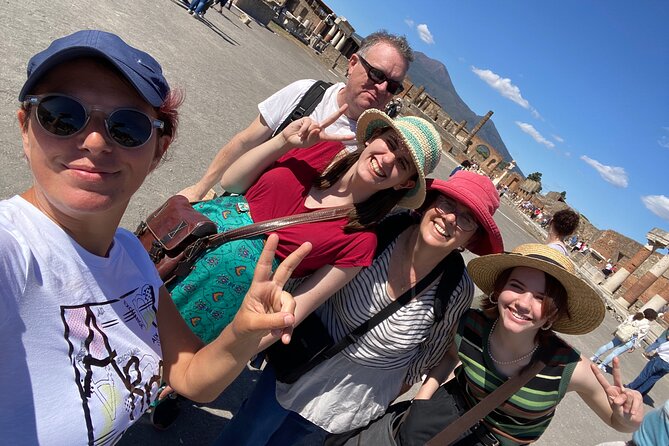
The Lupanar is one of the best-known stops in Pompeii because it’s infamous. It was a brothel, and you can see original frescoes with scenes tied to sexual themes. That makes this stop heavy in subject matter, but it also makes it honest. This is part of how Pompeii tells the full story of everyday life, including what polite history often hides.
Right after, the tour includes a look at the Temple of Venus, partly destroyed during World War II. Even that detail matters. Pompeii is not only about the eruption—it’s also about what happened in modern times and how destruction and restoration shape what we see today.
If you’re squeamish, it helps to know this stop is part of the standard route. You don’t have to dwell on it, but you should be prepared for the tone.
Basilica, Shop Streets, and the City Market: Pompeii as a Place of Work
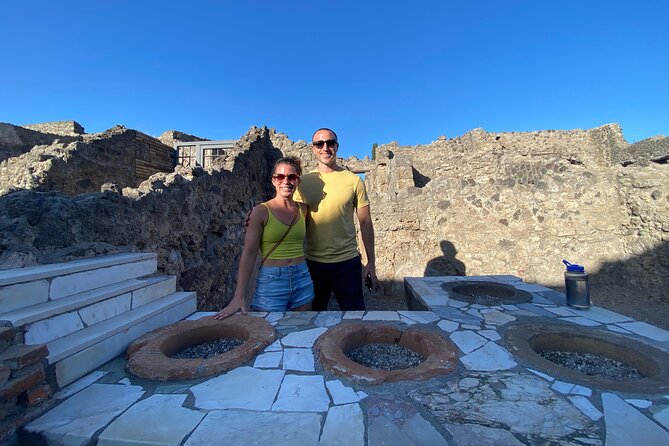
Next comes Pompei La Basilica, where justice was administered near the main square. This stop helps you understand Pompeii as a functioning legal and civic hub, not just a tragic ruin with tourist-friendly highlights.
After that, you’ll walk along the street full of shops—the main street of the archaeological site. You’ll also pass another street within the complex, giving you a better sense of how commerce moved through everyday pedestrian routes.
Then the tour heads to the city market near the large forum. The key idea here is resale. Large purchases of goods would be made with the plan to resell them in shops. That’s a practical detail that makes the market feel real instead of abstract.
And the tour also includes the Temple of the Apollo deities, one of the most popular in Pompeii. Put together, this cluster shows you how religious spaces and commercial spaces were close neighbors. In a Roman city, that closeness wasn’t accidental. It was how the city ran.
A quick strategy: on shop and market streets, don’t just look at the storefronts. Notice the street width and where people would naturally slow down. That’s how you picture trade in motion.
Stabian Baths and Pompeii 3D: Water, Everyday Comfort, and a Quick Reality Check
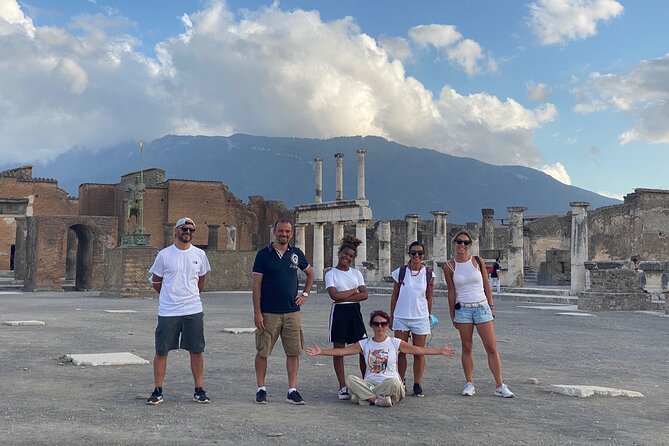
The final major outdoor stop is the Stabian Baths (Terme Stabiane). This is special because they are among the earlier baths in Pompeii and still show surviving casts and frescoes. Baths were a social routine, not just hygiene—so learning to read what remains here helps you imagine daily comfort in a way a photo alone cannot do.
After the baths, the tour includes a short visit connected to Pompeii 3D, titled Bodies of Pompeii. The time is brief (around 5 minutes), but it gives you a quick way to connect the town to the people affected by the eruption, and that kind of visual framing can make the site feel more human.
Then you return around the broader route and end back at the meeting point.
If you want to photograph anything before you leave, put your “must-have” shots early. Outdoor walking, sunlight changes, and crowds can affect your timing, and this tour keeps moving.
Price and Value: What You’re Paying For (and What’s Not Included)
The tour price is $132.03 per person, and the Pompeii entrance ticket is separate at 18 euros for adults (free for minors with ID). That means your real total cost depends on your entrance ticket, but the big value is the structure you buy: an archaeologist guide, a short time window with a clear route, and skip-the-line help for ticket purchase.
So is it good value? For many first-timers, yes, because Pompeii can be overwhelming alone. A guided route that hits theaters, houses, baths, and civic spaces helps you interpret what you see. You end up leaving with a coherent mental map, not just a collection of cool ruins.
What you don’t get: unlimited time at each stop. This isn’t designed for slow wandering. It’s designed for understanding quickly and moving through the highlights efficiently.
Also: this is offered in English, and it’s a group tour with a maximum of 15 people. That small size is part of the price justification. Bigger groups can turn Pompeii into a hurry-up-and-point experience.
Who This Tour Fits Best
This tour is a strong match if:
- you’re visiting Pompeii for the first time and want the main sights in a tight timeframe
- you prefer a guided explanation over reading everything yourself
- you want to reduce time lost in ticket lines
- you like variety: gladiators, laundry, theaters, a luxury house, a brothel, baths, and civic spaces
It may not fit as well if:
- you want to spend lots of time at fewer places
- you hate any “fixed schedule” feeling
- you want a deep archaeological lecture at one site
Should you book this 2-hour Pompeii guided tour?
If you want a smart first pass through Pompeii, I think this is an easy yes. The skip-the-line ticket purchase helps you protect your time, and the short guided circuit gives you context across the city instead of leaving you stuck interpreting fragments.
I’d book it especially if you like learning through stories while you walk, because the guide approach here is built for turning the ruins into something you can actually picture—training arenas, laundry work, theater life, justice, baths, and daily commerce. Just be honest with yourself about pacing: two hours is enough for orientation and highlights, not enough for slow deep soaking. If that sounds right, this tour is a solid way to make your Pompeii day count.
FAQ
What’s included in the Pompeii 2-hour group tour?
The tour includes an archaeologist tourist guide and assistance for the full duration, skip-the-line access to purchase tickets on site, and a group tour (maximum 15 people) covering main attractions. The Pompeii entrance ticket is not included.
Where do we meet for the tour?
You meet at the main entrance of Ristorante Suisse in Piazza Esedra (address listed as 10/13, 80045 Pompei NA, Italy). The tour ends back at the meeting point.
Do I need to buy an entrance ticket?
Yes. The Pompeii entrance ticket costs 18 euros per person for adults and is free for minors. Minors must bring an identity card.
Is the tour offered in English?
Yes. The tour is offered in English.
How long is the tour?
It lasts about 2 hours.
How big is the group?
The tour is a group experience with a maximum of 15 travelers.
What if the weather is bad?
This experience requires good weather. If it’s canceled due to poor weather, you’ll be offered a different date or a full refund.
More Tour Reviews in Pompeii
- Pompeii Small Group Tour with an Archaeologist★ 5.0 · 6,593 reviews
- Discover the Ancient Ruins of Pompeii: Day Trip from Rome★ 3.5 · 2,247 reviews
- Pompeii and Herculaneum Small Group Tour with an Archaeologist★ 5.0 · 1,350 reviews
- Skip the Line Guided Tour of Pompeii led by an Archaeologist★ 5.0 · 703 reviews
- Pompeii Ticket + Tour with Optional Tasting Experience at Pompeii★ 5.0 · 663 reviews
More Tours Led by an Archaeologist
- Pompeii Small Group Tour with an Archaeologist★ 5.0 · 6,593 reviews
- Pompeii and Herculaneum Small Group Tour with an Archaeologist★ 5.0 · 1,350 reviews
- Skip the Line Guided Tour of Pompeii led by an Archaeologist★ 5.0 · 703 reviews
- Pompeii Private Tour with an Archaeologist and Skip The Line – 3 hours★ 5.0 · 564 reviews
- Pompeii Skip-the-line Tour with Archaeologist Guide★ 5.0 · 559 reviews
Skip-the-Line Entries, More to Book
- Skip the Line Guided Tour of Pompeii led by an Archaeologist★ 5.0 · 703 reviews
- Pompeii Private Tour with an Archaeologist and Skip The Line – 3 hours★ 5.0 · 564 reviews
- Pompeii Skip-the-line Tour with Archaeologist Guide★ 5.0 · 559 reviews
- Pompeii Private Tour with an Archaeologist and Skip The Line★ 5.0 · 391 reviews
- Complete Pompeii Skip the Line Tour with Archaeologist Guide★ 4.5 · 379 reviews
Just reviewed: more Pompeii tours and day trips




Pompeii Archaeologist-Led Tours, compared.
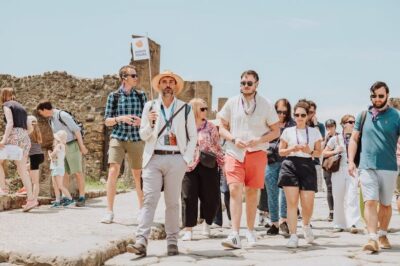 ★ 4.8Entry Ticket and Guided Tour with an ArchaeologistFrom $3519,459 reviews
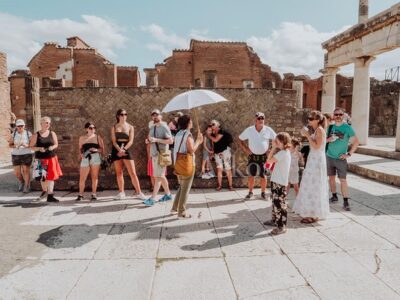 ★ 4.8Small Group Tour with an ArchaeologistFrom $4012,264 reviews
★ 5.0Pompeii Small Group Tour with an ArchaeologistFrom $356,593 reviews
★ 4.8Small Group Tour with an ArchaeologistFrom $4012,264 reviews
★ 5.0Pompeii Small Group Tour with an ArchaeologistFrom $356,593 reviews
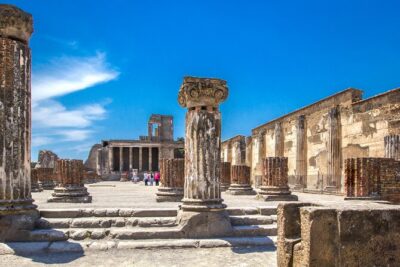 ★ 5.0Pompeii and Herculaneum Small Group Tour with an ArchaeologistFrom $771,350 reviews
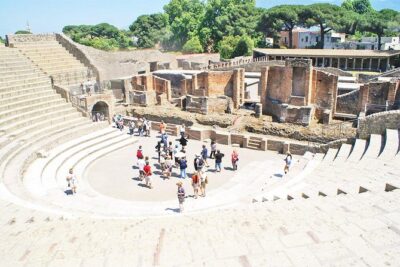 ★ 5.0Skip the Line Guided Tour of Pompeii led by an ArchaeologistFrom $95703 reviews
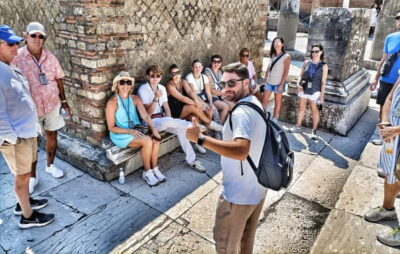 ★ 4.9Exclusive Tour with Archaeologist and Entry TicketsFrom $50634 reviews
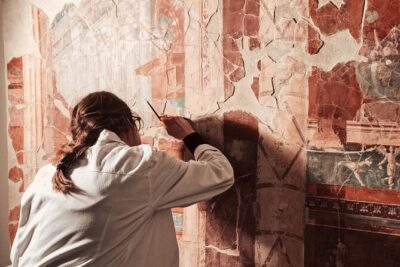 ★ 5.0Pompeii Private Tour with an Archaeologist and Skip The Line – 3 hoursFrom $302564 reviews
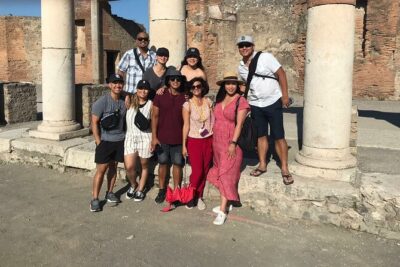 ★ 5.0Pompeii Skip-the-line Tour with Archaeologist GuideFrom $71559 reviews
Browse the lists this tour appears in