
Reviewed · POMPEII SKIP-THE-LINE ENTRY
Skip-the-Line Best of Pompeii in one Day Tour w Local Guide & new opened houses
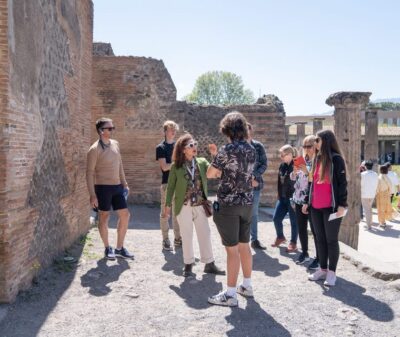
Pompeii works best with a plan. This skip-the-line Pompeii experience pairs fast entry with a local guide (Lello & Co.) who explains what you’re looking at as you walk.
Two big things I like for your visit: you get real interpretation at multiple key sites, and the route keeps you moving through Pompeii’s most important stops without getting stuck in ticket chaos. You’ll spend about four hours on-site (give or take), which is a good match for seeing a lot without turning it into a marathon.
One consideration: it’s still a walking tour through uneven ancient ground, so you’ll want moderate physical fitness and comfy shoes before you go.
In This Review
- Key things that make this Pompeii tour worth your time
- Skip-the-line Pompeii feels like a different day
- Who guides you at Pompeii: Lello & Co. and an art historian
- How long you really have: about 4 hours, with plenty of breathing room
- Meeting at Coffee Shop Vittoria: start and end where you begin
- From UNESCO Pompeii to the eruption story: where the tour begins
- Via dell’Abbondanza: Pompeii’s main street walk, step by step
- Foro de Pompeya: the Forum and Pompeii’s civic center
- Stabian Baths (Terme Stabiane): thermal life, households, and the Lupanare context
- Value check: $396.08 per person and what you’re buying
- Who this Pompeii tour is best for
- Small details that make the day go smoother
- Should you book this Pompeii tour?
- FAQ
- How long is the Pompeii tour?
- Is skip-the-line access included?
- What language is the tour offered in?
- Where do I meet for the tour?
- What sites do we visit?
- Is hotel pickup or drop-off included?
- Is this tour private?
- Does the tour include tickets?
- Can children join?
Key things that make this Pompeii tour worth your time
- Skip-the-line access to cut the biggest time suck at Pompeii
- Lello & Co. local guidance that turns ruins into daily life stories
- Stabian Baths stop with thermal baths, domus areas, mills, and the Lupanare setting
- Via dell’Abbondanza and the Forum for the “main streets + civic center” combo
- A professional art historian guide alongside your local guide
Skip-the-line Pompeii feels like a different day
Pompeii is famous for being well preserved. It’s also famous for lines. What I like about this tour is that it treats your time like it matters. With guaranteed skip-the-line access, you can spend your energy on the city itself instead of waiting at the entrance while the daylight fades.
Another advantage is the way the tour is built around a clear sequence of highlights. Instead of bouncing randomly, you move from the broad Pompeii overview into the main street experience, then the civic heart, then a deeper look at a major complex—the Stabian Baths area. That flow helps you understand how the place functioned, not just what it looked like.
You’re also not dealing with an information overload delivered all at once. The tour is broken into focused chunks, each tied to a specific area you can see in front of you. It’s an efficient way to turn big ruins into something your brain can organize quickly.
More ways past the ticket queue
- Skip the Line Guided Tour of Pompeii led by an Archaeologist
★ 5.0 · 703 reviews - Pompeii Private Tour with an Archaeologist and Skip The Line – 3 hours
★ 5.0 · 564 reviews - Pompeii Skip-the-line Tour with Archaeologist Guide
★ 5.0 · 559 reviews
Who guides you at Pompeii: Lello & Co. and an art historian
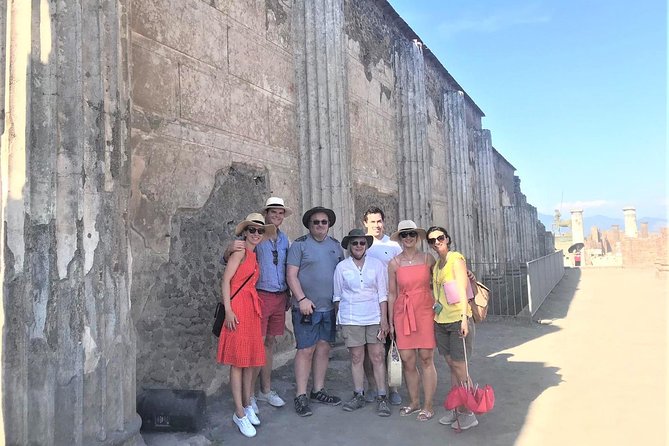
The biggest quality jump on this kind of tour comes down to interpretation. This one uses a local guide from Tours of Pompeii with Lello & Co., plus a professional art historian guide. That pairing matters because Pompeii isn’t only “old stones.” It’s engineering, everyday routines, artwork, and social customs all mashed together.
When you get a local guide like Lello involved, you also tend to get practical explanations—how people moved, how spaces were used, what certain layouts suggest. And with an art historian in the mix, you’re more likely to get clear, visual-minded talk about decorative elements and what they mean.
In other words, you’re not stuck reading signs while everyone else listens. You get help building a mental picture: city streets, public institutions, household spaces, and the systems behind them.
How long you really have: about 4 hours, with plenty of breathing room
The tour is listed at about 4 hours. In practice, you should plan on a day that fits comfortably in your schedule, rather than an all-day Pompeii marathon. The stops are structured so you’re in each major area for roughly an hour, including ticketed access.
That pacing is ideal if you’re trying to see the “best of Pompeii” without losing the plot. You won’t feel like you’re rushing nonstop, but you also won’t wander aimlessly.
If you’re choosing this as part of a larger trip plan, the key takeaway is simple: it’s short enough to stack with other things in the region, but long enough to learn a lot.
Meeting at Coffee Shop Vittoria: start and end where you begin
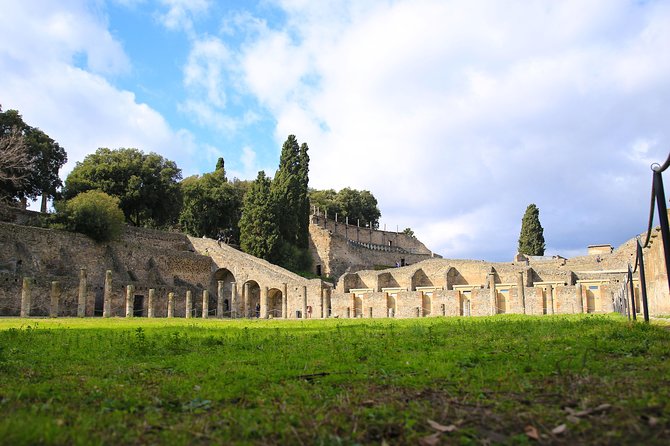
You meet at Coffee Shop Vittoria, Via Mare, 80045 Pompei NA, Italy, and the activity ends back at the same meeting point. That’s helpful because you don’t have to hunt down transportation decisions on arrival.
A tour that returns to the starting area usually means less stress at the end of your time in Pompeii. You can plan your next move with fewer unknowns, whether that’s grabbing lunch nearby or connecting to onward transport.
It also helps you keep your bearings. Pompeii can feel like an endless layout once you’re inside. Starting at a known point, then returning there, keeps logistics from stealing your attention.
From UNESCO Pompeii to the eruption story: where the tour begins
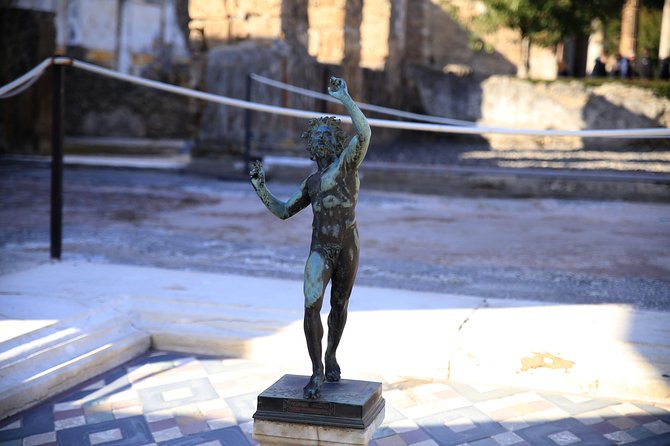
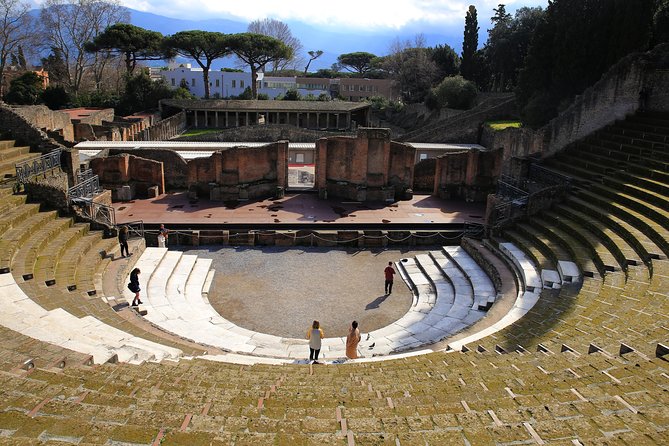
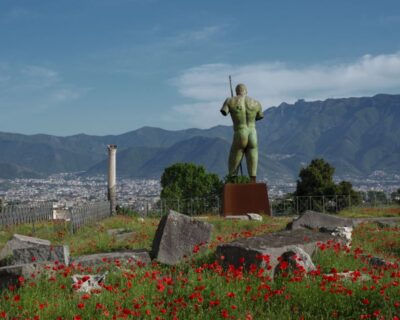
Your first stop is inside Pompeii, framed as a UNESCO World Heritage site. The tour sets the scene with what happened in 79 A.D., when Mount Vesuvius erupted and buried the city under ash and pumice. That context matters because Pompeii is different from most ruins. Here, the city got frozen in time.
Then your guide brings the place to life through the lens of what you can actually see. You’re not just told a date and a fact. You get anecdotes and stories tied to the remains, which is what makes the site easier to remember later.
This beginning block is a strong way to get your eyes calibrated. Before you hit the streets and major public areas, you learn how to read Pompeii—how buildings, street widths, and architectural features connect to daily life.
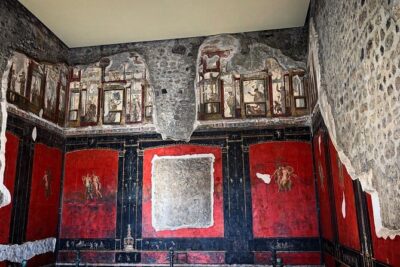
Inside more houses and the Villa of the Mysteries

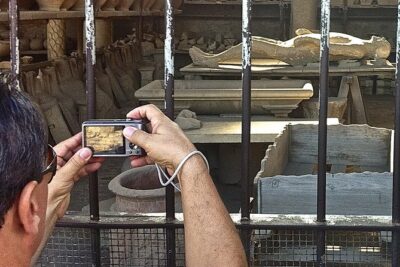
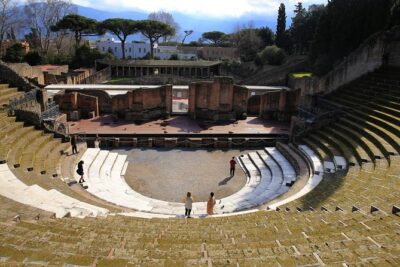
Via dell’Abbondanza: Pompeii’s main street walk, step by step
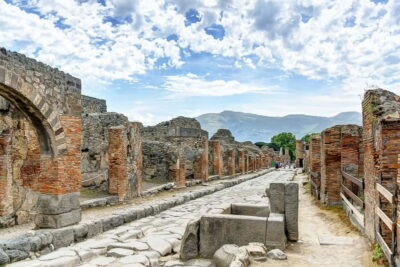
After the opening context, you shift to Via dell’Abbondanza, Pompeii’s main street. This is one of the best places to understand how the city worked at street level.
What I like about this stop is that it’s built around the idea of walking as the Romans did. You’re not just looking at temples or big set pieces. You’re seeing the arteries of a working town—where commerce, movement, and neighborhood life would have happened.
Also, because it’s a main street, it helps you orient quickly. Once you get the street rhythm, the Forum stop becomes easier to visualize. The city stops feeling like random ruins and starts looking like a designed place.
Practical tip: main streets can get sunny and busy with other visitors. If you’re the type who likes taking photos, it’s easier to do it on a structured walk like this than trying to time your own approach later.
Foro de Pompeya: the Forum and Pompeii’s civic center
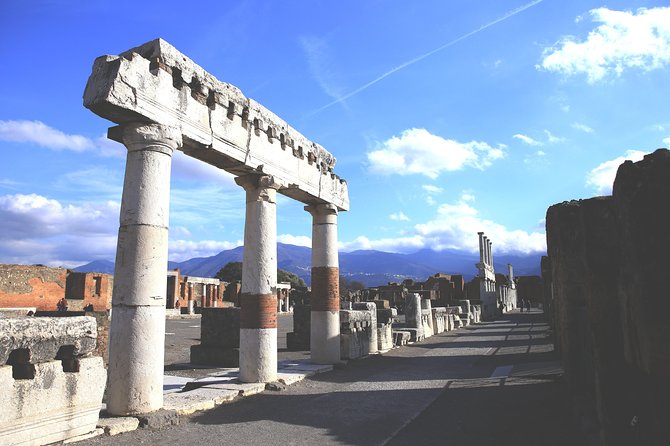
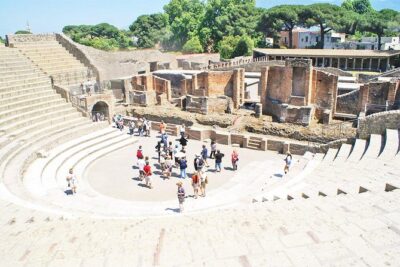
Next comes the Forum (Foro de Pompeya). This is where you get the civic identity of the city—public decision-making, social status, and the feeling of a community center.
A Forum stop is important because it gives you contrast. After walking a main street (more everyday and commercial), you now move into the political and social center. That shift helps you understand how Pompeii layered daily life with formal public spaces.
Your guide’s job here is to connect architectural fragments to what the space meant. Even when parts are ruined, the layout can still tell you a lot—how people likely gathered, where activities would have clustered, and how authority was displayed.
If you’re the kind of traveler who loves seeing how societies organized themselves, the Forum is one of those stops where the explanation turns the stone into something readable.
Stabian Baths (Terme Stabiane): thermal life, households, and the Lupanare context
The final highlight is Stabian Baths (Terme Stabiane). This is a big deal because it’s not just one room or one building. It’s a complex, and it lets you see Pompeii at a human scale.
Here’s what you can expect to see and discuss in this stop:
- thermal bath spaces and the idea of bathing as daily routine
- nearby domus areas (household connections)
- a gladiators’ gym setting
- mills (how grinding and food-related work tied into the complex)
- the Lupanare, known for its erotic frescoes, and the social atmosphere around it
Why this stop is so valuable: baths were a major hub. They weren’t only about hygiene. They were meeting places, status signals, and part of the social rhythm. When the tour explains how these spaces worked, you get a more complete picture of Pompeii as a lived-in city rather than a dead snapshot.
Also, the Stabian Baths stop is where Pompeii’s contradictions show up in a way that feels real. You’ll hear about leisure and public life alongside the more adult details connected to the Lupanare. That mix is part of Pompeii’s honesty.
One consideration: some travelers may find the Lupanare topic uncomfortable. The tour is built around historical interpretation, so you’ll hear context, not just shock value.
Value check: $396.08 per person and what you’re buying
At $396.08 per person, this isn’t a budget tour. But Pompeii tours aren’t cheap for a reason—site entry, guide time, and time-saving logistics add up fast.
Here’s what you get for the money that can justify it:
- Guaranteed skip-the-line access, so you’re not losing hours to queues
- a local guide from Lello & Co plus a professional art historian guide
- ticketed admission for each major stop listed
- a structured route covering multiple top Pompeii areas in about 4 hours
- a private tour setup where it’s described as only your group participating
If you’re comparing to a DIY day, the question becomes: do you want to spend your scarce hours figuring out what to see and how to connect it? If you’d rather arrive already knowing what each location is telling you, this price can feel more reasonable.
If you’re traveling as a pair or small group, it also often lands in a sweet spot. The guide attention stays high, but the per-person cost doesn’t explode the way some fully private options do.
Who this Pompeii tour is best for
This tour fits best if you want:
- the strongest Pompeii highlights without turning it into a whole-day grind
- explanations that cover engineering, art, engineering-adjacent daily life, and customs
- skip-the-line help so you get maximum time inside
It may not be ideal if you want total freedom to wander off for long periods, because the route is structured around key stops and timing.
It’s also not a great match for anyone who can’t handle uneven outdoor ground. The tour asks for moderate physical fitness, which is common in Pompeii, not a special limitation of this operator.
Small details that make the day go smoother
A few practical things that matter once you’re inside Pompeii:
- Bring comfortable shoes. You’ll be on ancient surfaces and uneven ground.
- Expect the schedule to be tight enough that stopping for long breaks won’t be the focus.
- Use the guide’s pace. If you follow the route closely, Pompeii becomes easier to understand.
- Expect historical talk to include adult themes related to the Lupanare area.
This isn’t about rushing through Pompeii like a checklist. It’s about seeing the right places in the right order so the city clicks.
Should you book this Pompeii tour?
If you want skip-the-line entry, a local guide named Lello (from Tours of Pompeii with Lello & Co.), and a structured, high-impact visit to Via dell’Abbondanza, the Forum, and Stabian Baths, this is a strong choice. The Stabian Baths stop alone tends to deliver real variety, from baths to mills and the Lupanare context, all in one concentrated area.
I’d book it if you’re short on time, care about interpretation, and want fewer unknowns on the ground. I’d think twice if you need a slower pace for mobility reasons or you’d rather roam independently without a guided structure.
FAQ
How long is the Pompeii tour?
It’s listed at approximately 4 hours.
Is skip-the-line access included?
Yes. The tour offers guaranteed skip-the-long-lines access.
What language is the tour offered in?
The tour is offered in English.
Where do I meet for the tour?
The meeting point is Coffee Shop Vittoria, Via Mare, 80045 Pompei NA, Italy, and the tour ends back at the meeting point.
What sites do we visit?
You’ll visit Pompeii with a guided introduction, then Via dell’Abbondanza, the Forum (Foro de Pompeya), and Stabian Baths (Terme Stabiane).
Is hotel pickup or drop-off included?
No. Hotel pickup and drop-off are not included.
Is this tour private?
It’s described as a private tour/activity, meaning only your group will participate.
Does the tour include tickets?
Admission tickets are included for the stops, and you’ll receive a mobile ticket.
Can children join?
Children must be accompanied by an adult, and the tour is designed for travelers with a moderate physical fitness level.
More Tour Reviews in Pompeii
- Pompeii Small Group Tour with an Archaeologist★ 5.0 · 6,593 reviews
- Discover the Ancient Ruins of Pompeii: Day Trip from Rome★ 3.5 · 2,247 reviews
- Pompeii and Herculaneum Small Group Tour with an Archaeologist★ 5.0 · 1,350 reviews
- Skip the Line Guided Tour of Pompeii led by an Archaeologist★ 5.0 · 703 reviews
- Pompeii Ticket + Tour with Optional Tasting Experience at Pompeii★ 5.0 · 663 reviews
More Houses and the Villa of the Mysteries
- Pompeii New Discoveries Private Guided Tour★ 5.0 · 49 reviews
- VIP Pompeii Tour including Newly Opened Houses With Archaeologist★ 5.0 · 33 reviews
- Pompeii and Villa of the Mysteries Private Tour★ 5.0 · 24 reviews
Skip-the-Line Entries, More to Book
- Skip the Line Guided Tour of Pompeii led by an Archaeologist★ 5.0 · 703 reviews
- Pompeii Private Tour with an Archaeologist and Skip The Line – 3 hours★ 5.0 · 564 reviews
- Pompeii Skip-the-line Tour with Archaeologist Guide★ 5.0 · 559 reviews
- Pompeii Private Tour with an Archaeologist and Skip The Line★ 5.0 · 391 reviews
- Complete Pompeii Skip the Line Tour with Archaeologist Guide★ 4.5 · 379 reviews
Just reviewed: more Pompeii tours and day trips





Pompeii Skip-the-Line Entry, compared.
 ★ 4.0Skip-the-Line Entrance Ticket with Audio GuideFrom $392,509 reviews
 ★ 4.6Skip-the-line-Ticket and Guided TourFrom $641,152 reviews
 ★ 4.9Guided Tour with Skip-the-Line EntryFrom $58812 reviews
 ★ 4.1Skip-the-Line Entry Ticket with Digital Guide AppFrom $22770 reviews
 ★ 4.9Pompeii Ruins Private Tour with Optional Skip-the-Line EntryFrom $254732 reviews
 ★ 5.0Skip the Line Guided Tour of Pompeii led by an ArchaeologistFrom $95703 reviews
 ★ 5.0Pompeii Private Tour with an Archaeologist and Skip The Line – 3 hoursFrom $302564 reviews
 ★ 5.0Pompeii Skip-the-line Tour with Archaeologist GuideFrom $71559 reviews
Browse the lists this tour appears in