
Reviewed · POMPEII SKIP-THE-LINE ENTRY
Pompeii and Herculaneum small group tour – skip the line
A long Roman day starts at Pompeii, then moves to Herculaneum. What makes it special is skip-the-line entry and a small group that keeps your guide close when questions pop up. I like that the focus stays on how people actually lived, not just big ruins on a map, but you should know it’s a lots-of-walking kind of outing on uneven ground.
You’ll get the kind of pacing that works well for a single visit: short stops at major sights, plus enough explanation to connect the dots between forums, homes, and bath complexes. If you want a day that feels structured (and not like you’re herding yourself through corridors), this plan fits. The only real drawback is time pressure at each stop, so if you need long pauses to stare, plan to treat this as a first pass.
This is also a smart value if you’re trying to do both UNESCO sites without losing half your day to lines and ticket hassles. The price is about $119.85 per person for a 5.5-hour experience, and the big win is that Pompeii and Herculaneum entries are handled for you, plus you get a one-way Circumvesuviana train ticket from Pompeii to Herculaneum.
In This Review
- Key things to know before you go
- Why this Pompeii + Herculaneum day feels efficient
- Price and logistics: what you’re really paying for
- Meeting at the right spot and finding your guide fast
- Pompeii highlights: from Porta Marina to the House of Menander
- Porta Marina Superiore: your entry into the Roman layout
- The Basilica: a sheltered hub for merchants and activity
- The Foro (Forum): Pompeii’s main square
- The main street walk: seeing the city connect
- Casa del Menandro: rich home, strong design choices
- Granai del Foro and Terme del Foro: food storage and baths
- The most famous brothel: sex work as street life
- Casa del Fauno and theaters: art, size, and performance
- The train transfer to Herculaneum: quick, simple, and part of the rhythm
- Herculaneum houses: charred details and daily-room drama
- Casa dei Cervi: named for the stags
- La Terrazza di M. Nonio Balbo and the College of the Augustales
- Casa del Rilievo di Telefo: private access and unusual layout
- Partem Domus lignea and Casa del Tramezzo di Legno: wood partitions that survived
- House of the Skeleton: why the name lingers
- Baths, luxury, and household variety at Herculaneum
- Central Thermae: men and women, separate entrances
- Casa del Salone Nero: the Black Hall’s monumental entry
- Casa Sannitica and Casa del Bel Cortile: different house plans, different ideas
- House of the Grand Portal: the big showpiece
- Walking reality check: what to pack for a long, uneven day
- Guide energy makes or breaks the day
- Who should book this tour, and who should skip it
- Should you book? My practical verdict
- FAQ
- How long is the Pompeii and Herculaneum small-group tour?
- Where do we meet at the start, and where does the tour end?
- Is the tour in English?
- Are skip-the-line tickets included?
- How do you get from Pompeii to Herculaneum?
- Are entrance tickets to the ruins included?
- Is lunch included?
- What should I know about walking and strollers?
- Can I get a refund if plans change?
Key things to know before you go
- Skip-the-line tickets in Pompeii and Herculaneum so you spend your energy looking, not waiting
- Max group size of 20 for better guide attention and easier question time
- Packed house-and-street route: frescoes, mosaics, baths, and even well-known brothel remains
- Train transfer built in (about 30 minutes by train plus ~10 minutes walking)
- Short visits at many stops means you’ll cover a lot, but not linger everywhere
Why this Pompeii + Herculaneum day feels efficient
Pompeii and Herculaneum are both UNESCO World Heritage sites, but they feel very different once you’re inside. Pompeii gives you the big public picture: streets, squares, theaters, and the structures that shaped daily commerce and civic life. Herculaneum feels more intimate and preserved in a way that makes private rooms and household routines feel close to you.
That’s the heart of this tour: it gives you both kinds of context in one long outing. You’re guided through the main pieces of city life—public gathering spaces, rich residences, and bath complexes—so the ruins don’t read like random walls. And because it’s small-group, you’re not forced to shout to the back of a bus every time you spot something interesting.
More ways past the ticket queue
- Skip the Line Guided Tour of Pompeii led by an Archaeologist
★ 5.0 · 703 reviews - Pompeii Private Tour with an Archaeologist and Skip The Line – 3 hours
★ 5.0 · 564 reviews - Pompeii Skip-the-line Tour with Archaeologist Guide
★ 5.0 · 559 reviews
Price and logistics: what you’re really paying for
At about $119.85 per person for roughly 5 hours 30 minutes, you’re not just buying “access.” You’re buying time saved and focus gained.
Here’s what the ticket value covers:
- Guidance throughout both Pompeii and Herculaneum
- Skip-the-line tickets for the ruins
- One-way Circumvesuviana train tickets from Pompeii to Herculaneum
- A mobile ticket for smooth entry
What’s not included:
- Meals (you get time for a quick lunch break if you need it)
- Getting to Pompeii and getting back to your accommodation after the tour
For most visitors, the biggest money-and-time saver is skipping the entry lines. With these sites, lines can turn a planned visit into a restless one—so pre-arranged entry is a big deal. Add in the train transfer being included, and you get a clear “do both” route without juggling schedules.
Meeting at the right spot and finding your guide fast
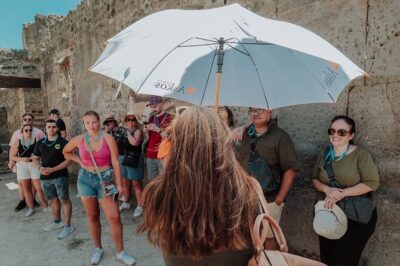
The tour starts at Piazza Esedra, 4, Pompei. For Pompeii, your guide meets you at the main entrance of the archaeological area, Porta Marina Superiore, holding an Askos Tours sign.
This detail sounds minor, but it matters in a place like Pompeii where timing and orientation can get messy fast. If you show up on time and stick close to the meeting point, you’ll lose less energy to searching and more time to walking.
On the Herculaneum side, you meet at the ticket office of the ruins after the train ride, with Corso Resina as the reference point.
Pompeii highlights: from Porta Marina to the House of Menander
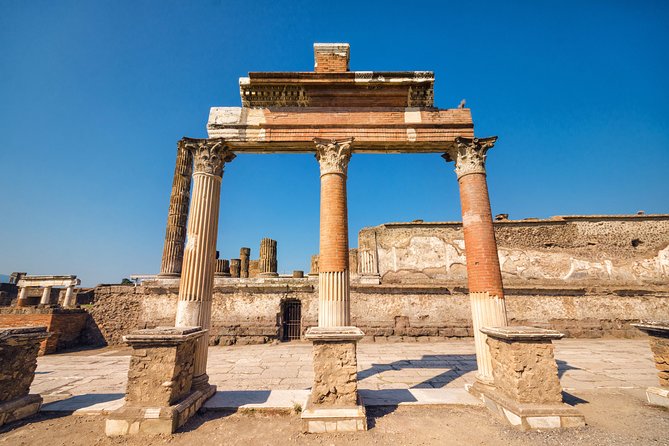
Pompeii is where the city scale hits you first. Even when each stop is brief, the guide keeps you oriented: what the space was used for, who would have used it, and what to look for when you’re staring at stone and soot-blackened traces of wood.
Porta Marina Superiore: your entry into the Roman layout
You begin right at the Pompeii park entrance. From there, you’ll be led through a set of stops that progressively shifts from public structures to private houses. That order helps. You start by seeing the city’s rhythm, then you move into how wealth and daily routines show up inside homes.
More of Herculaneum next door

The Basilica: a sheltered hub for merchants and activity
Next up is the Basilica, an open portico used as shelter for merchants and other activities. Look for how it functioned like a covered meeting zone. It’s not just architecture for architecture’s sake. It’s a reminder that Roman life needed space for trade and conversations that couldn’t always happen outdoors.
The Foro (Forum): Pompeii’s main square
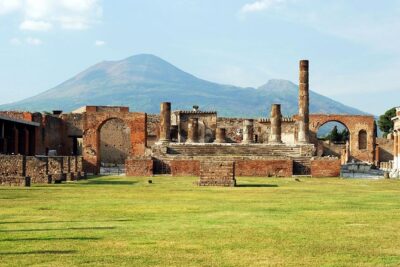
Then comes the Foro de Pompeya, the ancient main square. This is where civic life and commerce mix. Even if you only spend around ten minutes there, you’ll get enough framing to understand why the Forum matters: it’s the spine of the city’s public identity.
The main street walk: seeing the city connect
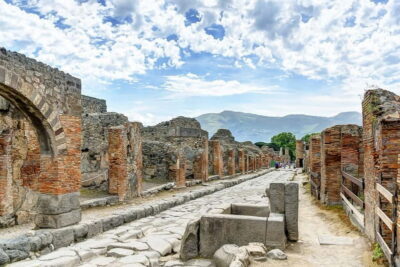
You’ll also take a walk along Pompeii’s main street. This is one of those parts you’ll be glad you didn’t skip, because street-level orientation is how the whole place stops feeling like disconnected highlights.
If you’re taking photos, do it here. The street view is where you can best understand movement—where people would have gone and how the public spaces linked together.
Casa del Menandro: rich home, strong design choices
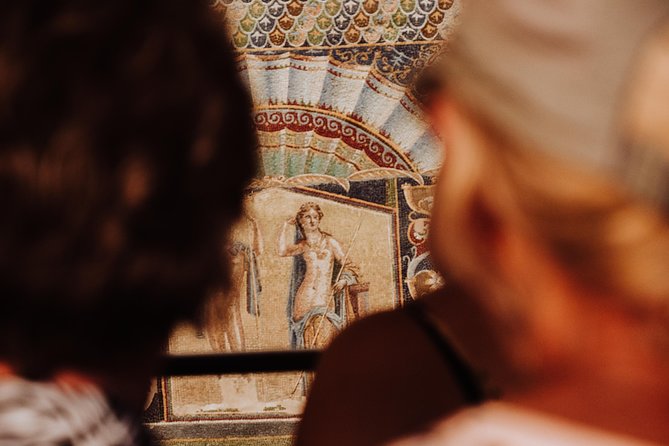
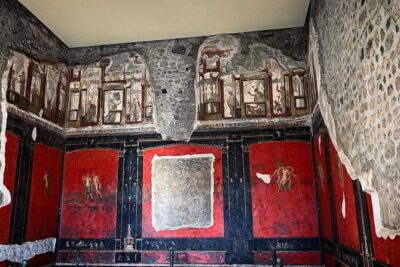
The Casa del Menandro is one of the richest houses in Pompeii, especially for its architecture and decoration. The big takeaway is that wealthy Romans weren’t just buying comfort. They were buying visual impact and status. You’ll see enough frescos and decorative detail to get the point, without needing a whole day in one residence.
Granai del Foro and Terme del Foro: food storage and baths
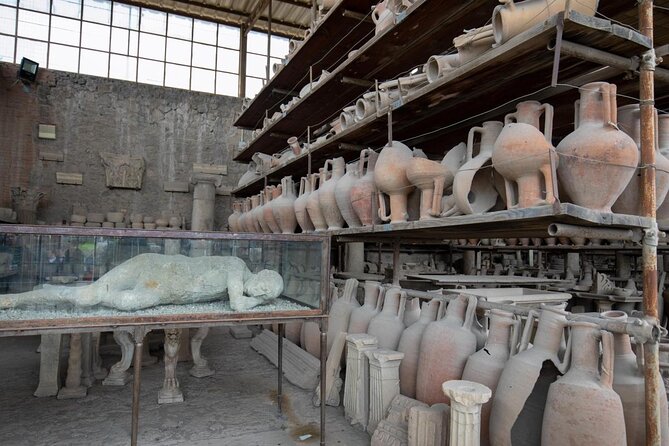
Next, the Granai del Foro (granaries) helps you understand logistics: marble tables, fountain-related basins, and the chilling cast work associated with the eruption—also including remains of a dog and a tree. It’s sobering, and it’s meant to be.
After that, you’ll see the Terme del Foro, the older thermal complex in the city. Bath complexes weren’t just about cleanliness; they were social spaces. This stop gives you a break from the Forum’s public square energy and shifts you toward how people relaxed and gathered.
The most famous brothel: sex work as street life
You’ll get a look at the brothel area in Pompeii’s Roman city. It can feel jarring in a “UNESCO ruins” way, but that’s part of the point: this place includes the full range of social life, not a curated version of it.
Casa del Fauno and theaters: art, size, and performance
Then you’ll head to Casa del Fauno, a large and impressive private residence. The scale helps you see why some homes became cultural statements. After that you’ll look at the Teatro Piccolo and the Teatro Grande.
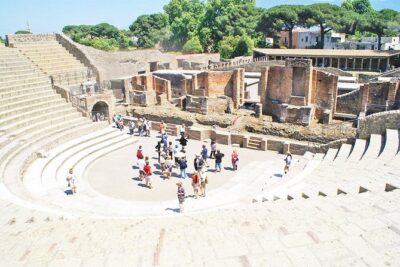
You spend about fifteen minutes at the Teatro Grande, which is Pompeii’s main theater. Even a short visit works because your guide ties it to how Romans experienced performance and public entertainment.
The train transfer to Herculaneum: quick, simple, and part of the rhythm
Between the two sites, the tour includes a transfer by train: about 30 minutes riding plus around 10 minutes walking to reach the Herculaneum meeting point near the ticket office.
This timing is useful. It breaks up the day so you’re not mentally fried when you arrive. You also get a quick lunch break if required—and because meals aren’t included, this is your practical moment to decide whether you need snacks.
One practical note from on-the-ground experience: the Circumvesuviana station area in Herculaneum can involve uphill walking. There’s also been construction/renovation at times, so follow the posted signs and don’t assume every route will be identical day to day.
Herculaneum houses: charred details and daily-room drama
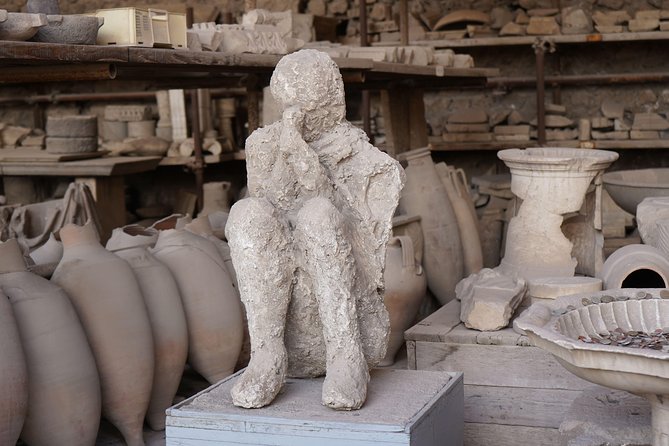
Herculaneum is where this tour turns from “major city highlights” into “how it felt to live here.” The preserved architecture and traces of household items make the rooms feel personal.
Casa dei Cervi: named for the stags
You start with Casa dei Cervi, named for marble statues of stags/deer found in the peristyle. It’s a good stop early in the Herculaneum portion because it teaches you how to interpret household ornamentation: statues and décor weren’t random; they were part of social signaling and taste.
La Terrazza di M. Nonio Balbo and the College of the Augustales
Next are La Terrazza di M. Nonio Balbo and the College of the Augustales. Even when the stops are short, your guide points out what’s distinctive so you’re not just walking through rooms that look similar at first glance. Focus on the ways spaces suggest status and function.
Casa del Rilievo di Telefo: private access and unusual layout
Then Casa del Rilievo di Telefo, described as somewhat unusual because it has its own access to the adjoining Suburban Thermae. That detail matters: it shows that in some homes, the boundary between private living and public bath culture could blur for those with the right status.
Partem Domus lignea and Casa del Tramezzo di Legno: wood partitions that survived
One standout stop is Partem Domus lignea—including the Casa del Tramezzo di Legno—important for the wooden partition that remained. In a city where much of the original material has vanished, seeing surviving traces of wood changes the way you “read” the place. It’s not just stone outlines anymore.
House of the Skeleton: why the name lingers
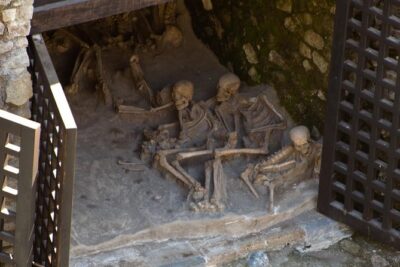
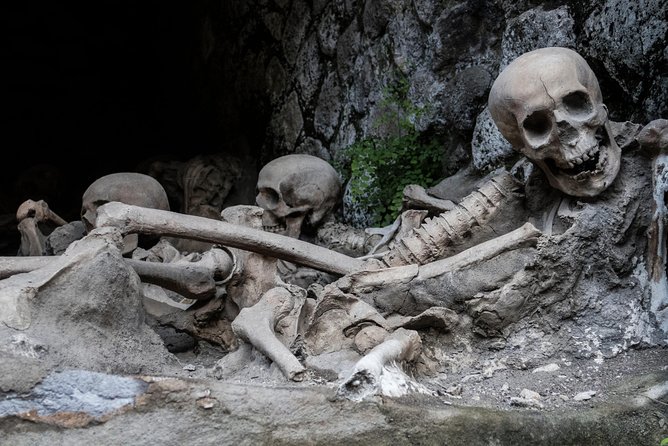
You’ll also see the House of the Skeleton, named after human remains found in 1831. It’s a sobering stop, but your guide can help you understand why the site preserves these stories. It’s not gore for shock value; it’s about what the eruption preserved and what archaeologists learned later.
Baths, luxury, and household variety at Herculaneum
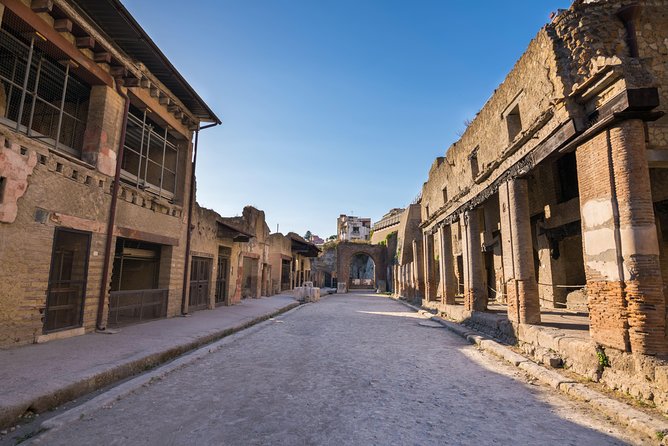
If Pompeii is the public city, Herculaneum is the private one with a serious dose of bath culture.
Central Thermae: men and women, separate entrances
The Central Thermae were built around the beginning of the 1st century AD and were divided into men’s and women’s baths with separate entrances. This is a great stop for noticing how Romans organized space around social norms.
Casa del Salone Nero: the Black Hall’s monumental entry
Then comes Casa del Salone Nero, known for its luxurious feel and monumental entrance with carbonised traces of doorposts and lintel. This is one of those places where the guide’s interpretation really helps, because the survival of darkened elements tells you what fire and burial did to everyday life.
Casa Sannitica and Casa del Bel Cortile: different house plans, different ideas
Casa Sannitica features an atrium arrangement typical of the Samnites, with an Ionic-column gallery and frescoes. Then you’ll see Casa del Bel Cortile, with an original courtyard layout, a stairway, and a stone balcony instead of a traditional atrium.
These stops help you avoid a common mistake: thinking Roman houses were all the same. They weren’t. Even within one city, layouts reflect different influences and priorities.
House of the Grand Portal: the big showpiece
Finally, you’ll reach the House of the Grand Portal, described as a beautiful domus with multiple environments, colonnati, frescos, and everywhere-at-Herculaneum-charred remains of wooden parts. Even if you only have about ten minutes here, it’s a strong end because it pulls together what Herculaneum does best: showing household complexity with haunting traces of the moment life stopped.
Walking reality check: what to pack for a long, uneven day
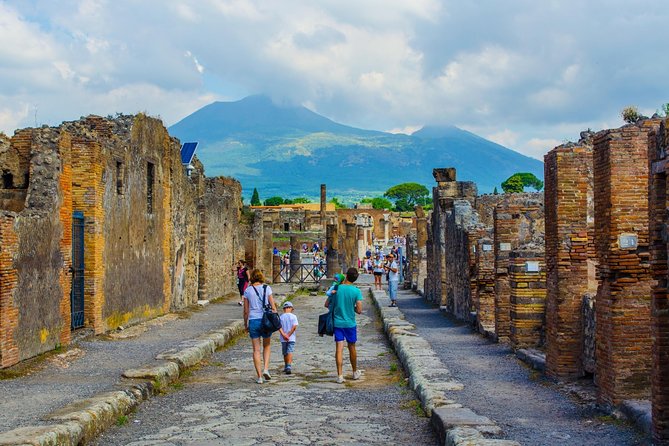
This tour is not a “sit and watch” experience. It’s a guided walking day through both ruins, with short visits and lots of uneven surfaces.
Here’s what I’d plan for:
- Comfortable shoes with good grip (Pompeii and Herculaneum ground can be rough)
- Water—you’ll be moving for hours, and you don’t want to be rationing sips
- Toilet strategy—use facilities before you get locked into the next walking block
- Skip the stroller if you can: the walking is uneven, and you may end up carrying your child anyway
A nice bonus is that during the walk you may find chances to refill your bottle from an ancient Roman-style water point. If it’s available when you go, it’s a satisfying little connection to everyday Roman infrastructure.
Guide energy makes or breaks the day
The consistent thread through the experience is that the guide matters. People rave about guides who bring structure and humor, and who know how to explain what you’re seeing without turning it into a lecture.
You might meet different guides on different days—names that have shown up include Amadeau, Vince, Sergio, Paulo, Vincenzo, Diego, Michele, and Alfredo. One of the best things you can do is show up with questions ready. This tour format rewards that: small-group pacing means you can ask, and your guide can tailor the explanation on the spot.
Who should book this tour, and who should skip it
This tour fits you if:
- You want both UNESCO sites in one trip without planning trains and ticket lines
- You like guided context that turns “ruins” into “daily life”
- You enjoy architecture plus street-level city understanding
- You’re okay with a lot of walking and spending ten-ish minutes in many different spots
You might want to skip it if:
- You need a lot of mobility support or extended rest time between stops
- You’re hoping for a slow, picture-perfect wander with minimal transitions
- You’re traveling with a stroller and want a stress-free push-around day
Should you book? My practical verdict
I think this is a strong book for first-timers who want maximum impact in limited time. The combo of skip-the-line tickets, a small group up to 20, and an included train hop makes it feel like you’re paying for a smooth day rather than managing logistics yourself.
Book it if you want a well-paced overview that still gives you real details—Forum life, baths, and the contrast between Pompeii’s public spaces and Herculaneum’s preserved household rooms. Consider skipping if walking uneven ruins is a dealbreaker for you.
If you’re deciding now, here’s the clincher: this one tends to sell out earlier than you’d guess (it averages about 47 days in advance), so lock it in once your dates are set.
FAQ
How long is the Pompeii and Herculaneum small-group tour?
It runs about 5 hours 30 minutes.
Where do we meet at the start, and where does the tour end?
You start at Piazza Esedra, 4, Pompei, and you end at the Archaeological Park of Herculaneum on Corso Resina.
Is the tour in English?
Yes, it’s offered in English.
Are skip-the-line tickets included?
Yes. Skip-the-line tickets are included for Pompeii and Herculaneum.
How do you get from Pompeii to Herculaneum?
You transfer by train (Circumvesuviana) with about 30 minutes of train time plus about 10 minutes of walking. The one-way train ticket from Pompeii to Herculaneum is included.
Are entrance tickets to the ruins included?
Admission tickets are included for the Pompeii and Herculaneum ruin stops listed, while the transfer/lunch time in Herculaneum is counted as part of the day.
Is lunch included?
No. Meals and personal expenses aren’t included, though there’s time for a quick lunch break if you need it.
What should I know about walking and strollers?
It involves a lot of walking and uneven ground. A stroller is not a great plan because you may need to carry your child anyway.
Can I get a refund if plans change?
Yes. You can cancel up to 24 hours in advance for a full refund.
More Tour Reviews in Pompeii
- Pompeii Small Group Tour with an Archaeologist★ 5.0 · 6,593 reviews
- Discover the Ancient Ruins of Pompeii: Day Trip from Rome★ 3.5 · 2,247 reviews
- Pompeii and Herculaneum Small Group Tour with an Archaeologist★ 5.0 · 1,350 reviews
- Skip the Line Guided Tour of Pompeii led by an Archaeologist★ 5.0 · 703 reviews
- Pompeii Ticket + Tour with Optional Tasting Experience at Pompeii★ 5.0 · 663 reviews
More of Herculaneum
- Pompeii and Herculaneum Small Group Tour with an Archaeologist★ 5.0 · 1,350 reviews
- Private Day Tour to Vesuvius, Herculaneum & Pompeii with Pick Up★ 5.0 · 279 reviews
- The Ultimate Ruins of Pompeii and Herculaneum Private Day Trip★ 5.0 · 103 reviews
- Naples: Pompeii & Herculaneum Day Trip – Small Group Tour★ 4.5 · 72 reviews
- Pompeii and Herculaneum small group Excursion from Naples★ 5.0 · 70 reviews
Skip-the-Line Entries, More to Book
- Skip the Line Guided Tour of Pompeii led by an Archaeologist★ 5.0 · 703 reviews
- Pompeii Private Tour with an Archaeologist and Skip The Line – 3 hours★ 5.0 · 564 reviews
- Pompeii Skip-the-line Tour with Archaeologist Guide★ 5.0 · 559 reviews
- Pompeii Private Tour with an Archaeologist and Skip The Line★ 5.0 · 391 reviews
- Complete Pompeii Skip the Line Tour with Archaeologist Guide★ 4.5 · 379 reviews
Just reviewed: more Pompeii tours and day trips



Pompeii Skip-the-Line Entry, compared.
 ★ 4.0Skip-the-Line Entrance Ticket with Audio GuideFrom $392,509 reviews
 ★ 4.6Skip-the-line-Ticket and Guided TourFrom $641,152 reviews
 ★ 4.9Guided Tour with Skip-the-Line EntryFrom $58812 reviews
 ★ 4.1Skip-the-Line Entry Ticket with Digital Guide AppFrom $22770 reviews
 ★ 4.9Pompeii Ruins Private Tour with Optional Skip-the-Line EntryFrom $254732 reviews
 ★ 5.0Skip the Line Guided Tour of Pompeii led by an ArchaeologistFrom $95703 reviews
 ★ 5.0Pompeii Private Tour with an Archaeologist and Skip The Line – 3 hoursFrom $302564 reviews
 ★ 5.0Pompeii Skip-the-line Tour with Archaeologist GuideFrom $71559 reviews
Browse the lists this tour appears in