

Reviewed · GUIDED
Guided Tours of Pompeii Excavations Historical and Cultural Itineraries
Pompeii in four hours is a sprint. It’s a small-group walkthrough with Bruno Pisano, using a historiographical and cultural approach that makes the ruins feel less like rubble and more like a working city. You also get a highlight that’s hard to beat: the Villa dei Misteri and its famous Dionysian fresco.
I really like the range packed into the time: baths, temples, forum spaces, and several major domus, so you see everyday life plus belief systems, not just one type of site. The other big plus is the guide’s storytelling style, which links Pompeii’s identity as a Hellenistic commercial hub to the mystery cults and how people might have interpreted the eruption. One thing to plan for: the Pompeii entrance ticket is not included, so you’ll need to add that cost and time.
In This Review
- Key points to know before you go
- Pompeii, filtered through a guide who explains why it mattered
- Setting your day: where you meet and what to bring
- Stop 1: Pompeii Archaeological Park frigidarium and the Nilotic swimming scene
- Stop 2: Tempio di Venere and the imperial cult on a sweeping terrace
- Stop 3: The Basilica of Pompeii as a blueprint for later basilicas
- Stop 4: Temple of Apollo, with bronze Apollo and Diana
- Stop 5: The Forum of Pompeii, where business, religion, and administration meet
- Stop 6: Terme del Foro, the spa culture and the Egyptian alabaster labrum
- Stops 7–9: Pompeii houses that show belief, wealth, and taste
- Casa del Fauno: a Hellenistic palace with a mosaic battle scene
- Casa dei Vettii: fourth Pompeian style frescoes and Priapus
- Casa degli Amorini Dorati: peristyle, obsidian mirrors, and Isis
- Villa dei Misteri: Dionysian frescoes and the idea of mystery cults
- Price and value: when $57.62 makes sense
- Who this Pompeii tour is best for
- Should you book this Pompeii guided tour?
- FAQ
- How long is the guided Pompeii tour?
- What is the price per person?
- Is the Pompeii entrance ticket included?
- How many people are in the group?
- Who guides the tour?
- Where do I meet the tour and when does it start?
- Is a mobile ticket used?
- How soon will I get confirmation after booking?
- Can I cancel and get a full refund?
- Are service animals allowed and is it suitable for most people?
Key points to know before you go
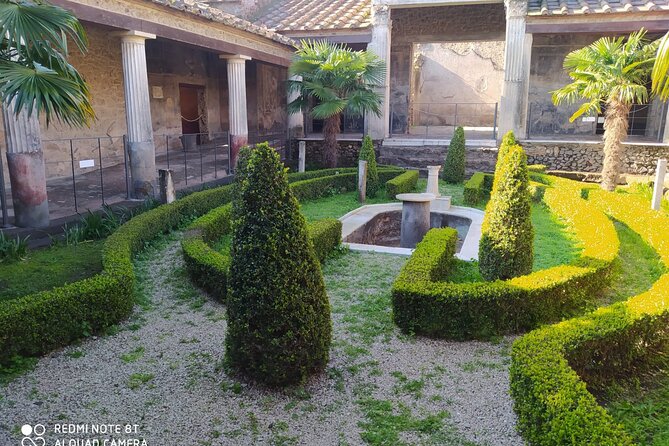
- Small group, maximum 15 people gives you a more human pace through Pompeii.
- Bruno Pisano guides with archaeology, history, and philosophy, not just location-by-location facts.
- Villa dei Misteri is on the route, with the Dionysian fresco noted for its exceptional preservation.
- The schedule is tight, with about 25 minutes per stop across major structures and houses.
- Several stops emphasize daily life and belief: mystery cults, the Isis shrine, and Roman-era worship spaces.
- Entrance ticket not included, so your final cost depends on what ticket you purchase.
Pompeii, filtered through a guide who explains why it mattered
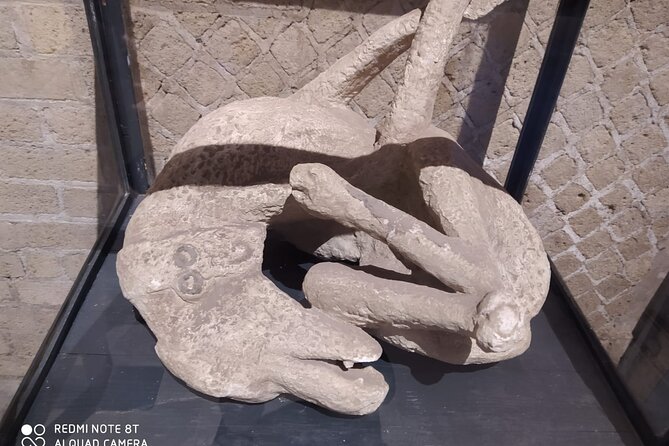
Pompeii is famous for the dramatic ending, but what I like about this tour is how it keeps pulling your attention back to the living middle. You’re not just told what stands there; you’re shown how the pieces fit into a society—how people worshipped, ate, worked, bathed, and gathered in public spaces.
This is also a practical way to handle Pompeii if you only have one morning or one block of time. The tour runs about 4 hours 10 minutes, starting at 9:30 am, and the timing is built around roughly 25 minutes per stop. That means you’ll cover a lot, but you won’t be wandering slowly on your own rhythm the whole time.
The group stays small—up to 15 travelers—and the guide is specialized in archaeology, history, and philosophy. That last part matters. Pompeii is crowded, hot, and visually overwhelming. A guide who can connect objects and architecture to ideas helps your brain stay organized instead of just snapping photos and moving on.
More guided visits to choose
- Skip the Line Guided Tour of Pompeii led by an Archaeologist
★ 5.0 · 703 reviews - Pompeii private tour with an Official Guide
★ 5.0 · 631 reviews - Pompeii Skip-the-line Tour with Archaeologist Guide
★ 5.0 · 559 reviews
Setting your day: where you meet and what to bring
You meet at Porta Marina audioguide official, along Via Villa dei Misteri, 2, 80045 Pompei NA, Italy, and the tour ends in the same place. You’ll have a mobile ticket, so have your phone ready for any check-in or scanning.
Snacks aren’t included. If you’re sensitive to low energy, I’d treat this as a reason to plan your own snack and water before you start. Also note that the entrance ticket to the Pompeii ruins is not included, so you’ll want to make sure you have access squared away ahead of time.
Stop 1: Pompeii Archaeological Park frigidarium and the Nilotic swimming scene
The tour kicks off at the Pompeii Archaeological Park and immediately heads into the world of Roman-era leisure: the suburban spas. I like that the first stop isn’t a temple or a “big postcard” façade. You start with how people chilled, refreshed, and socialized.
This frigidarium is described with a nymphaeum in glass paste and surfaces in polychrome and glazed tiles. The detail here is that you’re seeing how decorative arts weren’t just for wealthy homes—public bathing spaces were also designed for visual pleasure. Next you get the idea of Pompeii’s taste through the swimming pool frescoed with Nilotic subjects, linking the pool environment to exotic themes people wanted to bring into daily life.
Potential drawback: because this segment is about 25 minutes, you’ll get a guided look, not a long, slow “stand here and study the tiles” experience. If you’re the type who likes to linger, keep your curiosity on a shortlist: pick one visual feature and let the guide’s explanation do the rest.
Stop 2: Tempio di Venere and the imperial cult on a sweeping terrace
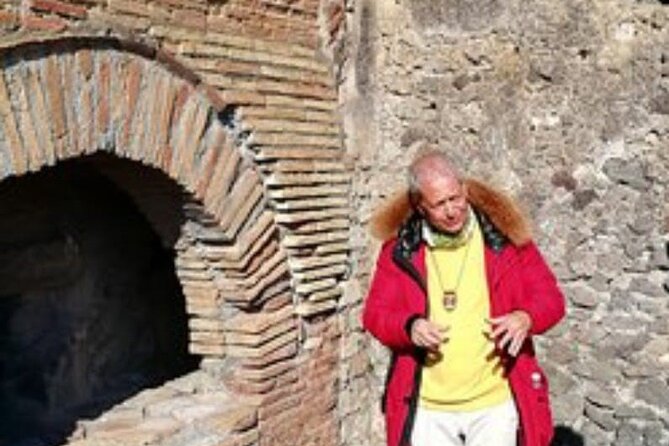
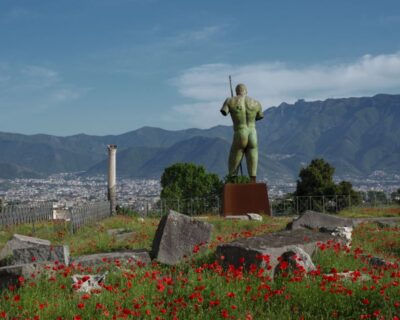
From baths to belief. The Tempio di Venere is framed as a place tied to the imperial cult and the goddess associated with sailors. Even without getting lost in labels, you’ll feel the “public importance” in how this temple sits and how it dominates the surrounding view.
You’ll also notice a modern artistic layer in the mix: an impressive bronze statue of Daedalus, attributed to Igor Mitoraj. That’s a smart inclusion on a guided visit because it gives you an easy bridge between ancient symbolism and the way modern artists keep responding to old myths.
This stop also helps you understand the tour’s larger argument: Pompeii wasn’t isolated. Religious life here connected to politics, travel, and the sea—so you’re seeing faith as something public and civic, not only private ritual.
Stop 3: The Basilica of Pompeii as a blueprint for later basilicas
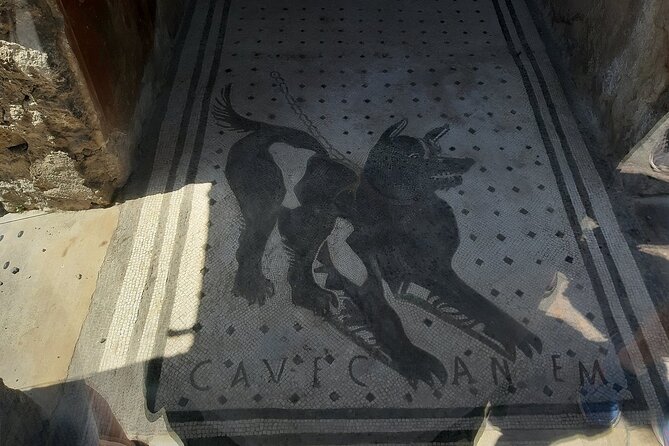
The Basilica of Pompeii is the kind of structure that stops you from thinking of Pompeii as just homes and street corners. It’s described as Pompeii’s great Tribunal, with three naves and an architectural typology that anticipates later Christian basilicas.
I find it useful when a guide tells you to look at form as well as function. Here, that means reading the building as a major public machine: the largest public building in Pompeii and a monument of “extraordinary architectural grandeur,” built for gatherings, law, and civic life.
Because you’re moving through in a guided rhythm, you won’t have time to admire every angle like an architect would. But you will come away with a clear sense of why this building mattered: it’s civic power in stone.
More history in the sites around here

Stop 4: Temple of Apollo, with bronze Apollo and Diana
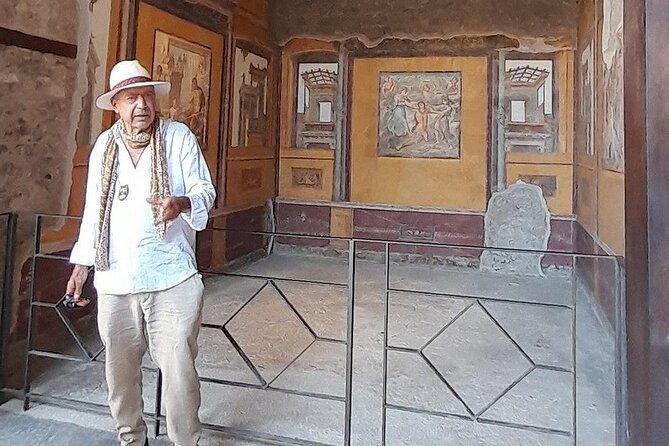
Next comes the Temple of Apollo, described as Greek in design and associated with ethical and prophetic worship. The important part for you isn’t only the name; it’s how the architecture and statuary are used to signal meaning.
Two bronze statues—Apollo and Diana—dominate the space. That pairing is a reminder that ancient worship spaces weren’t always single-purpose. They could hold multiple layers of devotion, roles, and symbolism, depending on how you interpret the site as part of the city’s religious map.
If you’re the kind of traveler who likes to understand how myths connect to place, this stop is a good pivot point. The guide’s larger theme—the “why” behind Pompeii’s culture—starts to feel clearer.
Stop 5: The Forum of Pompeii, where business, religion, and administration meet
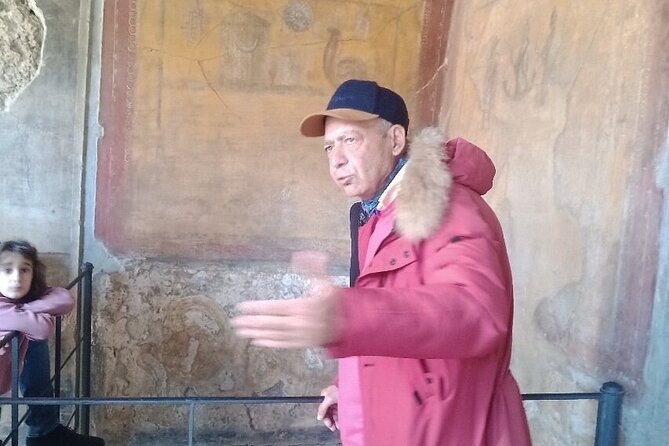
Now you’re in the Forum of Pompeii, framed as the commercial, administrative, and religious center. The guide directs attention to the urban complex’s grandeur, and the anchor is the Temple of Jupiter, Juno and Minerva.
This is one of those spots where Pompeii stops feeling like an archaeological park and starts feeling like a city you could almost picture in motion. Even with the ruins, the layout tells you where people met for official business and where ceremonies likely echoed.
The practical value here is that the forum gives you a “map concept.” Once you’ve seen this central civic space, the later domestic houses and mystery spaces feel more grounded—you understand what kind of public life existed, then you compare it to private devotion.
Stop 6: Terme del Foro, the spa culture and the Egyptian alabaster labrum
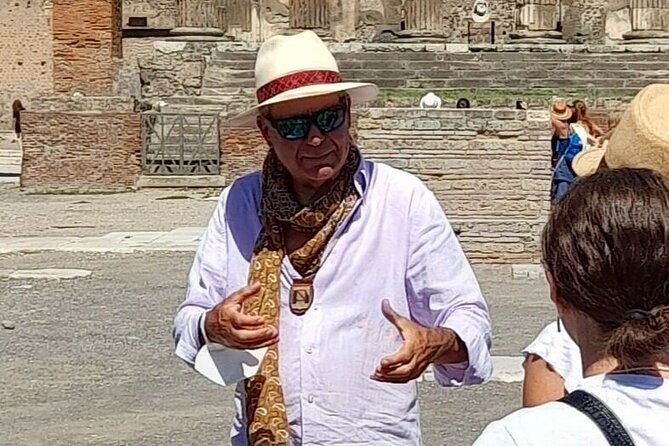
After civic life, you get wellness: the Terme del Foro. It’s described as the ancient community’s wellness center and SPA, and the details are the kind you’d miss without a guide.
You’ll focus on the tepidarium with stuccoes attributed to the Neronian school, then the calidarium with a grand alabaster labrum of Egyptian origin. That Egyptian reference matters because it signals trade and taste, not just local building habits.
Even if you don’t know what every material is, you can still follow the guide’s logic: Pompeii’s culture was connected to the broader Mediterranean world. The city’s comforts weren’t generic—they were shaped by imported ideas and objects.
Stops 7–9: Pompeii houses that show belief, wealth, and taste
The tour then moves into the domus, and this is where Pompeii becomes personal. You’re no longer only reading public space; you’re stepping into how people displayed status and meaning inside homes.
Casa del Fauno: a Hellenistic palace with a mosaic battle scene
The Casa del Fauno is described as the largest house in all Pompeii, a palace home from the Hellenistic era. It includes an excellent copy of one of the most famous Roman-world mosaics: the Battle of Issus (333 BC), showing Alexander the Great vs. Darius III of Persia.
I like this stop because it turns “ancient history” into something you can literally see in someone’s home. You’re not reading a textbook; you’re looking at a visual story someone chose to live with.
Casa dei Vettii: fourth Pompeian style frescoes and Priapus
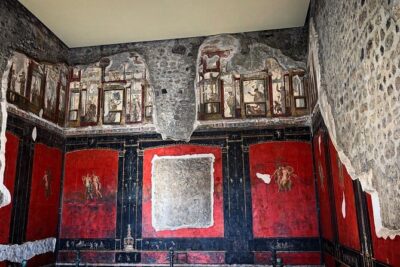
At the Casa dei Vettii, the emphasis shifts to fresco style and mythic themes. You’ll see frescoes of the fourth Pompeian style and the famous depiction of Priapus, noted as Neronian school.
The grand hall is described with a rich production of Cupids working at activities, plus a large Neronian pictorial cycle. Mythological scenes include Daedalus and the Minotaur. This is one of those houses where the guide’s interpretation matters because Pompeii’s imagery can look random until someone explains the cultural “why” behind it.
Casa degli Amorini Dorati: peristyle, obsidian mirrors, and Isis
The Casa degli Amorini Dorati is presented as a perfectly preserved domus with a Rhodian peristyle. There are also obsidian mirrors, which immediately signals how people sought reflective and luxurious effects.
But the big reason this stop fits the tour’s theme is belief inside the house. You’ll visit a shrine dedicated to the cult of Isis and a Lararium honoring the protector gods of the house. There are also frescoes linked to the Trojan War.
This home creates a bridge for you: the forum tells you what was public. The domus tells you what mattered privately. When both are on the same guided path, Pompeii stops being two separate worlds.
Villa dei Misteri: Dionysian frescoes and the idea of mystery cults
If you want one “why this tour” moment, it’s the Villa dei Misteri. The Dionysian fresco is described as unique in the world for its state of conservation, dated to the first century BC.
The tour frames this through the Dionysian and Isiac mystery cults, and it treats the frescoes as part of how people practiced meaning, not just as art on a wall. That’s where the guide’s philosophy background is most helpful: you’re not only looking at paint; you’re being guided to interpret what mystery rituals might have represented within daily life.
This is also where the tour’s broader story about Pompeii really lands. Pompeii isn’t presented as purely Greek or purely Roman; it’s treated as Hellenistic—a commercial and industrial center with relations reaching Asia Minor, and even mentions of connections tied to India and Persia. The guide also frames the eruption as something people could interpret as divine punishment, with the reference to biblical stories like Sodom and Gomorrah.
Whether you agree with the framing or not, the value is that you leave with a consistent explanation of Pompeii’s identity. You’re not collecting random facts. You’re getting a coherent cultural interpretation.
Price and value: when $57.62 makes sense
The price is $57.62 per person, and the average booking timing is about 23 days in advance. That’s a clue that this is a popular option, and it’s smart to lock in early if your schedule is fixed.
Here’s the value logic that matters: you’re paying for a specialized archaeology/history/philosophy guide and a small group experience, plus the guided time that carries you through major parts of Pompeii in about 4 hours 10 minutes.
But you should also budget for what’s not included: the entrance ticket to the Pompeii ruins is not part of this price. In plain terms, your “all-in” total will be higher than the tour cost alone. One helpful strategy is to check your final checkout carefully, especially if you’re buying through an intermediary. One person felt the booking channel added extra fees compared to the base tour price, so compare totals before you hit confirm.
Who this Pompeii tour is best for
This works especially well if you want your Pompeii visit to feel like a guided story, not just a checklist. The mix of baths, civic buildings, and homes means you get a balanced picture of daily life, belief, and status display.
It’s also a good choice if you’re traveling with kids or teens who need context. One recurring theme from the experience is that the guide teaches with clarity and sometimes connects ancient life to modern thinking, including references to psychology. That style can help younger visitors stay engaged instead of glazing over at explanations that start too late.
If you’re the type who wants long free time at a single house or wants to study inscriptions line-by-line, you might find the pace too structured. In this format, Pompeii is a guided “read,” not a self-directed “research project.”
Should you book this Pompeii guided tour?
Yes, if you want a compact, guided route that covers major Pompeian spaces and comes with an interpretation you can actually follow. The small group size and the presence of Bruno Pisano are strong reasons to choose this option over larger tours that move like cattle through the site.
Book it if you care about understanding Pompeii as a Hellenistic world shaped by long-distance connections, mystery cult beliefs, and daily life—not only as a tragic monument. Just make sure you’re ready for the one key catch: you’ll need to handle the Pompeii entrance ticket separately, and bring something to eat since snacks aren’t included.
FAQ
How long is the guided Pompeii tour?
The tour lasts about 4 hours 10 minutes.
What is the price per person?
The price is listed at $57.62 per person.
Is the Pompeii entrance ticket included?
No. Admission ticket to the Pompeii ruins is not included.
How many people are in the group?
The tour has a maximum of 15 travelers per guide.
Who guides the tour?
The experience provider listed is Bruno Pisano, specialized in archaeology, history, and philosophy.
Where do I meet the tour and when does it start?
The meeting point is Porta Marina audioguide official, Via Villa dei Misteri, 2, 80045 Pompei NA, Italy, and the start time is 9:30 am. The tour ends at the same location.
Is a mobile ticket used?
Yes, the tour uses a mobile ticket.
How soon will I get confirmation after booking?
Confirmation is received within 48 hours of booking, subject to availability.
Can I cancel and get a full refund?
Yes. Free cancellation is available if you cancel up to 24 hours in advance for a full refund.
Are service animals allowed and is it suitable for most people?
Service animals are allowed, and most travelers can participate.
More Historical Tours in Pompeii
- Pompeii Walking Tour: The Real History of the Ruins★ 4.5 · 16 reviews
More Guided in Pompeii
- Skip the Line Guided Tour of Pompeii led by an Archaeologist★ 5.0 · 703 reviews
- Pompeii private tour with an Official Guide★ 5.0 · 631 reviews
- Pompeii Skip-the-line Tour with Archaeologist Guide★ 5.0 · 559 reviews
- Pompeii Guided Tour & Horse Riding on Vesuvius with Lunch★ 5.0 · 419 reviews
- Complete Pompeii Skip the Line Tour with Archaeologist Guide★ 4.5 · 379 reviews
More Tour Reviews in Pompeii
- Pompeii Small Group Tour with an Archaeologist★ 5.0 · 6,593 reviews
- Discover the Ancient Ruins of Pompeii: Day Trip from Rome★ 3.5 · 2,247 reviews
- Pompeii and Herculaneum Small Group Tour with an Archaeologist★ 5.0 · 1,350 reviews
- Skip the Line Guided Tour of Pompeii led by an Archaeologist★ 5.0 · 703 reviews
- Pompeii Ticket + Tour with Optional Tasting Experience at Pompeii★ 5.0 · 663 reviews
Just reviewed: more Pompeii tours and day trips




Guided, compared.
 ★ 4.8Entry Ticket and Guided Tour with an ArchaeologistFrom $3519,459 reviews
 ★ 4.2Entry Ticket with Optional Audio GuideFrom $2612,360 reviews
 ★ 4.0Skip-the-Line Entrance Ticket with Audio GuideFrom $392,509 reviews
 ★ 4.3Guided Walking Tour with Entrance TicketFrom $501,423 reviews
 ★ 4.6Skip-the-line-Ticket and Guided TourFrom $641,152 reviews
 ★ 4.9Guided Tour with Skip-the-Line EntryFrom $58812 reviews
 ★ 4.1Skip-the-Line Entry Ticket with Digital Guide AppFrom $22770 reviews
 ★ 5.0Skip the Line Guided Tour of Pompeii led by an ArchaeologistFrom $95703 reviews