
Reviewed · POMPEII GUIDED RUINS WALKS
Pompeii Walking Tour: The Real History of the Ruins
Pompeii hits different when a guide talks. This 2-hour Pompeii walking tour is built to show you how a city actually worked on a normal day in AD 79, from theaters and houses to baths, brothels, and the Forum. I especially like the tight pacing: you cover major zones without feeling like you’re wandering in circles, and you get context for what you’re seeing.
The second thing I like is that entrance tickets are included, so you’re paying for a guided route plus the park access in one go. One possible drawback to plan for: the meet time and the actual group start can vary, so give yourself a little buffer once you arrive at the InStazione help desk.
In This Review
- Key highlights worth your time
- Pompeii’s 10:30 rhythm: why this route works in just 2 hours
- Price and what’s included for a guided Pompeii walk
- Meeting at InStazione: the only logistics problem to watch
- Teatro Grande: where Romans watched comedies, mimes, and atellane
- Casa del Menandro: a wealthy Pompeii domus with a name that tells you something
- Via dell’Abbondanza vibes: the street that makes Pompeii feel lived-in
- Stabian Baths (Terme Stabiane): the oldest bath complex type in town
- Lupanar: what’s visible, and how to stay respectful
- Forum of Pompeii: the civic heart, built in stages
- Basilica, Temple of Apollo, and the granaries: justice and trade in stone
- Guides in English: how names like Grace and Vincenzo shape the day
- Who should book this Pompeii walking tour
- Should you book Pompeii: The Real History of the Ruins?
- FAQ
- Is the tour offered every day?
- How long is the Pompeii walking tour?
- What is included in the ticket price?
- What language is the tour?
- Where do I meet the tour?
- Where does the tour end?
- How many people are in a group?
- Do I need good weather?
- When will I receive confirmation after booking?
- What’s the cancellation policy?
Key highlights worth your time
- Daily 10:30 start at InStazione help desk keeps the schedule simple
- Theater to Forum route hits the big “how Romans lived” sites fast
- Entrance tickets included means fewer moving parts
- Stabian Baths (Terme Stabiane) is a standout stop for Roman daily life
- Casa del Menandro shows what a wealthy urban domus looked like
- Forum + Temple of Jupiter + Basilica connects religion, law, and commerce
Pompeii’s 10:30 rhythm: why this route works in just 2 hours
Pompeii is huge in your imagination and even bigger in real life. So the smartest challenge is not seeing everything. The smart goal is seeing the right things and understanding why they mattered.
This tour’s plan is built around that idea. You start at the Archaeological Park entrance area with the guide, then move through a sequence that makes the city feel connected: performance space (Teatro Grande), private wealth and decoration (Casa del Menandro), everyday street commerce (Via dell’Abbondanza area), body-and-social life (Stabian Baths), the rougher side of Roman entertainment (Lupanar), then the civic center (Forum, Temple of Jupiter, Basilica, Temple of Apollo). It’s an efficient story arc.
I also like that the pacing is time-boxed by design. Several stops are listed at about 5 to 15 minutes each. That may sound short, but in Pompeii short stops are often the advantage. You see the main features, you learn what to look for, and you don’t burn an hour getting stuck on one wall painting.
Keep walking the excavated streets
- Pompeii 3 Hours Walking Tour Led by an Archaeologist
★ 5.0 · 126 reviews - Explore Pompeii: 2-Hour Guided Walking Tour with Included Ticket
★ 4.5 · 77 reviews - Pompeii: walking tour with 3D glasses and with entrance ticket
★ 4.5 · 61 reviews
Price and what’s included for a guided Pompeii walk
At $42.05 per person for roughly 2 hours, this is priced like a focused guided visit rather than a full-day extravaganza. For me, the value comes from two practical factors.
First: the tour includes the entrance ticket and guided tour. In Pompeii, that matters because skipping the ticket line (when possible) and rolling straight into the guided route saves time you’d rather spend looking at stone.
Second: you get English commentary built around archaeology and Roman culture. Pompeii isn’t just dramatic ruins. It’s a real city that was organized, governed, and lived in. A guide turns that into something you can read.
What you should keep in mind: lunch is not included. If you’re hungry after 2 hours (and most people are), you’ll need to plan your next meal.
Meeting at InStazione: the only logistics problem to watch
The tour meets at the InStazione help desk and departs daily at 10:30 am. After registering details, you move with the guide to the entrance area at Porta Anfiteatro.
Here’s the one practical consideration I’d take seriously: don’t treat the meet time like a guaranteed start time with zero waiting. One set of experiences shared a gap between the planned pickup/start timing and the actual start, which caused stress in the morning. You can’t control that, but you can control your own buffer.
My advice: arrive a bit early, settle your ticket situation, use the restroom if you need to, and then stay relaxed. Pompeii will still be there when your group walks in.
Group size is capped at 35 travelers, which usually helps. In a smaller group you can hear the guide, and you’re less likely to lose the plan.
Teatro Grande: where Romans watched comedies, mimes, and atellane
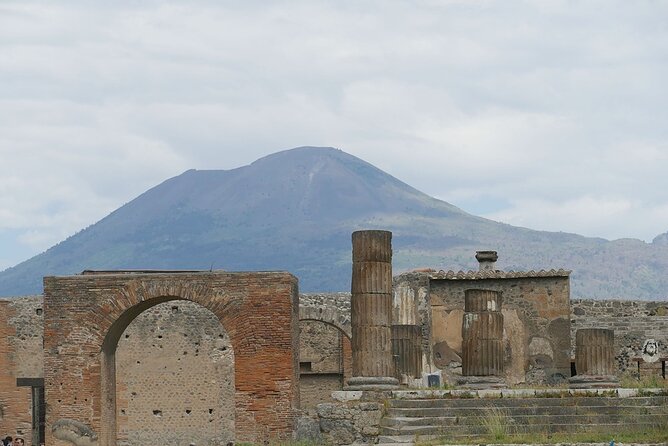
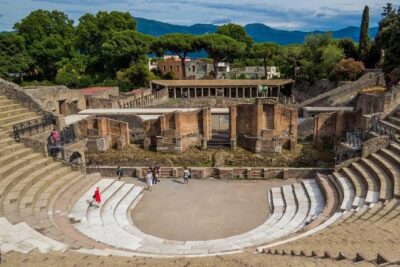
The first big “wow” zone is the Teatro Grande, a Roman theater buried by the Vesuvius eruption of AD 79 and uncovered through excavation.
What I like about this stop is how it reframes a theater from a pretty structure into a social machine. The tour focuses on the types of performances represented inside, including comedies, mimes, pantomimes, and the atellane. That lineup matters because it tells you Pompeii’s entertainment wasn’t only formal or elite.
Also, you’re not looking at an abstract stage. You’re moving through a place designed for crowds, sound, and spectacle. Even if you don’t care about ancient drama, the theater helps you understand how people filled their evenings and how public life worked.
A quick timing note: the itinerary doesn’t list a long slot for every theater detail, so if you’re the type who likes to take your time with architecture, focus on the parts the guide points out first. Then, if you still want more, you can return later.
Casa del Menandro: a wealthy Pompeii domus with a name that tells you something
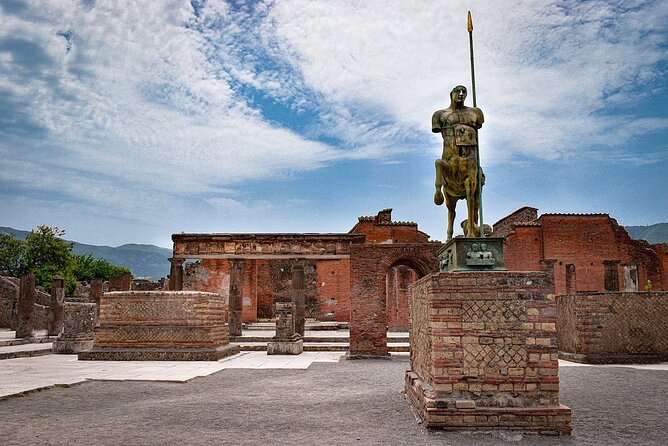
Next is the Casa del Menandro, described as a large urban domus of almost 1,800 square meters. It was excavated in the late 1920s and early 1930s, and it’s known as a strong example of how wealthy families lived in Pompeii.
The house gets its name from an image of the Greek poet Menander, found there. That’s a detail worth paying attention to because it connects private space to wider Mediterranean culture. Pompeii wasn’t isolated. Wealthy owners absorbed Greek themes and displayed them.
This is one of those stops where a guide makes a real difference. You’re looking at rooms and surfaces that could otherwise feel like random ancient interiors. With commentary, you start noticing layout and decoration choices that signal status and lifestyle.
Time is listed at about 15 minutes here. That’s enough to get the overall feel without turning it into a museum sprint.
More of the story behind the stones
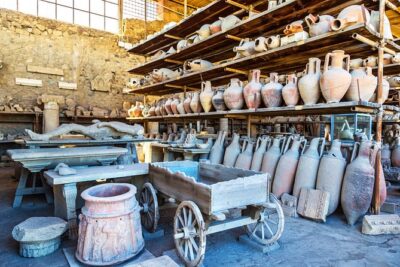

Via dell’Abbondanza vibes: the street that makes Pompeii feel lived-in
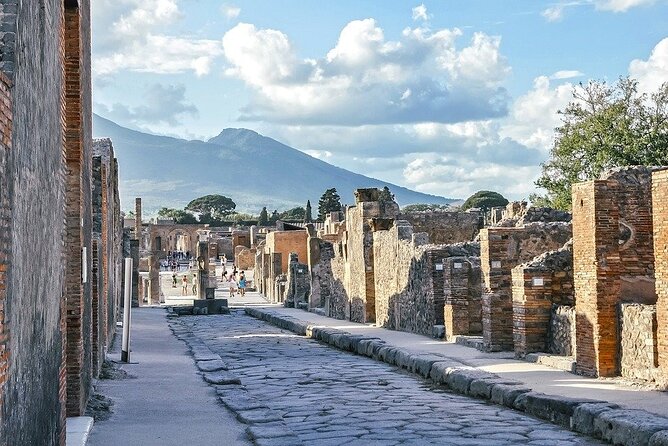
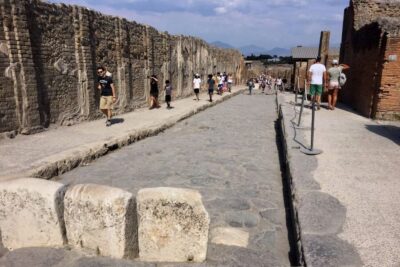
Between the domus and the more civic sites, the route includes the Via dell’Abbondanza area, sometimes described as the street of abundance. It’s basically the city’s rhythm: public spaces, shops, and residences packed into one walkable corridor.
This segment is especially useful if you want more than monuments. The tour points out restored paintings in shop fronts, including the thermopolium of Asellina, described as a well-known inn. You also get attention on artisan workshops, called officinae.
I like this part because it helps you picture daily habits: where people bought food, where they worked, and how storefront life sat right next to living space.
If you’re only doing one guided Pompeii route and you care about atmosphere, this street segment is one reason to choose a tour like this. It’s not just “ruins.” It’s a city street.
Stabian Baths (Terme Stabiane): the oldest bath complex type in town
Then you move into the Stabian Baths, another Vesuvius-buried site excavated after the eruption. The key detail for your brain is that it’s described as the oldest bath complex in the city.
Roman bathing was never only about being clean. It was social time, news time, and a place to be seen. A good guide will point out how the complex functioned and how spaces were organized.
The tour highlights the male and female sectors as perfectly preserved. That’s a small line in the itinerary, but it’s a huge deal visually. It helps you understand planning and routine in a way that single rooms usually can’t.
This stop is listed at about 15 minutes. With something this well-preserved, you’ll feel the temptation to linger. Still, the time box is useful. You’ll get the essentials and move on while your energy holds.
Lupanar: what’s visible, and how to stay respectful
The Lupanar is the stop that makes many people hesitate, and it’s also one of the most historically specific parts of Pompeii.
The tour explains that lupanari were places for mercenary sexual pleasure—essentially houses of tolerance in the Roman era. Some of these sites are still visible in Pompeii, and this stop is one of those.
If you’re worried about the tone, the best approach is mental, not emotional. Go with the mindset that you’re looking at a real commercial space of the ancient world, not shock value. A guide’s framing matters here, and the overall tour tone in general is more interpretive than sensational.
This stop is listed at about 10 minutes. That’s probably the right amount of time. You’ll see what you came to see, learn the context, and then get back to less heavy topics.
Forum of Pompeii: the civic heart, built in stages
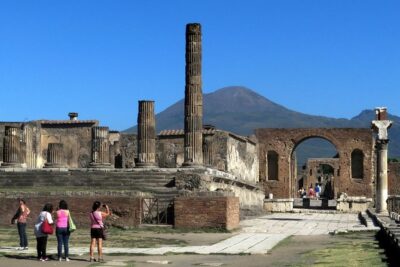
Next comes the Forum of Pompeii, one of the most important zones for understanding how the city governed itself and carried out public life.
The description here is specific. The Forum dates back to around the 4th century BC, in the Samnite era, near key road junctions heading toward Neapolis, Nola, and Stabiae. Then, after Roman conquest, it was rebuilt and enlarged, especially in the 2nd century BC.
The tour notes that many shops were removed and that political and religious buildings took over the perimeter as the area’s density shifted. That detail is key because it helps you see the Forum as a living thing that changed with power and priorities.
One of the stops inside this zone is the Temple of Jupiter, noted as overlooking the Forum and later becoming associated with the Capitolium. The tour connects it to the main divinities of Rome: Jupiter, Juno, and Minerva. It also mentions the erarium, the public treasure kept in the temple’s basement.
This is where you start understanding Pompeii as a Roman city in function, not just Roman in style.
The time listed here is shorter (about 5 minutes), but the meaning is huge. If you want to remember something, remember how the Forum ties roads, trade, law, and belief together.
Basilica, Temple of Apollo, and the granaries: justice and trade in stone
After the Forum, you hit the Basilica, described as an imposing public building dating to the second century BC. In practice, it functioned like an indoor forum. When weather pushed people indoors, many activities moved here.
The Basilica plan gives you a clear sense of authority. The itinerary notes a tribunal on one side where judges sat elevated above the parties. There’s also mention of a wooden staircase used to access the judge’s area, described as a security measure to prevent the condemned from attacking the judges.
Even if you don’t care about Roman legal systems, the building layout tells you how order was enforced.
Then comes the Temple of Apollo. The cult story here is helpful: Apollo’s worship reached Italic populations through the Greek world. The tour points out that around the eruption period, Apollo’s following had faded while the importance of Jupiter grew as the Capitolium focus strengthened.
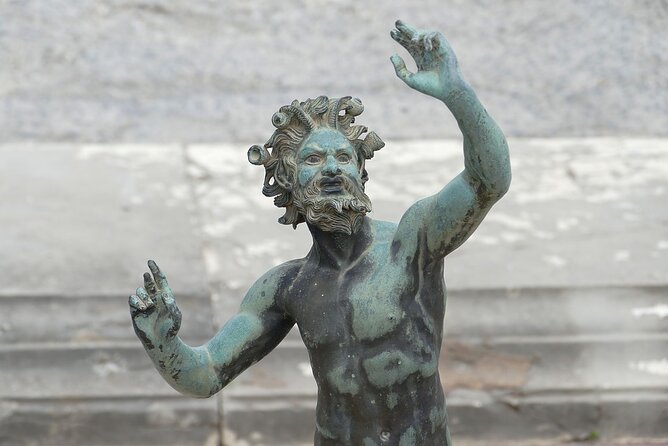
On-site, you’re told a bronze statue of Apollo depicted as an archer is visible, and a statue of Diana can be seen in front of it. This is a good stop for anyone who likes to connect text, mythology, and what’s actually visible.
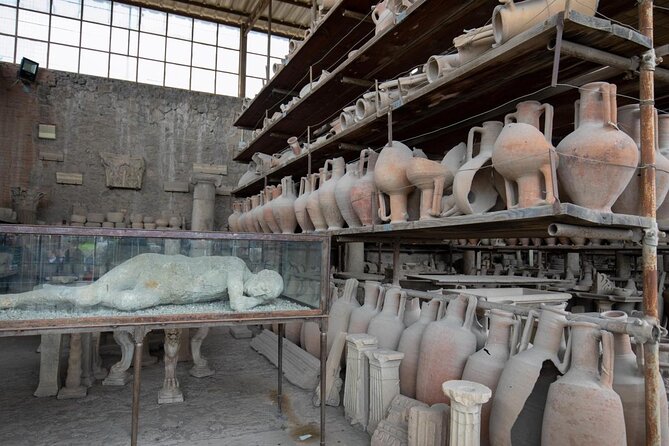
Finally, there’s the granaries area. The tour explains that what you see now is largely a deposit of materials found during excavations. In the past, it served as a market for cereals and legumes, and the absence of plaster traces led to the idea that the structure wasn’t finished before the eruption.
The best practical detail here is the ponderary table, including tools needed to ensure exchanges and convert measurement units for traders from across the empire into Pompeii’s local units.
This is the kind of detail that makes you feel the city’s economy working. You’re not just walking through famous ruins. You’re seeing how people measured, traded, and handled supply.
Guides in English: how names like Grace and Vincenzo shape the day
The tour is offered in English, and the guide is the difference between seeing objects and understanding them.
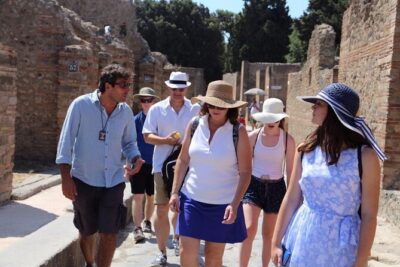
Based on the guide names tied to strong experiences on this route, you may be with someone like Grace, Frederica, Vincenzo, or Igor. The common threads in what’s praised are clarity, humor, and making sure everyone can see what matters. One guide style described as engaging and funny seems especially helpful in a place like Pompeii, where the sheer amount of stone can overwhelm without interpretation.
If you’re sensitive to pacing, aim for a guide who explains the purpose of each building as you walk. This route is built on quick but meaningful stops, so the guide’s voice and priorities matter.
Who should book this Pompeii walking tour
This tour fits best if you want:
- A guided Pompeii highlight route in about 2 hours
- English commentary that ties buildings to real Roman life
- Theater, baths, and Forum as your main anchors
- Entrance tickets included without planning your own skip-the-line puzzle
It’s also a solid choice if you don’t want to spend your whole day trudging and second-guessing what you’re looking at. With a small group cap of 35, you should be able to stay together and keep up.
If your travel style is slow and detailed—meaning you want to linger for long periods in one house or memorize every corner of a mosaic—this might feel tight. But for most people, the time limit is exactly what makes the day manageable.
Should you book Pompeii: The Real History of the Ruins?
I’d book this tour if you want the fastest path to understanding Pompeii as a functioning Roman city. The price is reasonable for what you get, especially with entrance tickets included, and the itinerary hits high-impact sites that connect culture, daily routines, and civic life.
I’d think twice if you’re the type who hates any schedule friction at all. Be ready for the real-world possibility that the start moment can drift from the ideal time. Arrive early and you’ll likely be fine.
Bottom line: this is a strong choice for a first Pompeii visit, or for anyone who wants a guided “best of” without turning the day into a marathon.
FAQ
Is the tour offered every day?
The tour is described as departing every day at 10:30 am.
How long is the Pompeii walking tour?
It’s listed as about 2 hours (approximately).
What is included in the ticket price?
The tour includes the entrance ticket and the guided tour. Lunch is not included.
What language is the tour?
It’s offered in English.
Where do I meet the tour?
You meet at InStazione (80045 Pompei, Metropolitan City of Naples, Italy) at the help desk.
Where does the tour end?
The tour ends at Scavi di Pompei, Viale delle Ginestre, 80045 Pompei NA, Italy.
How many people are in a group?
The tour has a maximum of 35 travelers.
Do I need good weather?
Yes. This experience requires good weather and may be offered on a different date or refunded if canceled due to poor weather.
When will I receive confirmation after booking?
You should receive confirmation at the time of booking.
What’s the cancellation policy?
You can cancel for a full refund up to 24 hours in advance of the experience’s start time, and the cutoff is based on local time. Free cancellation is offered under that rule.
More Tour Reviews in Pompeii
- Pompeii Small Group Tour with an Archaeologist★ 5.0 · 6,593 reviews
- Discover the Ancient Ruins of Pompeii: Day Trip from Rome★ 3.5 · 2,247 reviews
- Pompeii and Herculaneum Small Group Tour with an Archaeologist★ 5.0 · 1,350 reviews
- Skip the Line Guided Tour of Pompeii led by an Archaeologist★ 5.0 · 703 reviews
- Pompeii Ticket + Tour with Optional Tasting Experience at Pompeii★ 5.0 · 663 reviews
The Story of the City, More Ways In
- Discover the Ancient Ruins of Pompeii: Day Trip from Rome★ 3.5 · 2,247 reviews
- 2 hours Pompeii Tour with Local Historian – Ticket Included★ 5.0 · 335 reviews
- Stories of Pompeii: Small Group tour with archeology expert guide★ 5.0 · 191 reviews
- Ancient Pompeii Private Tour: Skip the Line & Kid-Friendly Option★ 5.0 · 167 reviews
- Skip-the-Line Half-Day Private Tour Ancient Pompeii Highlights with Native Guide★ 5.0 · 146 reviews
Still in the Ruins? Keep Walking
- Pompeii 3 Hours Walking Tour Led by an Archaeologist★ 5.0 · 126 reviews
- Explore Pompeii: 2-Hour Guided Walking Tour with Included Ticket★ 4.5 · 77 reviews
- Pompeii: walking tour with 3D glasses and with entrance ticket★ 4.5 · 61 reviews
- Pompeii walking tour★ 5.0 · 29 reviews
- Small Group Guided Walking Tour of Ancient Pompeii Highlights★ 5.0 · 27 reviews
Just reviewed: more Pompeii tours and day trips





Pompeii Guided Ruins Walks, compared.
 ★ 4.3Guided Walking Tour with Entrance TicketFrom $501,423 reviews
 ★ 4.8Discover Pompeii: French Walking Tour of the Buried CityFrom $41253 reviews
 ★ 5.0Pompeii 3 Hours Walking Tour Led by an ArchaeologistFrom $256126 reviews
 ★ 4.6Highlights Guided Walking TourFrom $53105 reviews
 ★ 4.33D Walking Tour with Entry TicketFrom $61102 reviews
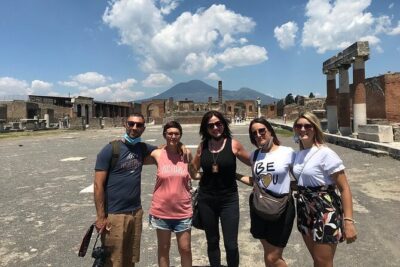 ★ 4.5Explore Pompeii: 2-Hour Guided Walking Tour with Included TicketFrom $5277 reviews
 ★ 4.5walking tour with 3D glasses and with entrance ticketFrom $6261 reviews
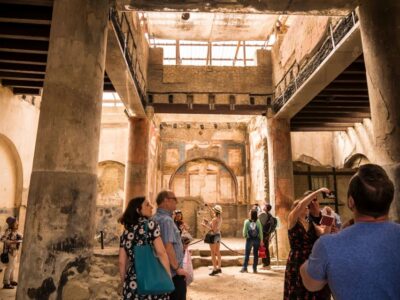 ★ 5.0Herculaneum: Private Walking Tour with Archeologist GuideFrom $31759 reviews
Browse the lists this tour appears in