
Reviewed · POMPEII SKIP-THE-LINE ENTRY
Pompeii tour with LOCAL GUIDE and SKIP THE LINE entrance
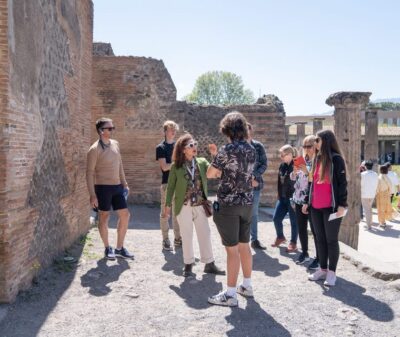
Pompeii can feel eerily current. This skip-the-line tour gets you into the ruins fast, then threads you through the big sights with a local expert’s voice instead of a solo wandering shuffle. If you like your history specific (who lived here, what they ate, how they spent the night), this format delivers.
What I like most is the tight pairing of major landmarks with household-scale details. You’ll cover the Forum’s civic power and then jump into places like Casa del Menandro’s frescoed rooms and the Lupanar brothel layout, where even the built-in beds have a story. The one catch: the whole experience is roughly 2 hours 30 minutes, so you’ll see highlights—not everything.
In This Review
- Quick hits before you go
- Pompeii in 2.5 hours: what this fast format really covers
- Skip-the-line entry and the meeting point near Via Villa dei Misteri
- The main Archaeological Park stop: why the ruins feel like a time capsule
- Casa del Menandro: high-status life, epic stories, and a hidden silver hoard
- Lupanar: the brothel layout that turns scandal into architecture
- Pompeii’s Forum: where power, business, and justice meet
- Stabian Baths: Roman bathing, heat, and the oldest complex in the city
- Price and value: is $66.38 worth your time?
- Who this Pompeii tour fits best (and who should think twice)
- How to get the most out of your guided walk
- Should you book this Pompeii tour?
- FAQ
- How long is the Pompeii tour?
- What’s included in the ticket price?
- Is the tour offered in English?
- Where do I meet for the tour?
- What group size should I expect?
- Is this experience refundable?
Quick hits before you go
- Skip-the-line entry plus an authorized local guide, so you spend less time waiting and more time learning.
- A small group cap (14 travelers), which makes it easier to ask questions and keep the pace humane.
- Casa del Menandro gets real attention: Iliad and Odyssey fresco scenes, a rhodium-type peristyle, and the household’s lost silver hoard story.
- The Lupanar stops are designed for understanding how the brothel worked—two floors, built-in beds, curtained rooms, and the corridor artwork.
- The Stabian Baths are included as a Roman-era thermal complex, noted as the oldest of its kind in the city.
- You can potentially stay inside after the guided portion to slow down and explore on your own.
Pompeii in 2.5 hours: what this fast format really covers
Pompeii is huge. Even with good shoes and decent stamina, a self-guided visit can turn into a frantic highlight chase. This tour’s whole angle is time control: you’re guided through the key zones in a planned flow, then given just enough freedom to continue at your own pace afterward.
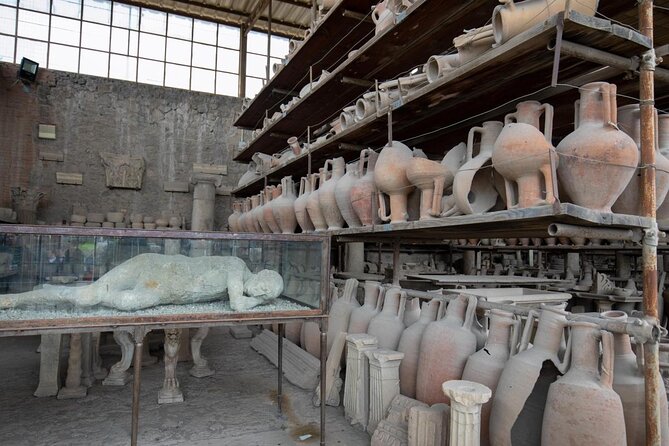
The typical guided portion runs about 2 hours, with the full experience around 2 hours 30 minutes. That means you’ll hit the city’s headline moments—Forum, a major house, a brothel area, and Roman baths—without drifting off into less important streets. If you want a deep, slow, archaeology-nerd crawl through every neighborhood, you’ll likely feel a little rushed. If you want a strong “first Pompeii” visit, this is a solid hit.
More ways past the ticket queue
- Skip the Line Guided Tour of Pompeii led by an Archaeologist
★ 5.0 · 703 reviews - Pompeii Private Tour with an Archaeologist and Skip The Line – 3 hours
★ 5.0 · 564 reviews - Pompeii Skip-the-line Tour with Archaeologist Guide
★ 5.0 · 559 reviews
Skip-the-line entry and the meeting point near Via Villa dei Misteri
The practical win starts before you even walk in. You meet near Via Villa dei Misteri, 3 (Pompei), close to the main entrance area and public transport. The tour includes priority/skip-the-line service, plus your guide and admission tickets.
Why this matters: Pompeii gets crowded, and long entry waits are the kind of time-loss that ruins the day’s momentum. Here, the goal is straightforward—get you inside, then use the guide’s explanations to make what you’re seeing “click.”
One more practical detail: the tour ends back at the meeting point. That’s helpful if you’re catching onward transport or meeting someone later.
The main Archaeological Park stop: why the ruins feel like a time capsule
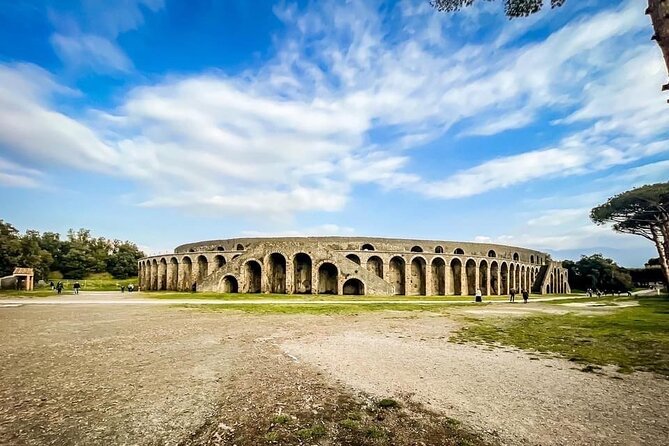
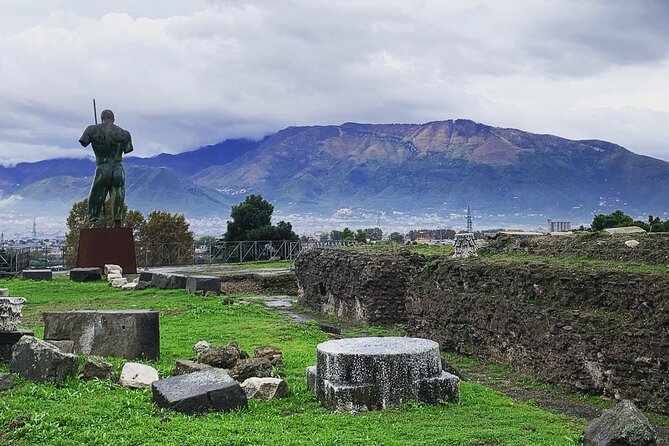
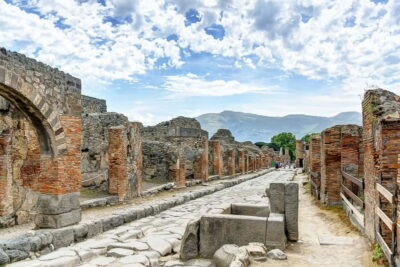
Your first big block is the Archaeological Park of Pompeii, where the site’s reputation becomes real fast. Pompeii is preserved by volcanic ash, and that’s the reason the city still feels “alive” in a way other ancient places don’t. You’re looking at streets and buildings that kept their shapes and positions instead of collapsing into vague stone piles.
What you’re learning in the park is not just dates and emperors. It’s how the city worked as a Roman town about 2,000 years ago—the sense of daily life, not just monuments. The guide-led route helps you make sense of the layout so you’re not staring at walls with no map in your head.
A realistic note: since this is a highlight route, you won’t see everything. You’ll want to be okay with “important areas plus targeted detail,” not “every corner.”
Casa del Menandro: high-status life, epic stories, and a hidden silver hoard
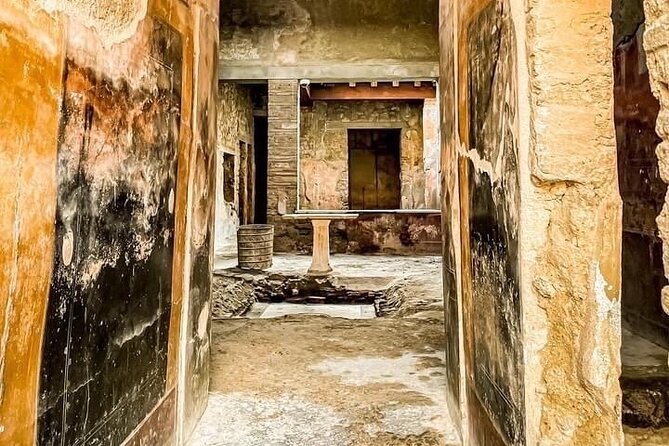
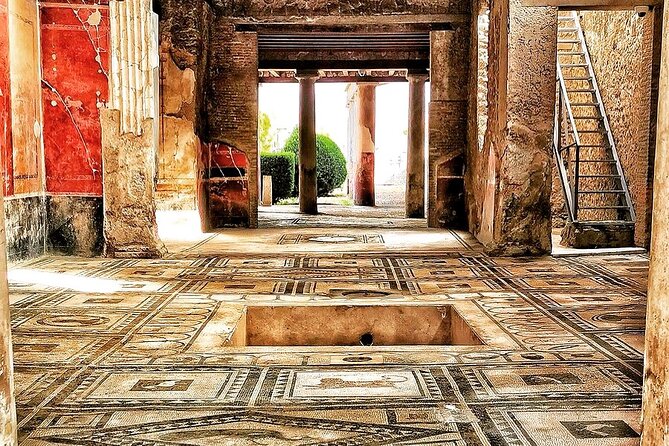
Casa del Menandro is the kind of stop that makes you stop and look up. This house represents a high-ranking family’s typical home, and it’s packed with clues about taste and wealth.
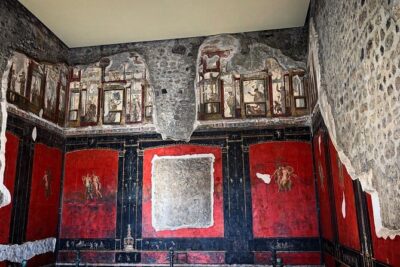
Inside, the atrium is decorated with fresco scenes from the Iliad and the Odyssey. That’s not just decoration—it’s a statement about education and cultural identity. Then you’ll notice the peristyle described as a “rhodium” type, with the northern side higher. Those design choices point to how rooms were planned for movement, light, and status.
The house’s name comes from a portrait of Menander, an Athenian playwright, placed in the porch. That detail is easy to miss if you’re moving quickly, so having a guide matter here. You also get the story of a small thermal district below the house and an underground room—perhaps a cellar—where a chest with 118 pieces of silverware was found and is now exhibited at the National Archaeological Museum of Naples. Even the “why it was hidden” angle is part of the emotional punch of Pompeii.
If you like household archaeology—the stuff about banquets, pouring wine, and everyday objects—this stop earns its time.
Lupanar: the brothel layout that turns scandal into architecture
The tour includes Lupanar stops that focus on how a Roman-era brothel functioned. This isn’t modern gossip. It’s social history, shown through floor plans and built space.
You’ll hear basics like: the prostitutes were mostly Greek and Oriental slaves, and the pricing was measured in asses (with one cup of wine costing one). The building has two floors—owners and slaves on the upper level, and on the lower level five rooms arranged along corridors. Each room has a built-in bed, and the rooms were closed by a curtain. There’s even mention of a latrine visible under the stairwell at the end of the corridor.
What makes this stop useful is how the guide’s explanation ties the structure to behavior. The corridor has small pictures with erotic depictions that acted like visual advertising for customers. You’re essentially walking through a “service system” that the city tolerated and regulated—just in a very different way than today.
Because the tour includes Lupanar twice, you’ll likely get two different angles: one closer look at rooms and layout, and another quick follow-up connection. If you’d rather skim this topic, it’s the one part of the tour where you can’t really substitute it with another sight—you’re meant to learn the story.
More guided visits to choose


Pompeii’s Forum: where power, business, and justice meet
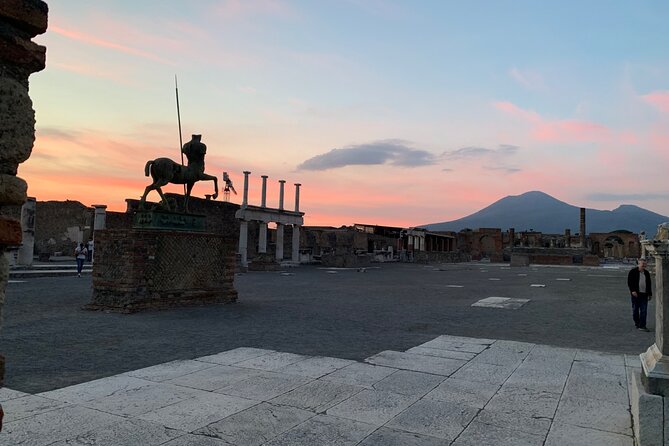
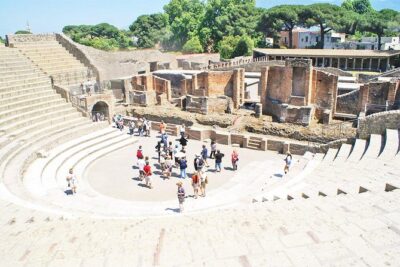
Next up is the Forum, the civil center of daily life. If you’ve ever wondered how Roman cities organized themselves, the Forum is where you can see it: the main public buildings for administration and justice, plus spaces tied to commerce and business activity.
This stop helps you “zoom out” from houses and private life. The Forum originally looked like an open rammed-earth area, with the Sanctuary of Apollo on one side and shops on the other. Later, between the III–II century B.C., it was modified: the square became more regular, surrounded by arcades, and paved with tuff slabs. The axis of the square aligned with the facade of the Temple of Jupiter, positioned in line with Vesuvius—a detail that makes the city feel intentionally staged.
In the imperial age, the Forum was repaved with travertine slabs, and some slabs show recesses designed for bronze letters from a large inscription. That’s a great moment to look for the physical “technology” of messaging—how the city communicated rules, status, and public information.
If you want your Pompeii to connect to how Romans governed and traded, this is one of your best ROI stops.
Stabian Baths: Roman bathing, heat, and the oldest complex in the city
The tour ends with a visit to the Stabian Baths (Terme Stabiane). Even if baths sound like a boring detour, in Roman cities they were social hubs, not just hygiene. Here you’re getting the thermal complex with the added story of eruption burial and later rediscovery.
The details are clear: they’re a Roman-era bath complex, buried by the eruption of 79, rediscovered through excavations. You’ll also hear that it’s the oldest building in Pompeii of its kind. That “oldest” note is useful because it sets the Baths as an anchor point for understanding how long bathing culture existed there.
This stop is shorter in time, but it’s an effective contrast to houses and brothel architecture. You move from private life and civic administration into a community space designed for movement, conversation, and relaxation—Roman style.
Price and value: is $66.38 worth your time?

At $66.38 per person, this tour isn’t a budget-only deal, but it also isn’t trying to be luxury. You’re paying for three things that matter in Pompeii: skip-the-line entry, an authorized local guide, and admission tickets bundled into one timed visit.
Here’s how I’d think about value if you’re planning your day:
- If you hate waiting in queues, the skip-the-line component is real money saved in stress and time.
- If you want context while you walk, the guide’s explanations are what convert stones into understanding—especially at places like Casa del Menandro and the Lupanar, where the “what you’re looking at” might not be obvious fast.
- With a group cap of 14 travelers, you should feel more “guided” than “herded.”
The trade-off is that you’re buying a highlights route. If you’re the type who wants to linger for half an hour in one room, you’ll need a longer tour, extra museum time, or a second visit later.
Who this Pompeii tour fits best (and who should think twice)
This tour is a great fit for you if:
- You’re visiting Pompeii for the first time and want a structured overview.
- You enjoy specific stories: fresco subjects, house layout, civic spaces, and Roman social systems.
- You want help reading the site without doing all the research yourself.
It may not be the best fit if:
- You already know a lot about Pompeii and want a slower, deeper academic-style itinerary.
- You want maximum time inside every stop with no “quick look” pressure.
Also, if your trip day is tightly scheduled, this format helps. It gives you a predictable path, returns you to the meeting point, and includes time to continue exploring after the guide finishes.
How to get the most out of your guided walk
Pompeii rewards people who plan for comfort. Since you’ll be moving between several areas in limited time, I’d show up ready:
- Wear shoes you can walk in for hours. Some paths can be uneven.
- Bring sun protection and water. Even on a “cooler” day, you’ll cover ground.
- If you’re sensitive to noise or want clarity, consider using your own earphones so you can hear the guide over crowd sound (the tour doesn’t promise audio devices).
- After the guided portion, take 20–30 minutes to roam one area you liked most. That’s where the site starts to feel personal instead of scripted.
Should you book this Pompeii tour?
If your priority is a strong, first-pass Pompeii visit with skip-the-line entry and a local guide, I’d say book it. The itinerary hits exactly the kind of variety that makes Pompeii fascinating: civic center (Forum), status home (Casa del Menandro), Roman social life (Lupanar), and a community facility (Stabian Baths).
But if you’re expecting a long, slow, see-everything day, don’t buy this hoping it will become a 5-hour tour. The time limit is the main limitation, and you’ll feel it if you love lingering. For a “dream realized” first visit, though, this is a smart way to get in, learn fast, and still have time to wander after.
FAQ
How long is the Pompeii tour?
It’s approximately 2 hours 30 minutes.
What’s included in the ticket price?
The tour includes entrance tickets, an authorized local guide, and skip-the-line priority service for entry.
Is the tour offered in English?
Yes, it’s offered in English.
Where do I meet for the tour?
The meeting point is Via Villa dei Misteri, 3, 80045 Pompei NA, Italy, and the tour ends back at the meeting point.
What group size should I expect?
The tour has a maximum of 14 travelers.
Is this experience refundable?
No. It’s non-refundable and cannot be changed for any reason. If it’s canceled due to poor weather, you’ll be offered a different date or a full refund. If the minimum number of travelers isn’t met, you’ll be offered a different date/experience or a full refund.
More Guided in Pompeii
- Skip the Line Guided Tour of Pompeii led by an Archaeologist★ 5.0 · 703 reviews
- Pompeii private tour with an Official Guide★ 5.0 · 631 reviews
- Pompeii Skip-the-line Tour with Archaeologist Guide★ 5.0 · 559 reviews
- Pompeii Guided Tour & Horse Riding on Vesuvius with Lunch★ 5.0 · 419 reviews
- Complete Pompeii Skip the Line Tour with Archaeologist Guide★ 4.5 · 379 reviews
More Tour Reviews in Pompeii
- Pompeii Small Group Tour with an Archaeologist★ 5.0 · 6,593 reviews
- Discover the Ancient Ruins of Pompeii: Day Trip from Rome★ 3.5 · 2,247 reviews
- Pompeii and Herculaneum Small Group Tour with an Archaeologist★ 5.0 · 1,350 reviews
- Skip the Line Guided Tour of Pompeii led by an Archaeologist★ 5.0 · 703 reviews
- Pompeii Ticket + Tour with Optional Tasting Experience at Pompeii★ 5.0 · 663 reviews
Skip-the-Line Entries, More to Book
- Skip the Line Guided Tour of Pompeii led by an Archaeologist★ 5.0 · 703 reviews
- Pompeii Private Tour with an Archaeologist and Skip The Line – 3 hours★ 5.0 · 564 reviews
- Pompeii Skip-the-line Tour with Archaeologist Guide★ 5.0 · 559 reviews
- Pompeii Private Tour with an Archaeologist and Skip The Line★ 5.0 · 391 reviews
- Complete Pompeii Skip the Line Tour with Archaeologist Guide★ 4.5 · 379 reviews
Just reviewed: more Pompeii tours and day trips






Pompeii Skip-the-Line Entry, compared.
 ★ 4.0Skip-the-Line Entrance Ticket with Audio GuideFrom $392,509 reviews
 ★ 4.6Skip-the-line-Ticket and Guided TourFrom $641,152 reviews
 ★ 4.9Guided Tour with Skip-the-Line EntryFrom $58812 reviews
 ★ 4.1Skip-the-Line Entry Ticket with Digital Guide AppFrom $22770 reviews
 ★ 4.9Pompeii Ruins Private Tour with Optional Skip-the-Line EntryFrom $254732 reviews
 ★ 5.0Skip the Line Guided Tour of Pompeii led by an ArchaeologistFrom $95703 reviews
 ★ 5.0Pompeii Private Tour with an Archaeologist and Skip The Line – 3 hoursFrom $302564 reviews
 ★ 5.0Pompeii Skip-the-line Tour with Archaeologist GuideFrom $71559 reviews
Browse the lists this tour appears in