
Reviewed · POMPEII ARCHAEOLOGIST-LED TOURS
Pompeii tour with archaeologist
Pompeii becomes clear fast with an archaeologist guide. I love how Dr. Pina Esposito connects big events like the 79 AD eruption to what you can see on the street, and I love the tight 2 hours 30 minutes route that keeps you moving without feeling rushed. The main trade-off: it’s a lot of stops in one sitting, so expect standing, walking, and heat.
You start near Villa dei Misteri and finish at the Pompeii Forum, which is a smart way to end. You’ll get an archaeologist’s storytelling voice in English (or Italian/German), and a small group size that makes questions feel normal instead of forced. The tour includes the guide, but not food, drink, tip, or any entrance fees you may need for specific areas.
In This Review
- Key highlights worth planning around
- Pompeii with an archaeologist: what this tour does differently
- Meeting at Villa dei Misteri and ending at the Forum (the smart flow)
- Price and value: is $42.01 a good deal?
- Stop-by-stop: how each place earns its spot
- Foro di Pompei: the city’s center, explained from start to eruption
- Granai del Foro: granaries, finds, and the victim casts that hit hard
- Basilica and Temple of Apollo: power, worship, and Roman design
- Hotel Vittoria gate and the Cave Canem mosaic: the city edge and a warning sign
- Casa del Fauno: mosaics and statues that make you slow down
- Thermopolium: ancient fast-food and social life you can picture
- Temple of Vespasian: the imperial cult in plain sight
- Via dell’Abbondanza and the theater district: how the city moved and performed
- Doric Temple and Triangular Forum: the oldest layer of worship
- Stabian Baths (Terme Stabiane): daily routine in a thermal setting
- Lupanar: the brothel with famous preservation
- Pace, group size, and how to make the most of 2.5 hours
- Practical tips that matter at Pompeii
- Should you book this Pompeii archaeologist tour?
- FAQ
- How long is the Pompeii tour with an archaeologist?
- What does the tour cost?
- What language is the tour offered in?
- Where do I meet and where does the tour end?
- What’s included in the price?
- What’s not included?
- How large is the group?
- Is a mobile ticket used?
- Is the tour dependent on weather?
- What’s the cancellation window?
Key highlights worth planning around
- Forum storytelling first: you open with the political and everyday heart of Pompeii, then zoom into what the city stored, traded, and worshipped.
- Granaries + victim casts: quick stop, heavy impact—plaster casts help you picture the eruption’s human cost.
- Art and scale in the Casa del Fauno: the Dancing Faun bronze and the Alexander Mosaic are the kind of details that make you slow down.
- Daily life stops that feel practical: a thermopolium (ancient fast-food counter) and public bathing show how people actually lived.
- Finish at the Forum: if you still have energy, you can stay inside the excavations on your own after the tour ends.
Pompeii with an archaeologist: what this tour does differently
This is not a check-the-box walk. The point is interpretation—turning exposed stone, mosaics, and street grids into something you can picture as a lived place. Pompeii can overwhelm you fast if you only read plaques. Here, the guide stitches scenes together: how the city worked, how people ate and shopped, how they worshipped, and what the eruption changed.
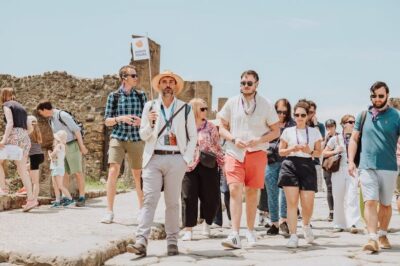
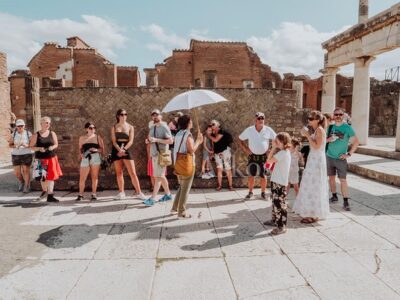
I also like the structure. You’re in the field for about 2 hours 30 minutes, hitting the big “anchor” sites without turning it into a marathon. And with a maximum of 15 people, you’re not swallowed by a crowd. That matters at Pompeii, where paths are narrow and surfaces are uneven.
One more practical win: the route is designed to end in the Forum. You’re not stuck walking back to the start after the tour. You can keep going while your brain is still switched on.
More of the site walked with an archaeologist
- Pompeii and Herculaneum Small Group Tour with an Archaeologist
★ 5.0 · 1,350 reviews - Skip the Line Guided Tour of Pompeii led by an Archaeologist
★ 5.0 · 703 reviews - Pompeii Private Tour with an Archaeologist and Skip The Line – 3 hours
★ 5.0 · 564 reviews
Meeting at Villa dei Misteri and ending at the Forum (the smart flow)
You meet at Pompei Scavi Villa Dei Misteri (80045 Pompeii). That’s a good place to begin because it puts you close to the early story of the city and its neighborhood feel. You’re not starting in the middle of the densest tourist chaos; you’re easing into the site.
The walk finishes at the Pompeii Forum (Foro di Pompei, near Via Villa dei Misteri). That ending is useful for two reasons. First, you’re placed in the main historical center, so if you want more time, you can naturally extend your visit. Second, it gives you a clear finish line. With Pompeii, clarity beats guesswork.
The tour runs roughly during Pompeii’s operating window (the listed hours span 9:00 AM to 7:30 PM). Since the experience requires good weather, pick a day where you won’t be praying for clear skies all morning. Pompeii is outdoors and you’ll be outside for most of the tour.
Price and value: is $42.01 a good deal?
At $42.01 per person, this is priced like a guided “best-of Pompeii” experience rather than a deep, slow academic seminar. The good news is that you’re buying time-saving structure. Pompeii is huge, and without a guide you’ll waste energy figuring out what matters most.
What you should watch: the tour includes the guide (archaeologist) and a mobile ticket, but it does not include food, drink, tip, or any entrance fee. Even if some stop points are marked as admission ticket free within the experience, you can still end up needing your own Pompeii ticket depending on how you enter and what areas you want beyond the guided route. So I’d plan your budget like: guide cost first, then add any site admission you still need.
Where the value really shows up is in the “so what” explanations. You’re not just seeing a mosaic or a temple. You’re learning why it was there, how it connected to Roman life, and how our understanding has changed over time. That’s the difference between seeing Pompeii and understanding it.
Stop-by-stop: how each place earns its spot
Foro di Pompei: the city’s center, explained from start to eruption
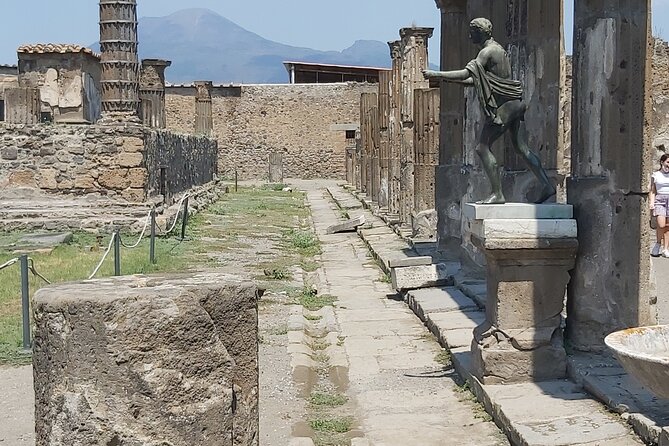
You begin at the Foro di Pompei, and that’s the right move. The Forum is where Pompeii’s civic life happened—religion, politics, commerce, and public identity in one place. A guide can prevent the classic Pompeii problem: you stand in front of impressive ruins but can’t connect them to daily life.
This stop is about the big timeline. The guide explains Pompeii from its origins up to the dramatic eruption of 79 AD. That framing matters, because once you know what comes next, the rest of the route stops feeling like random highlights. You start noticing patterns: where people gathered, what they valued, and how the city arranged power.
Practical consideration: the Forum is open and exposed. Bring sun protection and plan to hydrate before you get tired.

Granai del Foro: granaries, finds, and the victim casts that hit hard
Next you move to the Granai del Foro (the granaries). This is a clever change of pace because it’s not just temples and streets. Granaries are where a city’s survival logic lives: storage, trade, and the systems that keep people fed.
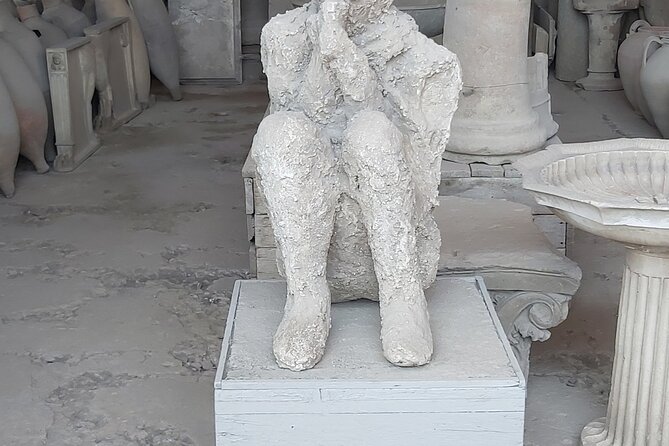
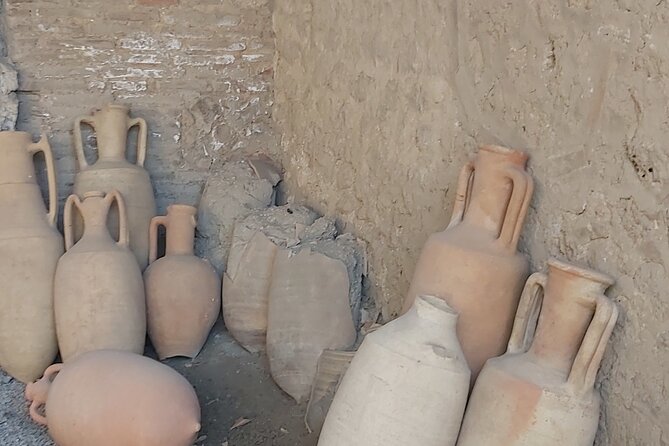
The guide also points out finds connected to the granaries—like amphorae, sculptures, and inscriptions—and then focuses on something emotionally unforgettable: the plaster casts of the victims of the eruption. Even with a short time here, the casts turn the disaster from a chapter in a textbook into human bodies caught mid-moment.
If you’re sensitive, just know that this stop is heavy. It’s also one of the most meaningful parts of Pompeii, and it helps explain why archaeologists treat Pompeii differently than an ordinary set of ruins.
Basilica and Temple of Apollo: power, worship, and Roman design
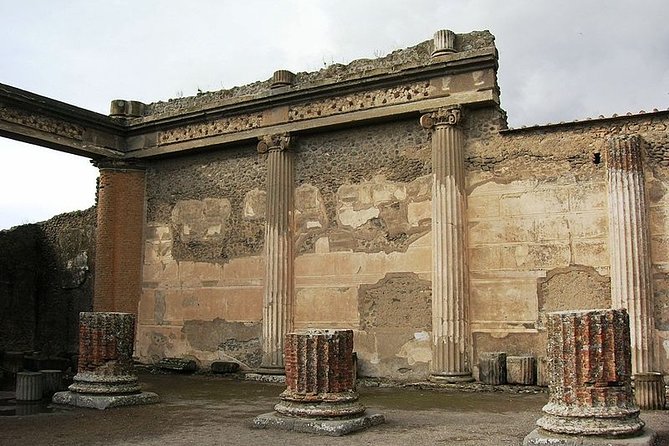
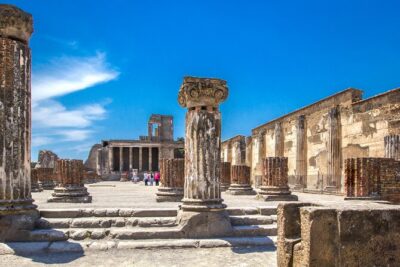
You then head to Pompei La Basilica. The guide explains what a basilica did in Roman civic life—how it functioned as a monumental space and what that meant for people using it day after day. Even if the basilica ruins look like stone walls and columns at first glance, you’ll come away with a mental model of activity.
After that, you visit the Temple of Apollo, a highlight for anyone who likes original architectural details. The guide explains the temple alongside notable finds, including sculptures, an altar, a fountain, inscriptions, columns, and even a Roman sundial. That mix is a clue that these places were practical and symbolic at once: worship, observation, identity, and art in one package.
Good to know: temples can be “fast” stops if you’re not guided. Here, the guide gives you the why behind the layout, which makes the remaining stones feel intentional instead of leftover.
Hotel Vittoria gate and the Cave Canem mosaic: the city edge and a warning sign
A short hop brings you to Hotel Vittoria, described as an ancient gateway to the city and the surrounding area. Even if the name sounds like a modern hotel, it’s functioning here as a marker of the ancient approach—how you entered Pompeii and what you’d meet right away.
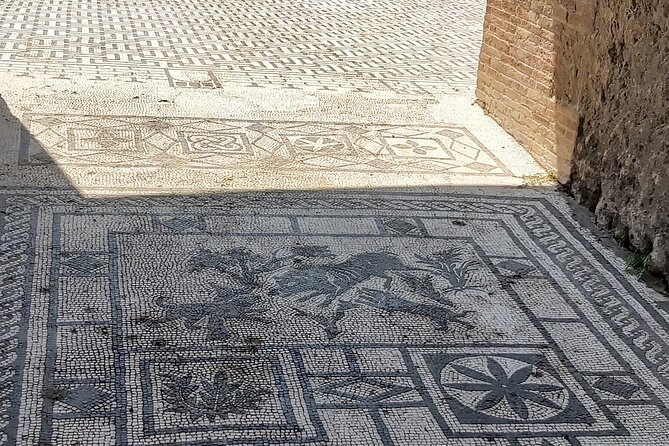
Then you stop at the Pompei Il Mosaico Cave Canem placed at the entrance of the House of the Tragic Poet. The famous warning mosaic is one of those moments that surprises people. It’s funny, slightly rude, and very human: your house front comes with a message. The guide helps connect the mosaic to the setting, so you get more than a photo-op. You get a sense of household personality and street-to-door social rules.
Casa del Fauno: mosaics and statues that make you slow down
The heart-of-the-route stop is Casa del Fauno. The guide focuses on its status as the largest house in Pompeii and on what was found there. If you’ve heard of Pompeii from a distance, this is where the site stops being “that place with volcanic ash” and turns into “the place with ancient art you can actually see.”
Key details include the bronze dancing Faun sculpture and the Alexander Mosaic, described as more than a million tiny colored tiles. That kind of scale is hard to grasp until you’re in front of it, and it changes the way you view everything else. You realize how much effort went into decoration—and how Roman wealth and taste were displayed at home.
Time-wise, you’re only here for about 15 minutes. That’s enough for understanding, but not enough to become an art-student in the gallery. If you want to linger, plan to return later on your own after the tour.
Thermopolium: ancient fast-food and social life you can picture
Next is Thermopolium Regio VI, Insula VIII, 8. A thermopolium is basically an ancient counter for quick meals—something closer to fast food than a formal restaurant. The guide explains the food and the nutrition angle, but more importantly, it highlights social life: who ate here and what that meant for daily routines.
This stop is valuable because it shifts you from “big buildings” to “small transactions.” It’s easier to imagine Pompeii when you can picture a person stepping up for a meal, chatting, and moving on.
Temple of Vespasian: the imperial cult in plain sight
At Temple of Vespasian—also known as the temple of Genius Augusti—you’ll see how Roman rule showed up in local religious practice. The guide explains the Roman imperial cult, which is one of those concepts that can feel abstract until it’s connected to actual architecture.
This is a solid “connect the dots” moment. You’ve already seen civic spaces and worship spaces. Now you see how power and loyalty were staged in sacred form.
Via dell’Abbondanza and the theater district: how the city moved and performed
Then comes Via dell’Abbondanza, Pompeii’s famous main street. The guide explains the road network and urban plan. This is more than a geography lesson. If you understand the street grid, you start noticing how people would travel between markets, homes, and public buildings.
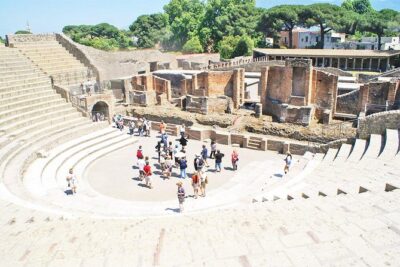
After that, you hit the theater district, with Teatro Grande, Teatro Piccolo, and the Quadriportico dei Teatri. The big value here is context. Pompeii theaters weren’t just architecture. They were social engines: gathering points for public life, entertainment, and community identity.
If you like places where people watched other people, this section will feel especially real.
Doric Temple and Triangular Forum: the oldest layer of worship
You make a quick visit to the Doric Temple, described as the oldest temple in Pompeii, plus the Triangular Forum. Short stop, big meaning. Learning that this is the oldest religious layer makes earlier Pompeii feel less like a backdrop and more like a foundation.
This stop works best when you mentally zoom out: you’re not only seeing stones from one era. You’re seeing a site that layers time.
Stabian Baths (Terme Stabiane): daily routine in a thermal setting
Next is Stabian Baths (Terme Stabiane), one of the extraordinary thermal buildings in Pompeii. Baths were not just for cleanliness. They were part of routine, mixing, and relaxation.
The guide explains the building and what it meant for daily life, helping you understand why people would spend time there. Even if your legs are tired by this point, the baths are the kind of stop that keeps Pompeii from feeling like a museum of only politics and art.
Lupanar: the brothel with famous preservation
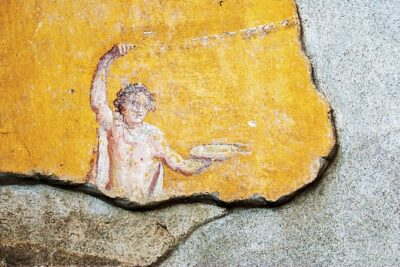
Finally, you visit the Lupanar, Pompeii’s most spectacular example of an ancient brothel. This stop is famous for its exceptional state of conservation, including bedrooms and erotic frescoes depicting amorous positions.
You can expect this to feel jarring, especially if you weren’t expecting it. But it’s also an important slice of life that rounds out the picture. Pompeii wasn’t only made of temples and homes. It included sex work, rules, and human behavior.
If you want to keep the tone comfortable, you might mentally prepare that this is the most adult-focused part of the route.
Pace, group size, and how to make the most of 2.5 hours
This is built for momentum. With 14 stops and about 2 hours 30 minutes overall, you’ll get quick orientations at each place. That’s great if you want to cover key highlights with guided context.
It’s less ideal if your style is: linger, read everything, sit, and think. Pompeii rewards that kind of pace too. But this tour is designed for getting oriented and making the site feel coherent fast.
With a maximum group of 15, you should be able to ask questions without shouting. Still, I’d keep your expectations realistic. Some spots are tight, and the guide is managing timing across the route.
Practical tips that matter at Pompeii
A few things I’d plan for based on how this tour runs through outdoor spaces:
- Wear comfortable shoes with good traction. Pompeii paths can be uneven.
- Bring water and sun protection even if you plan to find snacks later. It’s outdoors most of the day.
- Use the mobile ticket as directed and keep it easy to access on your phone.
- Decide ahead of time what you want after the tour. Since it ends at the Forum, you can extend your walk if you’re still curious.
Also, plan your expectations about comfort. This experience is described as suitable for most people, and service animals are allowed. But “most people” still means plenty of standing and walking.
Should you book this Pompeii archaeologist tour?
Book it if you want Pompeii to feel like a real city, not a pile of impressive buildings. You’ll get a guided narrative built around the Forum, major temples, public life, and even adult street culture, all in one compact route. The small group size and the archaeologist-led explanations (with Dr. Pina Esposito specifically noted) are the main reasons this works.
Consider skipping or pairing it with extra self-guided time if you need a slower pace to absorb details. Also, confirm entrance fees you might still need for the areas you want beyond the route, since the tour itself does not include food, drink, tip, or entrance fees.
If you like your sightseeing structured but not cold, this is a strong way to see Pompeii with context—and leave the site with a clearer story in your head.
FAQ
How long is the Pompeii tour with an archaeologist?
It lasts about 2 hours 30 minutes.
What does the tour cost?
The price is $42.01 per person.
What language is the tour offered in?
It’s offered in English, Italian, or German.
Where do I meet and where does the tour end?
You start at Pompei Scavi Villa Dei Misteri and the tour ends at the Pompeii Forum (Foro di Pompei).
What’s included in the price?
The tour includes a guided experience with an archaeologist/guide in the selected language and a mobile ticket.
What’s not included?
Food and drink, tip, and any entrance fee are not included.
How large is the group?
The maximum group size is 15 travelers.
Is a mobile ticket used?
Yes, it uses a mobile ticket.
Is the tour dependent on weather?
Yes. It requires good weather, and if it’s canceled due to poor weather, you’ll be offered a different date or a full refund.
What’s the cancellation window?
You can cancel up to 24 hours before the experience’s start time for a full refund, and cancellations made within 24 hours are not refunded.
More Tour Reviews in Pompeii
- Pompeii Small Group Tour with an Archaeologist★ 5.0 · 6,593 reviews
- Discover the Ancient Ruins of Pompeii: Day Trip from Rome★ 3.5 · 2,247 reviews
- Pompeii and Herculaneum Small Group Tour with an Archaeologist★ 5.0 · 1,350 reviews
- Skip the Line Guided Tour of Pompeii led by an Archaeologist★ 5.0 · 703 reviews
- Pompeii Ticket + Tour with Optional Tasting Experience at Pompeii★ 5.0 · 663 reviews
More Tours Led by an Archaeologist
- Pompeii Small Group Tour with an Archaeologist★ 5.0 · 6,593 reviews
- Pompeii and Herculaneum Small Group Tour with an Archaeologist★ 5.0 · 1,350 reviews
- Skip the Line Guided Tour of Pompeii led by an Archaeologist★ 5.0 · 703 reviews
- Pompeii Private Tour with an Archaeologist and Skip The Line – 3 hours★ 5.0 · 564 reviews
- Pompeii Skip-the-line Tour with Archaeologist Guide★ 5.0 · 559 reviews
Just reviewed: more Pompeii tours and day trips



Pompeii Archaeologist-Led Tours, compared.
 ★ 4.8Entry Ticket and Guided Tour with an ArchaeologistFrom $3519,459 reviews
 ★ 4.8Small Group Tour with an ArchaeologistFrom $4012,264 reviews
★ 5.0Pompeii Small Group Tour with an ArchaeologistFrom $356,593 reviews
★ 4.8Small Group Tour with an ArchaeologistFrom $4012,264 reviews
★ 5.0Pompeii Small Group Tour with an ArchaeologistFrom $356,593 reviews
 ★ 5.0Pompeii and Herculaneum Small Group Tour with an ArchaeologistFrom $771,350 reviews
 ★ 5.0Skip the Line Guided Tour of Pompeii led by an ArchaeologistFrom $95703 reviews
 ★ 4.9Exclusive Tour with Archaeologist and Entry TicketsFrom $50634 reviews
 ★ 5.0Pompeii Private Tour with an Archaeologist and Skip The Line – 3 hoursFrom $302564 reviews
 ★ 5.0Pompeii Skip-the-line Tour with Archaeologist GuideFrom $71559 reviews
Browse the lists this tour appears in