
Reviewed · POMPEII SKIP-THE-LINE ENTRY
Pompeii: Guided Tour with Priority Entrance
Pompeii is chaos without a plan. This guided tour uses priority admission so you waste less time in line, and it pairs that with a real licensed guide plus headsets for clear commentary even when the site feels packed. You also get a tight walk through the big story centers of the ancient city, with stops that connect everyday life to major monuments.
The main tradeoff is time. Pompeii covers a lot of ground, so 2.5 hours means you see the highlights and the most meaningful anchors, not every street and house. It’s also hot work on uneven stone paths, so bring good walking shoes and expect some standing around for short photo and explanation moments.
In This Review
- Key points at a glance
- Why priority entrance at Pompeii changes everything
- Meeting at Camping Zeus: get oriented and start listening
- The Pompeii Forum route: Basilica, Civil Forum, Temple of Jupiter
- Markets and main streets: Macellum and Via dell’Abbondanza
- House of the Faun mosaics: art that tells a story
- Stabian Baths: how Romans did cold, warm, and hot
- Lupanar stop: the famous brothel and its wall paintings
- Large Theater: open-air performances and crowd energy
- Pacing and group size: what 2 hours 30 minutes really means
- What you should wear and bring on this Pompeii walk
- Price and value: is $59.13 a fair deal?
- Who should book this Pompeii priority guided tour
- Should you book? My practical decision guide
- FAQ
- How long is the Pompeii guided tour with priority entrance?
- How much does the tour cost?
- What language is the tour guide?
- Is priority admission included?
- Are headsets included for listening to the guide?
- Where do I meet the guide?
- How big is the group?
- What if the weather is bad or I need to cancel?
Key points at a glance
- Priority entrance: skip the line so you start exploring faster.
- Headsets: built for busy outdoor crowd noise, especially in groups over 10.
- Forum focus: you’ll connect daily life to the Basilica, Civil Forum, and Temple of Jupiter.
- “What you’re looking at” context: your guide helps translate ruins into stories of administration, markets, and worship.
- Not just buildings: mosaic art in the House of the Faun and the Large Theater give variety.
- Short add-ons: Stabian Baths and the Lupanar fit in without dragging your day.
Why priority entrance at Pompeii changes everything
Pompeii is one of those places where the site is amazing, but the first thing you feel is the queue. This tour includes skip-the-line admission fees, which matters because you’re paying for time control. If you arrive late or stuck behind groups without priority, you lose the best part of the visit: the first stretch when your energy is still high and the light is good.
The other value is psychological. When you enter earlier, you’re more likely to follow the route smoothly instead of rushing to “beat” other tour groups. And because the tour is guided, you’re not just looking at stones and wondering what each one used to do.
It’s also a good sign that the tour is capped (maximum 25 travelers). A smaller group tends to move with fewer bottlenecks, and that makes the priority entrance work better.
More ways past the ticket queue
- Skip the Line Guided Tour of Pompeii led by an Archaeologist
★ 5.0 · 703 reviews - Pompeii Private Tour with an Archaeologist and Skip The Line – 3 hours
★ 5.0 · 564 reviews - Pompeii Skip-the-line Tour with Archaeologist Guide
★ 5.0 · 559 reviews
Meeting at Camping Zeus: get oriented and start listening
You meet your guide at Camping Zeus, Via Villa dei Misteri 3, 80045 Pompei NA, Italy. The tour ends back at the meeting point, so you don’t have to figure out your own logistics at the finish—handy when your phone battery is low and your legs are tired.
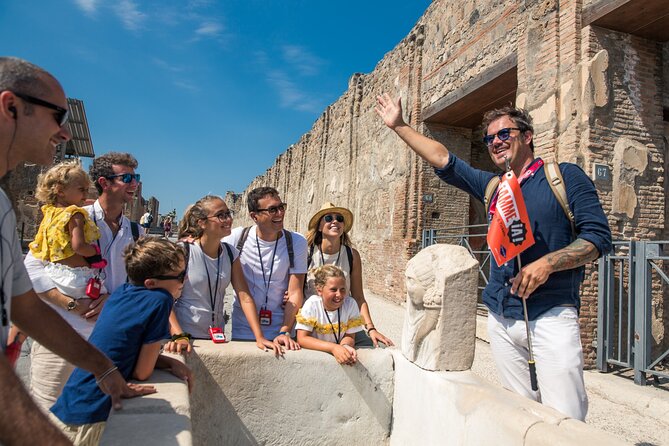
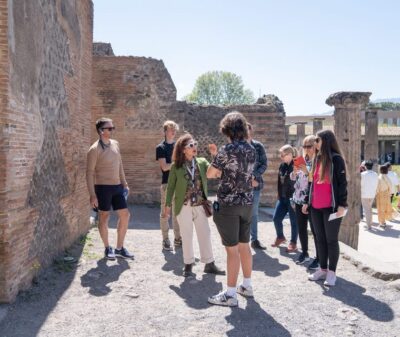
Once you find the group, the headsets (included) are your key comfort tool. They’re especially helpful because Pompeii is an outdoor site with constant noise: people talking, footsteps on stone, and guides repeatedly pausing for photos and questions. With headsets, you can stand in the right spot and still catch what the guide is saying.
A practical tip from the nature of Pompeii: don’t show up five minutes before. Even when meeting points are easy to find, you want time to settle in, check your headset, and be ready when the group starts moving.
The Pompeii Forum route: Basilica, Civil Forum, Temple of Jupiter
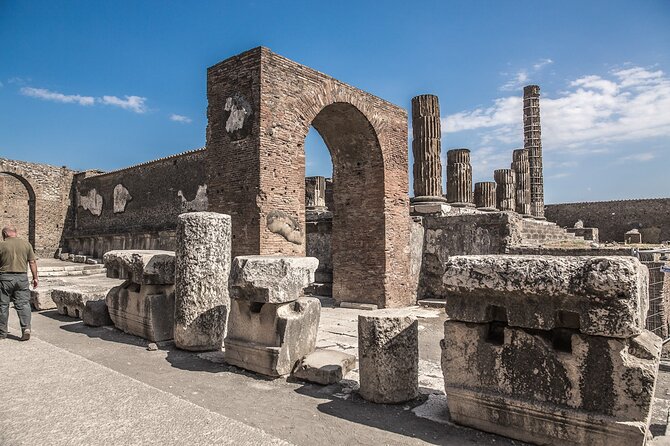
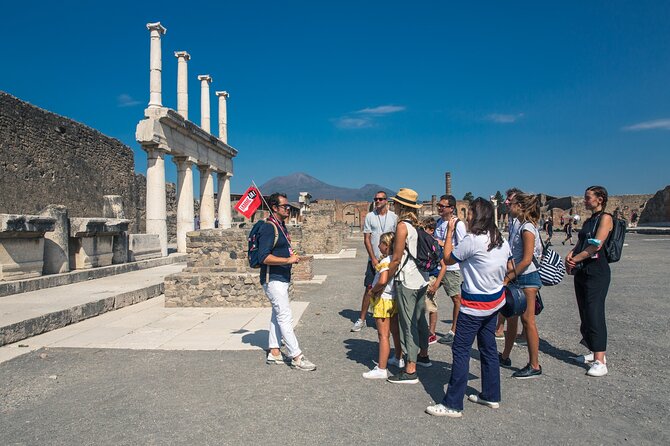
Most first-time visitors come to Pompeii for the “wow” images, but the smartest way to understand the city is through the core public spaces. This tour leads you into the Civil Forum, the heart of everyday life: where administration, justice, business, trade, and civic worship all intersected.
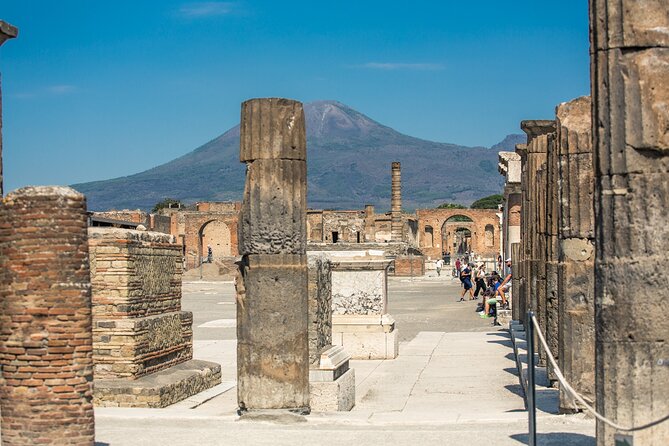
From here, you get to the Temple of Jupiter area. The guide’s explanation helps you see why this wasn’t just a temple. When the colony was founded around 80 BC, the temple was radically renovated and became a Capitolium-style centerpiece, with statues linked to Jupiter, Juno, and Minerva. The location also gives you that classic Pompeii feeling—Mount Vesuvius rising in the background while you read the city’s layout in front of you.
Then comes the Basilica. It’s a huge structure at roughly 1,500 square meters, and the point is what it hosted: business activity and administration of justice. The design is also a big “click moment” for visitors who don’t know what they’re looking at. You access it from the Forum through entrances with tuff pillars, and inside it’s organized into three naves with brick columns and Ionic capitals. That architecture turns the ruins from scenic into meaningful.
The big drawback with this Forum-heavy plan is that you may feel you’re standing in a few clusters for a while. That’s the cost of explaining complex spaces in a crowded open area.
Markets and main streets: Macellum and Via dell’Abbondanza
After you understand the civic center, the tour widens your view to daily life and commerce. The Macellum is one of the best stops for that. It’s described as a tuff quadriporticus—basically a market complex—plus a worship hall positioned on the elevated eastern side. You’ll also hear why statue fragments matter here, including details tied to the imperial cult.
This is also where you get a sense of how food culture and civic identity mixed. There’s mention of a counter-like masonry feature that likely relates to fish sales. Even if you don’t catch every technical detail, the guide’s context helps you interpret the rooms as functional spaces, not random walls.
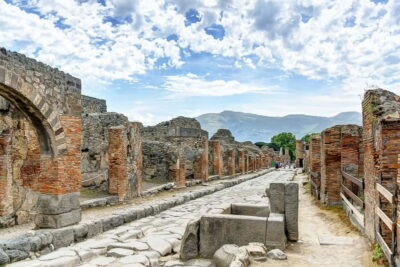
Then you walk down Via dell’Abbondanza, the ancient main street, a decumanus maximus running east to west from the Forum toward Porta Sarno. This street in Roman Pompeii was loud and busy in your imagination: shops, workshops (officinae), cafes, snack-bars, and restaurants for food and drink. For many people, this is where Pompeii stops feeling like a museum display and starts feeling like a place with noise, rhythm, and errands.
A good consideration: main streets can be busy with other tours and self-guided visitors. Your headsets help here, but you’ll still feel the “moving through the crowd” vibe.
House of the Faun mosaics: art that tells a story
The tour includes a stop inside the House of the Faun, famous for its mosaics. The headline here is the Alexander Mosaic, a major masterpiece that makes you realize how skilled Pompeiians were with art and narrative.
What I like about including this house in a short 2.5-hour plan is variety. If you only see temples and public buildings, Pompeii can feel one-note. The mosaic changes the emotional temperature because it brings creativity, status, and storytelling into the ruins.
Just be aware that house visits are still “highlights mode.” The guide points you to the important areas, but the full house experience is bigger than any two-hour route. If you’re an art-only person, you might want extra time later to circle back on your own.
More guided visits to choose


Stabian Baths: how Romans did cold, warm, and hot
Next you move to the Stabian Baths (Terme Stabiane). This set of baths is located behind the Temple of Jupiter and dates to shortly after the colony was founded by veterans around 80 BC. The tour connects the layout to real routines by explaining how the bathing sequence worked in different rooms.
One of the standout concepts is the separation of entrances for women and men. Then the men’s side is broken into spaces with specific temperature functions: an apodyterium (dressing room) that also served as a tepidarium, plus frigidarium for cold baths and calidarium for hot baths. That mental map helps you look at ruins and understand daily habits.
A useful note is the earthquake damage. Like many buildings in Pompeii, the baths were heavily damaged in 62 AD. That’s a reminder that the ruins you’re seeing aren’t just “old,” they’re the result of a specific event that changed the city’s fate.
This stop is listed as short, so you’ll get the big picture fast and then keep moving.
Lupanar stop: the famous brothel and its wall paintings
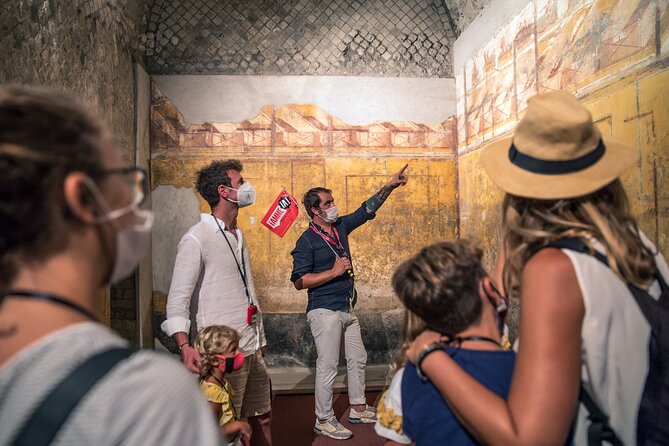
Pompeii’s Lupanar is included, and it’s probably the most talked-about stop on the entire site. It’s the Lupanar of Pompeii, also called Lupanare Grande, and it’s known for erotic paintings on the walls. The guide’s framing is important here: you’re not just looking for shock value, you’re learning how a Roman city had commercial, social, and private spaces—and how art communicated what people wanted or expected.
You’ll hear that the prostitutes were mostly Greek and Oriental slaves and were paid in units called asses, with the tour text even giving a comparison point (a glass of wine costing one As). It’s a strange detail, but it helps your brain process the scale of economics and daily costs.
This part of Pompeii can feel intense in a group setting. The rooms are small, the subject is adult, and the tour time here is brief. If you prefer a more neutral walkthrough, you might treat this as a quick context stop and focus your energy elsewhere.
Large Theater: open-air performances and crowd energy
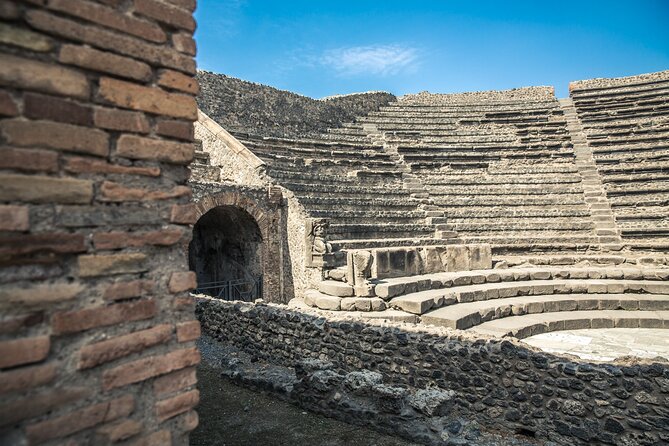
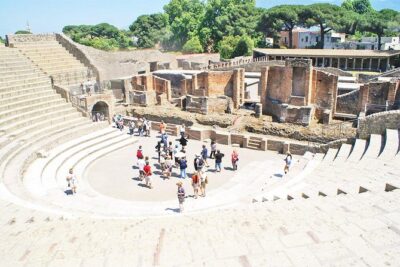
The tour also takes you toward the Large Theater, an open-air venue where crowds gathered for comedies, dramas, and musical performances. Even in ruins, the theater helps you picture Pompeii as a city with leisure and shared culture, not only work and worship.
This stop also offers a break in style. Temples and forums are “civic reading.” The theater is “public gathering reading.” You’ll feel it more when you stand where the audience once faced the stage.
Time can be tight here. With a short guided route, you might get a description and a few key vantage points rather than a slow sit-down moment.
Pacing and group size: what 2 hours 30 minutes really means
With an approximate duration of 2 hours 30 minutes, you’re seeing a curated path: priority entry, then the main public anchors, plus two extra “signature” spaces (baths and brothel) and a mosaic/art stop. The tour time works because the guide keeps you focused on what matters most in layout and meaning.
The group limit is 25 travelers, and headsets help keep the commentary clear when the group is larger than 10. If your group ends up on the smaller side, you’ll likely feel the pacing is smoother and you can ask more direct questions.
Where some tours can go wrong at Pompeii is when groups try to squeeze too much into the same corridors, creating bottlenecks. This one tries to prevent that with a planned route and a guide who manages movement. Still, be realistic: Pompeii is popular. You will share space with other visitors.
What you should wear and bring on this Pompeii walk
Pompeii is hot and uneven. The tour notes point you to sunscreen and comfortable shoes for summer heat, and the on-the-ground reality is that you’ll step across stone surfaces that aren’t perfectly level. Think grip-first footwear, not fashion-first sandals.
I also recommend you travel light. Some past visitors stressed not carrying heavy bags, because you’re constantly moving between rooms and open areas. A small daypack is fine, but keep it simple.
Water matters. Even though fountains exist on site for topping up, you still want your own plan: buy or carry water before you start, then use site options to refresh as needed. If you’re sensitive to heat, consider choosing an earlier departure when the air is cooler and crowds are thinner.
Finally, use the headsets as intended. If yours seems quiet or crackly, let staff know quickly so you don’t lose the commentary during the best stops.
Price and value: is $59.13 a fair deal?
At $59.13 per person for about 2.5 hours, you’re paying for three things that are hard to recreate on your own: a licensed guide, priority admission that cuts the worst queue pain, and headsets that make the explanation usable in a noisy outdoor site.
You also get admission coverage for key parts of the visit. The archaeological park ticket is included, and specific stops like the Lupanar and Basilica are listed as admission ticket included or free as part of the tour structure. Stabian Baths are also listed as free with the tour timeframe. In other words, you’re not only buying guidance; you’re also bundling site access in a way that usually saves time on tickets and decision-making.
The tour is particularly good value if you only have one Pompeii morning and want to hit the core without getting lost in interpretation. It’s less of a bargain if you have plenty of time, enjoy self-guided exploration, and don’t mind reading slowly while dodging the crowd.
A final value note: this kind of tour often sells well. It’s commonly booked around 42 days in advance on average, which tells me the early planning helps.
Who should book this Pompeii priority guided tour
This works best for you if:
- It’s your first time in Pompeii and you want a guided backbone through the Forum and signature sites.
- You want priority entrance so the day doesn’t start with long queue time.
- You like structured walking and a guide who explains how spaces connect to daily life.
- You appreciate headsets for clear listening in a crowded outdoor area.
It might not be the right match if:
- You want total freedom to roam at your own pace with no regrouping.
- You’re traveling with people who struggle with short stops, uneven ground, or heat pacing.
- You’re chasing every single corner of the site, since this plan focuses on highlights over full coverage.
Should you book? My practical decision guide
Book this tour if you’re prioritizing time, context, and a clean path through Pompeii’s most important areas. The priority entrance plus headsets make the experience more comfortable and more understandable, especially during the busy middle of the day.
Skip it if you’re the type who wants to wander endlessly and take your time between tiny details. Pompeii rewards that style too, but you’ll need to plan ticketing and navigation carefully, and you’ll miss some of the “this is why it’s here” explanations that make the ruins click.
If you do book, pick a time slot that fits your heat tolerance. Start early when you can, wear sunscreen, use good shoes, and you’ll get a lot of meaning out of every step.
FAQ
How long is the Pompeii guided tour with priority entrance?
It runs for about 2 hours 30 minutes.
How much does the tour cost?
The price is $59.13 per person.
What language is the tour guide?
The tour is offered in English.
Is priority admission included?
Yes. You get skip-the-line admission to the Pompeii archaeological site.
Are headsets included for listening to the guide?
Yes. Headphones/headsets are included for groups bigger than 10 passengers.
Where do I meet the guide?
You meet at Camping Zeus, Via Villa dei Misteri 3, 80045 Pompei NA, Italy.
How big is the group?
The maximum group size is 25 travelers.
What if the weather is bad or I need to cancel?
You can cancel for free up to 24 hours in advance for a full refund. The experience requires good weather, and if it’s canceled due to poor weather you’ll be offered a different date or a full refund.
More Guided in Pompeii
- Skip the Line Guided Tour of Pompeii led by an Archaeologist★ 5.0 · 703 reviews
- Pompeii private tour with an Official Guide★ 5.0 · 631 reviews
- Pompeii Skip-the-line Tour with Archaeologist Guide★ 5.0 · 559 reviews
- Pompeii Guided Tour & Horse Riding on Vesuvius with Lunch★ 5.0 · 419 reviews
- Complete Pompeii Skip the Line Tour with Archaeologist Guide★ 4.5 · 379 reviews
More Tour Reviews in Pompeii
- Pompeii Small Group Tour with an Archaeologist★ 5.0 · 6,593 reviews
- Discover the Ancient Ruins of Pompeii: Day Trip from Rome★ 3.5 · 2,247 reviews
- Pompeii and Herculaneum Small Group Tour with an Archaeologist★ 5.0 · 1,350 reviews
- Skip the Line Guided Tour of Pompeii led by an Archaeologist★ 5.0 · 703 reviews
- Pompeii Ticket + Tour with Optional Tasting Experience at Pompeii★ 5.0 · 663 reviews
Skip-the-Line Entries, More to Book
- Skip the Line Guided Tour of Pompeii led by an Archaeologist★ 5.0 · 703 reviews
- Pompeii Private Tour with an Archaeologist and Skip The Line – 3 hours★ 5.0 · 564 reviews
- Pompeii Skip-the-line Tour with Archaeologist Guide★ 5.0 · 559 reviews
- Pompeii Private Tour with an Archaeologist and Skip The Line★ 5.0 · 391 reviews
- Complete Pompeii Skip the Line Tour with Archaeologist Guide★ 4.5 · 379 reviews
Just reviewed: more Pompeii tours and day trips




Pompeii Skip-the-Line Entry, compared.
 ★ 4.0Skip-the-Line Entrance Ticket with Audio GuideFrom $392,509 reviews
 ★ 4.6Skip-the-line-Ticket and Guided TourFrom $641,152 reviews
 ★ 4.9Guided Tour with Skip-the-Line EntryFrom $58812 reviews
 ★ 4.1Skip-the-Line Entry Ticket with Digital Guide AppFrom $22770 reviews
 ★ 4.9Pompeii Ruins Private Tour with Optional Skip-the-Line EntryFrom $254732 reviews
 ★ 5.0Skip the Line Guided Tour of Pompeii led by an ArchaeologistFrom $95703 reviews
 ★ 5.0Pompeii Private Tour with an Archaeologist and Skip The Line – 3 hoursFrom $302564 reviews
 ★ 5.0Pompeii Skip-the-line Tour with Archaeologist GuideFrom $71559 reviews
Browse the lists this tour appears in