

Reviewed · POMPEII ARCHAEOLOGIST-LED TOURS
PompeiI Exclusive Tour with your Archaeologist in a Small Group
Pompeii makes more sense with the right guide. This small-group, archaeologist-led tour uses a priority line and a tight route so you see the city’s big ideas in about 2 hours. I love the stop-by-stop explanations that help you read the ruins instead of just walking past them, and I like the relaxed pace for questions. One thing to plan for: the Pompeii Archaeological Park admission ticket is not included in the tour price.
You’ll start at Porta Marina Superiore, where the guide waits outside the archaeological park with a sign that says Pompeii Vip. From there, you move through major religious, civic, and daily-life spots: the Temple of Venus, the Forum area with the Basilica and Jupiter, the Macellum market, Forum Baths, a Thermopolium (an ancient diner), and big-name houses like the House of the Faun and the House of the Vettii. The walk ends back at the meeting point after hitting Pompeii’s most important highlights.
This is a great fit if you want structure, context, and less guesswork. Pompeii is huge and uneven, so you’ll still want good shoes and a little patience, especially if you arrive during peak crowds.
In This Review
- Key takeaways before you go
- Pompeii VIP entry at Porta Marina Superiore (what it changes for your day)
- Pompeii in 10-minute chunks: how the route stays manageable
- Temples near Porta Marina: Venus and Apollo as your orientation points
- The Forum’s center of gravity: Basilica, Main Square, and Jupiter
- Macellum market to Forum Baths: how people ate, shopped, and cleaned up
- Thermopolium and two major houses: daily refreshment and elite life
- Via dell’Abbondanza to Teatro Grande: walking the main street and watching plays
- What an archaeologist guide actually adds (and how to use it)
- Simple questions that pay off
- Price and logistics that affect value: tour fee vs site ticket
- Small-group comfort: shoes, weather, and headset basics
- Should you book this Pompeii archaeologist tour?
- FAQ
- How long is the Pompeii exclusive tour with an archaeologist?
- Is the Pompeii Archaeological Park entrance ticket included in the price?
- What is the entrance fee for Pompeii?
- How do I get Pompeii entry tickets if they are not included?
- Where does the tour start, and where does it end?
- What group size should I expect?
- Is the tour offered in English?
- What happens if the weather is bad?
- Is free cancellation available?
Key takeaways before you go
- Porta Marina Superiore VIP-style entry to help you avoid the gate crush
- Small group (max 15) for smoother pacing and real Q and A time
- Two hours that actually covers the core: Forum, baths, market, houses, and theater
- Archaeologist-led interpretation that explains how scholars know what they know
- Tickets are separate: you pay for the tour now, then buy Pompeii site admission on your own (with help)
- Comfort matters: expect a lot of walking on stone in Pompeii
Pompeii VIP entry at Porta Marina Superiore (what it changes for your day)
The meeting point is Via Villa dei Misteri 1, 80045 Pompei NA, Italy, and the tour ends back there. Your guide meets you outside the archaeological park at the western entrance, Porta Marina Superiore, holding a sign labeled Pompeii Vip. That setup matters because Pompeii gate lines can eat a chunk of your short time.
The practical win here is the separate priority line. It doesn’t make Pompeii feel tiny, but it keeps the morning or afternoon from starting with a long standstill. With only about two hours, saving time at the entrance helps you spend that effort where it counts: looking closely at the Forum, the temples, and the everyday buildings that people actually used.
If you’ve been to Roman sites before, you know the first few minutes set the tone. With this format, you get oriented quickly and you’re not stuck wondering what you’re looking at.
More of the site walked with an archaeologist
- Pompeii and Herculaneum Small Group Tour with an Archaeologist
★ 5.0 · 1,350 reviews - Skip the Line Guided Tour of Pompeii led by an Archaeologist
★ 5.0 · 703 reviews - Pompeii Private Tour with an Archaeologist and Skip The Line – 3 hours
★ 5.0 · 564 reviews
Pompeii in 10-minute chunks: how the route stays manageable
This tour is about 2 hours and runs in English. The stops are timed out in short visits, around 10 minutes each, so you get a tour that’s more like a well-guided highlights walk than a slow museum shuffle.
That pacing is useful because Pompeii rewards attention. If you wander without context, you’ll recognize columns and doorways, but you might miss what makes each place different. The guide’s job is to connect the dots: how religious spaces relate to the public heart of the city, how markets connect to daily food, and how the baths and taverns fit into routine life.
The best benefit of the small group is that the guide can adjust. You can ask a question and get an answer without waiting for a long pause in the crowd. And since the tour caps at 15 people, it tends to feel less like a conveyor belt.
Temples near Porta Marina: Venus and Apollo as your orientation points
The route begins with two religious anchor stops: the Tempio di Venere (Temple of Venus) and the Sanctuary of Apollo. Even if you’re not a big mythology person, these stops help you understand why Pompeii’s city life wasn’t separated from worship.
Venus was the patron goddess of Pompeii, and seeing the Temple of Venus early gives you a baseline for how the city organized belief around public spaces. Then Apollo’s sanctuary shows you how Pompeii’s worship spots weren’t random. The guide points out that the Sanctuary of Apollo sits in one of the oldest worship areas and that it connects strategically along the street leading toward the public core.
These stops also help you start noticing street patterns. When you know where the important streets lead, the rest of Pompeii feels less like a maze.
The Forum’s center of gravity: Basilica, Main Square, and Jupiter
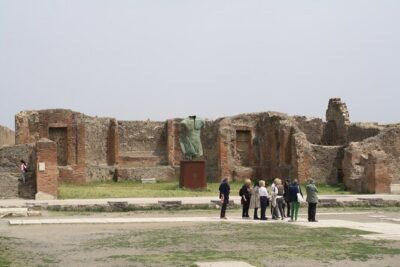
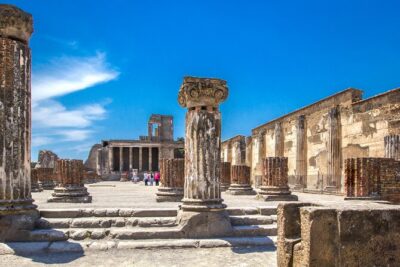
Next you move into the civic spine of Pompeii: the Basilica and the Forum (Main Square), plus the Tempio di Giove Capitolino (Temple of Jupiter). This is where Pompeii stops being a collection of buildings and starts feeling like a functioning city.
The Basilica was one of the most lavish buildings in the Forum. It served business management and administration of justice, which is a big clue about Pompeii’s priorities. You’re not just seeing architecture; you’re seeing where decisions happened and where people conducted public life.
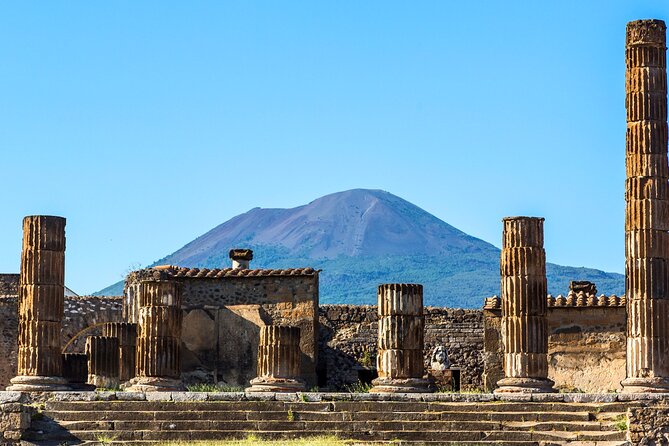
In the Forum itself, the guide frames it as the center of daily life. That matters because the Forum is busy in your mind once you learn what it represented. Then the Temple of Jupiter dominates the northern side of the Forum, with Vesuvius rising behind it. That visual relationship is one of Pompeii’s most memorable moments, and having a guide helps you look at it like a place people truly lived with, not just a postcard view.
Macellum market to Forum Baths: how people ate, shopped, and cleaned up
From the Forum you head toward the Macellum, a monumental market building used for selling food and daily consumer products. This is where the tour gets very practical: you start picturing routine errands and meals rather than only ceremonies and laws.
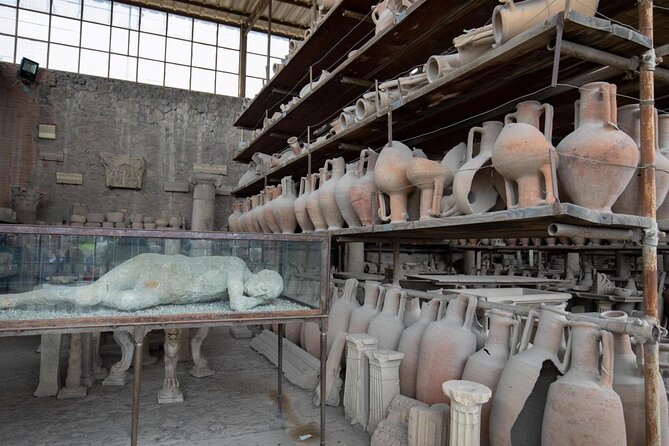
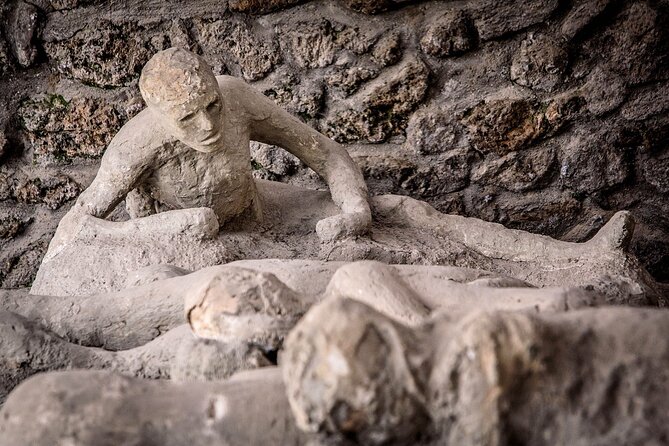
One of the most interesting details you may encounter here is the mention of plaster casts, called BODIES, as an archaeological method used to reveal what people looked like at the moment of the eruption. That turns the tragedy you associate with Pompeii into something more human and more grounded in scientific work.
Then you shift to the Terme del Foro (Forum Baths), which are among the best-preserved elements of the city. You’ll see how the baths were organized, including separate entrances for female and male areas. Again, it’s not just about seeing a building. It’s about seeing daily privacy and routine built into the city’s design.
If you want Pompeii to feel real, these stops are key. Food and bathing were major parts of everyday life, and the guide’s explanations make those spaces easier to imagine in use.
Smaller groups and quieter hours

Thermopolium and two major houses: daily refreshment and elite life
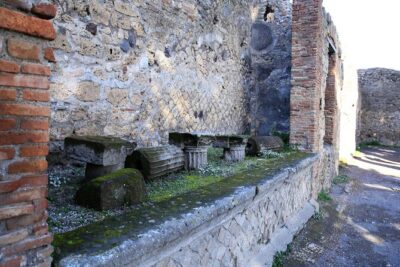
After the baths, you’ll pass through the Termopolio di Vetuzio Placido, a Thermopolium. A Thermopolium was basically an ancient diner, a place for refreshment and quick stops in the rhythm of the day. This is a small detail that can help you “get it” fast: Pompeii wasn’t just grand public buildings. It also ran on everyday commerce and convenience.
Then the tour moves to the housing highlights: the Casa del Fauno (House of the Faun) and the House of the Vettii. The Casa del Fauno is one of the largest houses in Pompeii, and you’ll notice the welcome inscription on the sidewalk, with HAVE in Latin. It’s the kind of detail that makes Pompeii feel like a lived-in place rather than a staged ruin.
The House of the Vettii is among the richest and most famous homes in Pompeii. The tour framing here includes Priapus, a god associated with prosperity, tied to the house’s identity and story. The guide can also connect what you see in the house to what it suggests about wealth, status, and household life.
One note: these houses can be subject to seasonal openings and closings. So if a specific interior isn’t open on your day, you’ll still get the essential context and what you can see from the accessible areas.
Via dell’Abbondanza to Teatro Grande: walking the main street and watching plays
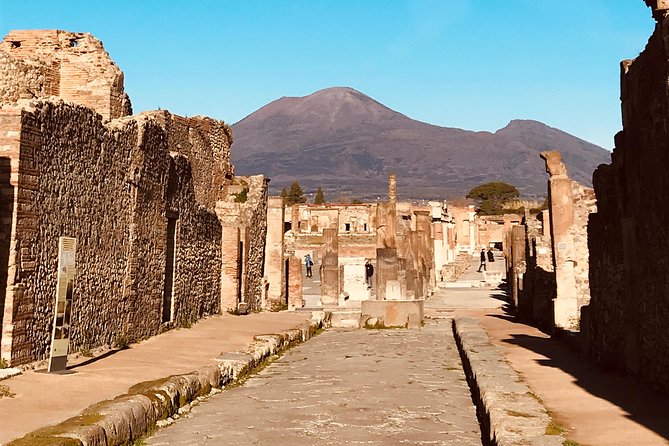
Via Dell’Abbondanza is the ancient main street, the decumanus maximus. This part matters because it’s where Pompeii starts to look like a city you could navigate. It’s the kind of street where shops and foot traffic would have shaped the mood, and the guide helps you connect the buildings back to the daily flow.
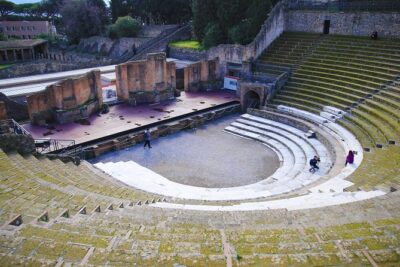
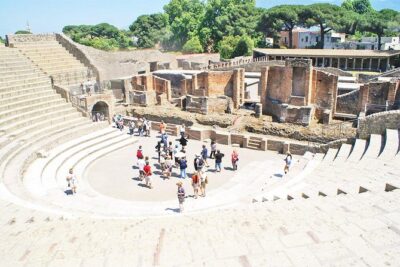
Then you finish at Teatro Grande, the large theater where comedies and tragedies in the Greco-Roman tradition were performed. This is a good finale because it adds culture and entertainment to the mix. After markets, baths, homes, and the civic center, you finally get a space built for shared public experience.
If you like stories of how people spent time, this is the moment where Pompeii feels less clinical and more human.
What an archaeologist guide actually adds (and how to use it)
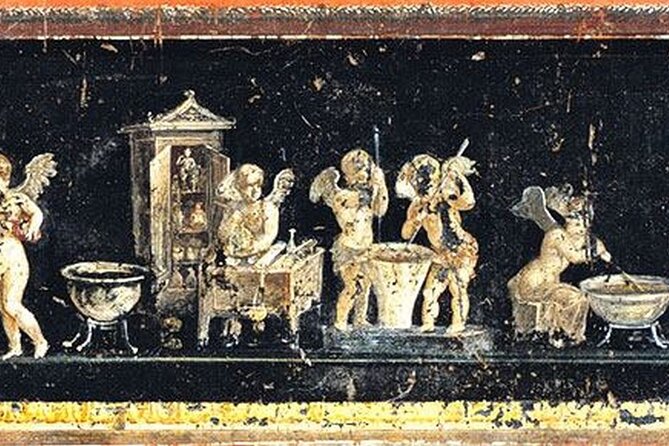
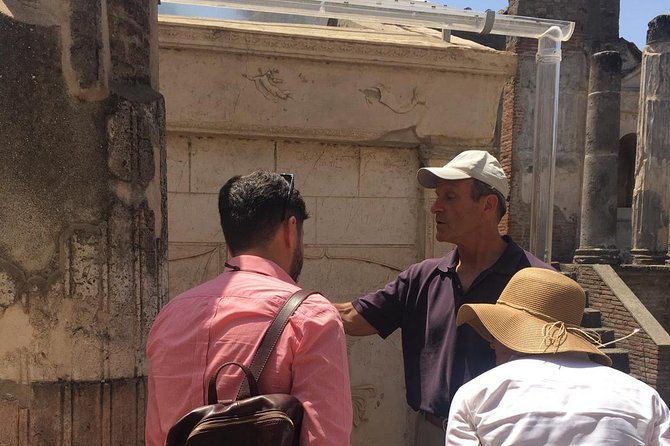
A major reason this tour rates so highly is the way the guide explains not only what you’re seeing, but how archaeologists figure it out. The best guiding style here sounds like real teaching: connecting physical remains to interpretation methods.
In the experience led by guides such as Antonio, Ricardo, Raffaele, Ornella, and PierLuigi, the common thread is clear English and patient answers. One of the smartest teaching habits you can look for is the guide asking questions back to the group to help you notice details yourself. That turns you from spectator into participant.
You can also get “inside Pompeii” perspective. In past guides, there’s been a focus on areas under current excavation, when access and rules allow. That gives you a sense of Pompeii as an active research site, not a finished product behind glass. If photos aren’t allowed in that area, you’ll likely be reminded in the moment, and the guide may share other visuals afterward.
Simple questions that pay off
Ask things like:
- How do we know this was used as a market or as a bath area?
- What clues suggest who lived here or how people moved through the city?
- What’s the most recent interpretation that changed our understanding?
A good guide will answer in a way that makes the stones stop being random.
Price and logistics that affect value: tour fee vs site ticket
The tour price is $30.25 per person, and it lasts about 2 hours. But Pompeii Archaeological Park admission is separate at €19 per adult (free under 18). So the real cost is the tour fee plus the site ticket you buy on arrival with help.
Here’s the value logic: the paid part buys you expert guidance and time savings at the entrance, plus a planned route that hits the core stops without you having to puzzle out what matters. The site ticket is the entry cost you’d pay no matter what. You’re not paying extra for the ruin itself; you’re paying for making sense of it fast.
The tour provider sends a link the afternoon before so you can buy entrance tickets online. It also helps with skip-the-line options, but it’s important to note the Viator ticket is not the Pompeii entry ticket. Think of it like a booking for the guided portion, not your park access.
Also, this experience is often booked about 25 days in advance on average, so if your travel dates are fixed, don’t wait until the last week.
Small-group comfort: shoes, weather, and headset basics
Pompeii requires good walking shoes. Stone surfaces, steps, and uneven ground are normal. Even if you’re only on the site for two hours, your feet will notice.
Weather matters too. This experience requires good weather, and if it’s canceled due to poor conditions, you’ll be offered a different date or a full refund. Pompeii isn’t the place where you want to be rushing through puddles with slippery soles.
Some guides use audio equipment in the form of an earpiece. One past situation included a headset that didn’t work during the tour. My advice is simple: if you’re given an earpiece at the start, test it right away and alert the guide quickly if sound is missing.
Should you book this Pompeii archaeologist tour?
Book it if you want Pompeii to feel understandable, not just vast. You’re getting a structured walk through the most important sights in about two hours, led by an archaeologist guide style that explains how scholars interpret ruins. The priority entry helps you protect your time, and the small group size makes Q and A realistic.
Skip it or switch plans if you want a long, independent stroll where you pick every detour. This route is built around highlights, so it won’t cover everything in Pompeii at an unhurried museum pace.
If you’re visiting from Naples and you only have a half-day to spare, this is an efficient way to get your bearings and learn the city’s logic fast.
FAQ
How long is the Pompeii exclusive tour with an archaeologist?
It lasts about 2 hours.
Is the Pompeii Archaeological Park entrance ticket included in the price?
No. The tour price does not include the Pompeii Archaeological Park admission ticket.
What is the entrance fee for Pompeii?
The Pompeii Archaeological Park admission is €19 per adult, and it is free for visitors under 18.
How do I get Pompeii entry tickets if they are not included?
You’ll receive a link the afternoon before the tour to help you buy entrance tickets online, and the guide can also help once you’re on site.
Where does the tour start, and where does it end?
You meet at Via Villa dei Misteri, 1, 80045 Pompei NA, Italy. The tour ends back at the same meeting point.
What group size should I expect?
This tour has a maximum of 15 travelers.
Is the tour offered in English?
Yes, it is offered in English.
What happens if the weather is bad?
The experience requires good weather. If it’s canceled due to poor weather, you’ll be offered a different date or a full refund.
Is free cancellation available?
Yes. You can cancel up to 24 hours in advance for a full refund. If you cancel less than 24 hours before, the amount you paid will not be refunded.
More Tour Reviews in Pompeii
- Pompeii Small Group Tour with an Archaeologist★ 5.0 · 6,593 reviews
- Discover the Ancient Ruins of Pompeii: Day Trip from Rome★ 3.5 · 2,247 reviews
- Pompeii and Herculaneum Small Group Tour with an Archaeologist★ 5.0 · 1,350 reviews
- Skip the Line Guided Tour of Pompeii led by an Archaeologist★ 5.0 · 703 reviews
- Pompeii Ticket + Tour with Optional Tasting Experience at Pompeii★ 5.0 · 663 reviews
Small-Group and VIP Access
- Fast Access Exclusive Private Ancient Pompeii Half Day Tour with Local Guide★ 5.0 · 54 reviews
- Half-Day Exclusive Private Tour of Pompeii and Herculaneum★ 5.0 · 49 reviews
- VIP Pompeii Tour including Newly Opened Houses With Archaeologist★ 5.0 · 33 reviews
- Skip-the-line Exclusive Private Full-Day Complete Ancient Pompeii Guided Tour★ 5.0 · 30 reviews
- Exclusive Private Tour: Explore Pompeii and the Amalfi Coast★ 5.0 · 29 reviews
More Tours Led by an Archaeologist
- Pompeii Small Group Tour with an Archaeologist★ 5.0 · 6,593 reviews
- Pompeii and Herculaneum Small Group Tour with an Archaeologist★ 5.0 · 1,350 reviews
- Skip the Line Guided Tour of Pompeii led by an Archaeologist★ 5.0 · 703 reviews
- Pompeii Private Tour with an Archaeologist and Skip The Line – 3 hours★ 5.0 · 564 reviews
- Pompeii Skip-the-line Tour with Archaeologist Guide★ 5.0 · 559 reviews
Just reviewed: more Pompeii tours and day trips




Pompeii Archaeologist-Led Tours, compared.
 ★ 4.8Entry Ticket and Guided Tour with an ArchaeologistFrom $3519,459 reviews
 ★ 4.8Small Group Tour with an ArchaeologistFrom $4012,264 reviews
★ 5.0Pompeii Small Group Tour with an ArchaeologistFrom $356,593 reviews
★ 4.8Small Group Tour with an ArchaeologistFrom $4012,264 reviews
★ 5.0Pompeii Small Group Tour with an ArchaeologistFrom $356,593 reviews
 ★ 5.0Pompeii and Herculaneum Small Group Tour with an ArchaeologistFrom $771,350 reviews
 ★ 5.0Skip the Line Guided Tour of Pompeii led by an ArchaeologistFrom $95703 reviews
 ★ 4.9Exclusive Tour with Archaeologist and Entry TicketsFrom $50634 reviews
 ★ 5.0Pompeii Private Tour with an Archaeologist and Skip The Line – 3 hoursFrom $302564 reviews
 ★ 5.0Pompeii Skip-the-line Tour with Archaeologist GuideFrom $71559 reviews
Browse the lists this tour appears in