
Reviewed · POMPEII SKIP-THE-LINE ENTRY
Pompeii: Skip-the-Line Ticket and Guidebook with Itineraries
Pompeii moves faster than you think. With a skip-the-line ticket plus a guidebook-and-map setup, you can see major sites without getting stuck in queues, and still choose your own 2, 4, or 6 hour pace.
I especially like the way the route options help you balance big “wow” stops—like the amphitheater and the plaster casts—with everyday Roman details such as frescoed houses and street-level shops.
One heads-up: the “guide” here is the guidebook, not a live person leading you room to room. If you’re hoping for lots of on-the-spot explanations, you’ll want to read what’s included carefully and plan to use the book like your tour companion.
In This Review
- Key things I’d circle before you go
- Skip-the-line ticket: what it really buys you at Pompeii
- The guidebook-and-map system: your “tour” in paper form
- Entering Pompeii smoothly: Piazza Anfiteatro and the staff point
- What you’ll see: Pompeii’s headline stops and why they matter
- The amphitheater
- The casts of the victims
- Frescoed houses and domestic life
- Spas, temples, and public buildings
- Shops and street life
- Theaters and entertainment spaces
- Brothels
- 2, 4, or 6 hours: choosing a pace that feels satisfying
- About 2 hours: the strongest highlights
- About 4 hours: the sweet spot
- About 6 hours: slower, more readable, more human
- Timing tips for a 9AM to 5PM visit
- What the price covers, and where the value is
- Who should book this self-guided Pompeii pass?
- Final call: should you book it?
- FAQ
- Where do I meet the team, and how do I enter the site?
- What’s included with the ticket?
- How long can I spend in Pompeii?
- What are the visiting hours?
- Do I need ID?
- Is there cancellation flexibility, and can I pay later?
Key things I’d circle before you go
- Skip-the-line entry that can save you a chunk of your limited visiting day
- Self-guided flexibility with a map and a guidebook that offers 2, 4, or 6 hour routes
- Big anchors on your walk: amphitheater, victims’ casts, frescoed houses, baths, and theaters
- Everyday Pompeii flavor: shops, temples, spas, and even Thermopolium-style snack counters
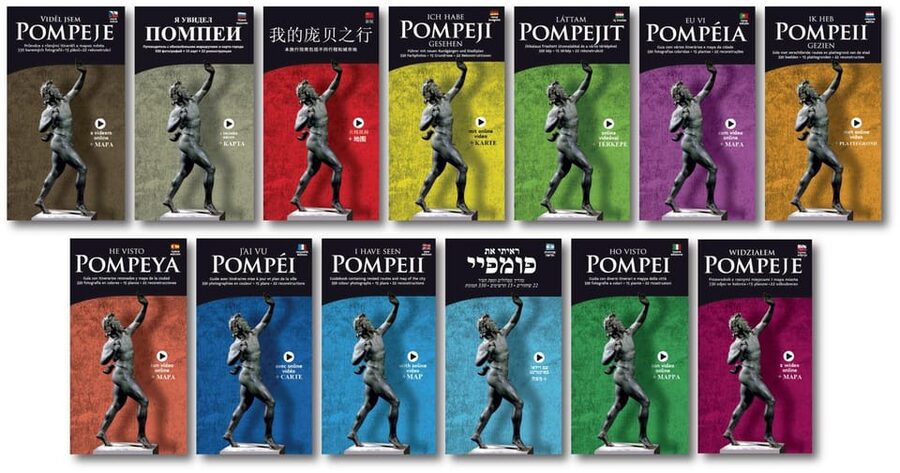
- Souvenir you actually use: the guidebook stays with you after the visit (translated into 13 languages)
- Clear entry point for your reservation: Piazza Anfiteatro
Skip-the-line ticket: what it really buys you at Pompeii

Pompeii is one of those places where timing can make or break the experience. Once you’re inside, the ruins are spread out and you’ll want your attention on the streets, buildings, and the stories carved into the stone. That’s why I like the skip-the-line ticket so much: it reduces the “waiting tax” and helps you start sightseeing sooner, especially if you’re going in during the busiest hours.
Also, Pompeii’s crowds can be the kind that make you rush. A skip-the-line pass helps you keep your rhythm. You can step into the site, then decide whether you want a quick hit or a deeper walk. You still control the pace—this isn’t a one-size-fits-all group schedule.
The value here isn’t just speed. It’s freedom. When the first hour starts smoothly, you’re more likely to enjoy the whole day instead of feeling like you’re constantly behind.
More ways past the ticket queue
- Pompeii: Skip-the-Line Entrance Ticket with Audio Guide
★ 4.0 · 2,509 reviews - Pompeii: Guided Tour with Skip-the-Line Entry
★ 4.9 · 812 reviews - Pompeii: Skip-the-Line Entry Ticket with Digital Guide App
★ 4.1 · 770 reviews
The guidebook-and-map system: your “tour” in paper form
This is a self-guided experience, so the main tool is the guidebook plus the map. That actually works well if you like moving when you want, pausing when something catches your eye, and skipping what doesn’t. You’re not required to stay with anyone.
Here’s how I’d use it to get the most out of your time:
- Pick the route length that matches your energy: 2, 4, or 6 hours
- Use the map to get your bearings fast once you enter
- Read just enough context before key areas, then let the ruins do the heavy lifting
- Don’t try to “check every box.” Try to understand what you’re looking at
What makes this system smarter than a generic pamphlet is that it’s designed around different visit lengths. A short visit can still feel satisfying, because it steers you toward the most important clusters. A longer visit gives you time to slow down in places like well-preserved public buildings and residential spaces with frescoes.
One practical consideration: this is not a live narration experience. A review disappointment specifically pointed out the difference between expecting a human guide and receiving an informational book. If you want back-and-forth questions and real-time storytelling, you may prefer a guided tour format. If you’re comfortable reading on the spot and looking closely, this setup can be a great match.
Entering Pompeii smoothly: Piazza Anfiteatro and the staff point
Your reservation entry point is Piazza Anfiteatro. That detail matters because Pompeii can feel confusing at the edges, and you don’t want to waste time zig-zagging once you arrive.
Here’s what to do:
- Meet the team outside their office area (they’re usually in blue and yellow jackets).
- Then go to the information point at VIA ROMA 123, POMPEI.
- Show your voucher to the staff so you can access the Pompeii Archaeological Park.
This “show voucher → get access at the right gate” flow is designed to reduce friction. I’d strongly suggest you arrive with everything ready: ID in your pocket and the voucher accessible on your phone (or printed if that’s how you travel best).
A small word of warning that’s worth heeding: one visitor described needing to collect paper tickets at a nearby shop after they’d already gone through security once. That’s the kind of headache you can avoid by making sure you have the correct ticket documents before moving toward security lines.
What you’ll see: Pompeii’s headline stops and why they matter
Pompeii isn’t just one big ruin. It’s a whole town frozen in time, and the best visits mix major monuments with everyday life.
The amphitheater
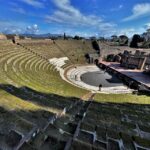
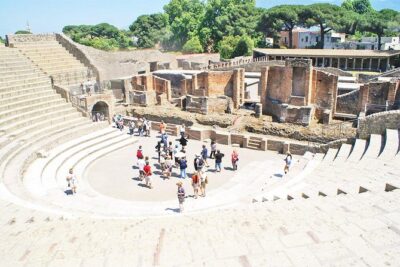
Pompeii’s amphitheater is one of the most memorable pieces of the site. It gives you a sense of entertainment culture and how Romans gathered for spectacles. If you’re pressed for time, this is a high-impact stop because it’s large, dramatic, and visually easy to grasp even before you read every detail.
More tickets to the site


The casts of the victims
The casts are emotionally heavy, and they’re also historically crucial. The eruption didn’t just destroy buildings—it trapped and preserved human moments. If you’re visiting with kids or anyone sensitive to intense scenes, pace yourself. Step in, look, then give your brain a break before moving on.
Frescoed houses and domestic life
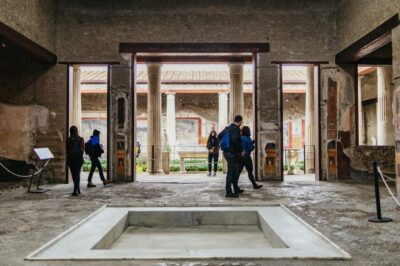
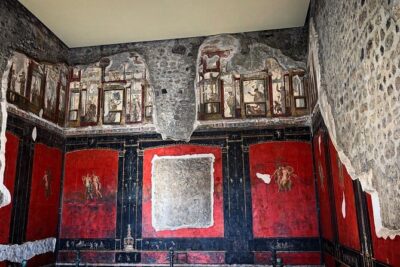
Pompeii is famous for the way homes preserve art. Frescoes in houses help you picture what people saw every day. You’ll also get a sense of how space worked: rooms, courtyards, and the way families lived around light and movement.
This is where the guidebook really earns its keep. Without some context, fresco rooms can turn into “pretty wall art.” With the book’s brief explanations, you start to notice patterns—what kind of themes appear, what surfaces were valued, and why certain spaces were decorated.
Spas, temples, and public buildings
You’ll see places that point to Roman routine: bathing culture in the spas, religious life in the temples, and civic behavior across public structures. These aren’t museum-style “isolated artifacts.” They’re part of a living city plan, so the layout helps you connect the dots.
Shops and street life
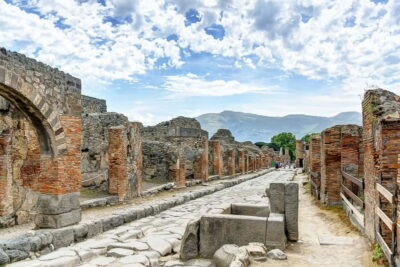
Pompeii’s shops and street details make it feel real. You’re not only looking at ruins; you’re walking past the framework of work and trade.
Thermopolium-style stops are a great example. Thermopolis (the time’s coffee-fast-food equivalent) helps you imagine grabbing something to eat quickly—only it’s Roman style, with its own layout and social rhythm.
Theaters and entertainment spaces
The theaters complement the amphitheater. Together, they help you understand that entertainment wasn’t occasional. It was a routine part of public life.
Brothels
Yes, brothels are part of Pompeii’s story, and you’ll encounter them while walking the site. I find they make the past less sanitized. You see the same human reality that exists in every society, then you can process it with context from the guidebook.
2, 4, or 6 hours: choosing a pace that feels satisfying
The guidebook gives you itineraries for different lengths, which is exactly how I’d plan Pompeii too. If you have only half a day, you don’t need to feel guilty. You need a tight route.
About 2 hours: the strongest highlights
A 2-hour plan should focus on the easiest “you’ll remember this” sites: the amphitheater, a major public zone, and the emotionally unforgettable casts. With short stops and quick context, you’ll still leave feeling like you understood Pompeii rather than just having walked through it.
About 4 hours: the sweet spot
Four hours is the time you start to feel the place as a whole town. You can cover headline monuments and add layers: frescoed homes, spas, theaters, and the street-level flavor of shops and Thermopolium-style areas.
This is also a nice length for pacing. Pompeii is physically tiring—uneven ground, lots of walking, and frequent stopping. Four hours usually gives you enough time to catch your breath without feeling rushed.
About 6 hours: slower, more readable, more human
A six-hour route is for people who like to linger—reading a bit, stepping back for views, and returning to see details you missed earlier. You’ll have more time to move beyond the “greatest hits” and spend longer in spaces where the design tells you how people used them.
If you love ruins that feel like they come with context—art, architecture, and how a city functions—six hours can feel genuinely worthwhile.
Timing tips for a 9AM to 5PM visit
You can enter the Pompeii site from 9AM to 5PM, and that range helps because it’s not tied to one exact start time. If you want the smoother experience, aim to arrive earlier in the day so your walking begins when the air is cooler and the site feels less packed.
Also, plan for breaks. Pompeii is open-air. Even if the weather is kind, you’ll still want water and short pauses. Food isn’t included, so bring what you like or plan to buy something nearby on your own schedule.
What the price covers, and where the value is
The price is listed at $41 per person, and that number is tied to the key “tools” you get: a skip-the-line ticket plus a guidebook and a map with multi-length itineraries.
The best way to judge value is to ask: are you saving time and getting guidance? For many people, yes. A skip-the-line ticket reduces the waiting part. The guidebook reduces the guesswork part, especially because it’s set up in different route lengths. That means you’re not stuck deciding on the fly while your shoes and patience are already tired.
Where value can drop is if you need a live guide to make sense of everything. This is not that. It’s paper-led. If you want constant explanation and Q&A, you’ll likely get more satisfaction with a tour that includes an actual guide speaking on-site.
Who should book this self-guided Pompeii pass?
This works best if you:
- Like independent travel and want to control your pace
- Want to see major Pompeii sights but don’t want to follow a group
- Prefer getting context from a guidebook you can reread and keep
- Have 2 to 6 hours in mind and want a route that matches your time
It may not be ideal if you:
- Want a live instructor leading you through the ruins
- Expect step-by-step directions posted everywhere in your preferred language
- Hate reading while walking (or your vision isn’t great without long pauses)
If you fall into the first group, you’ll likely appreciate the mix of speed and structure.
Final call: should you book it?
I’d book this option if you want a smooth entry and a plan that doesn’t force you into a rigid schedule. The guidebook-and-map approach is practical, and the ability to choose 2, 4, or 6 hours lets you shape the day around your energy instead of around someone else’s timing.
I’d skip it (or choose a different format) if you’re expecting a human guide to do the narrating. Here, the “guide” is the book, and that’s either a feature or a deal-breaker depending on how you like to travel.
If you’re on the fence, think like this: do you enjoy walking a historic site with short bursts of reading, or do you want someone talking nonstop? This fits the first style.
FAQ
Where do I meet the team, and how do I enter the site?
You meet the team outside their office (they’re usually in blue and yellow jackets). Then staff meet you at the information point at VIA ROMA 123, POMPEI. With your reservation, the archaeological park entrance is Piazza Anfiteatro, where you show your voucher.
What’s included with the ticket?
You get a skip-the-line ticket to Pompeii, a guidebook in 12 languages, and a Pompeii Ruins map with 3 itineraries.
How long can I spend in Pompeii?
Your visit is valid for 1 day, and the guidebook includes itineraries for about 2, 4, or 6 hours. You can explore independently within the park’s opening window.
What are the visiting hours?
You can enter from 9AM to 5PM.
Do I need ID?
Yes. Bring a passport or an ID card.
Is there cancellation flexibility, and can I pay later?
Yes. You can cancel up to 24 hours in advance for a full refund, and you can reserve now and pay later.
More Tickets in Pompei Campania
- Pompeii: Entry Ticket and Guided Tour with an Archaeologist★ 4.8 · 19,459 reviews
- Pompeii: Skip-the-Line Entrance Ticket with Audio Guide★ 4.0 · 2,509 reviews
- Pompeii: Skip-the-line-Ticket and Guided Tour★ 4.6 · 1,152 reviews
- Pompeii: Skip-the-Line Entry Ticket with Digital Guide App★ 4.1 · 770 reviews
- Pompeii: Afternoon to Sunset Guided Tour with Ticket★ 4.9 · 484 reviews
More Tour Reviews in Pompei Campania
- Pompeii: Entry Ticket and Guided Tour with an Archaeologist★ 4.8 · 19,459 reviews
- Pompeii: Small Group Tour with an Archaeologist★ 4.8 · 12,264 reviews
- Pompeii: Skip-the-Line Entrance Ticket with Audio Guide★ 4.0 · 2,509 reviews
- Naples: Pompeii and Mt. Vesuvius with Lunch and Wine Tasting★ 4.5 · 2,454 reviews
- Pompeii: Skip-the-line-Ticket and Guided Tour★ 4.6 · 1,152 reviews
Skip-the-Line Entries, More to Book
- Pompeii: Skip-the-Line Entrance Ticket with Audio Guide★ 4.0 · 2,509 reviews
- Pompeii: Skip-the-line-Ticket and Guided Tour★ 4.6 · 1,152 reviews
- Pompeii: Guided Tour with Skip-the-Line Entry★ 4.9 · 812 reviews
- Pompeii: Skip-the-Line Entry Ticket with Digital Guide App★ 4.1 · 770 reviews
- Pompeii: Tour with Archaeologist Guide & Skip-the-Line Entry★ 4.5 · 478 reviews
Just reviewed: more Pompei Campania tours and day trips



Pompeii Skip-the-Line Entry, compared.
 ★ 4.0Skip-the-Line Entrance Ticket with Audio GuideFrom $392,509 reviews
 ★ 4.6Skip-the-line-Ticket and Guided TourFrom $641,152 reviews
 ★ 4.9Guided Tour with Skip-the-Line EntryFrom $58812 reviews
 ★ 4.1Skip-the-Line Entry Ticket with Digital Guide AppFrom $22770 reviews
 ★ 4.9Pompeii Ruins Private Tour with Optional Skip-the-Line EntryFrom $254732 reviews
 ★ 5.0Skip the Line Guided Tour of Pompeii led by an ArchaeologistFrom $95703 reviews
 ★ 5.0Pompeii Private Tour with an Archaeologist and Skip The Line – 3 hoursFrom $302564 reviews
 ★ 5.0Pompeii Skip-the-line Tour with Archaeologist GuideFrom $71559 reviews
Browse the lists this tour appears in