
Reviewed · POMPEII GUIDED RUINS WALKS
Pompeii Ancient City Walking Tour – Italian & English Guide
Pompeii rewards a good guide. This two-day plan gets you into the heart of the ruins with entrance facilitation at the ticket gate and a route that spotlights the story told in the Villa dei Misteri frescoes. One thing to keep in mind: the Pompeii entrance ticket costs extra, and while most runs go smoothly, there’s been at least one bad experience tied to missing the meeting, so verify your details and don’t wander off on your own.
I like how this is built for real walking, not a rushed photo sprint. The group stays capped at 25 travelers, so you’re not stuck behind a sea of strangers, and the tour is offered in English (with an example of the guide switching back to Italian when needed).
For the price, the value depends on your ticket situation. You pay $36.12 for the guided portion, but the Pompeii admission ticket is €22 per person, so budget for both if you’re not eligible for free entry.
In This Review
- Key highlights worth planning around
- Why this Pompeii tour feels practical (not just scenic)
- Day 1 in Pompeii: the landmarks that actually anchor your visit
- Pompeii Archaeological Park: start with the big picture
- Casa del Fauno: mosaics and elite household scale
- Temple of Jupiter Capitolino: religion with political weight
- Temple of Apollo: the oldest religious building angle
- Roman Amphitheatre: a gladiator machine built for crowds
- Casa del Menandro: why the name is tied to art
- Casa dei Vettii: freed slaves who spent big
- Villa dei Misteri: the fresco story you’ll remember
- Day 2: the Roman Catholic Sanctuary adds a modern layer
- Price and value: what $36.12 buys you (and what it doesn’t)
- Group size, language, and how to avoid confusion
- Logistics that matter in Pompeii (and how to plan your day)
- Should you book this Pompeii Ancient City Walking Tour?
- FAQ
- Is the Pompeii entrance ticket included?
- What language is the tour offered in?
- How long is the tour?
- Where does the tour start and end?
- What group size should I expect?
- Is a service animal allowed?
Key highlights worth planning around
- Guided entry help at the ticket gate so you don’t lose time figuring out lines
- Pompeii’s “greatest hits” route across arenas and top villas
- Villa dei Misteri fresco scenes that explain an initiation ritual tied to Dionysus
- Roman Amphitheatre specifics like the 80 a.C. date and a capacity up to 20,000
- Day 2 includes a free sanctuary visit (entry included, about 1 hour)
Why this Pompeii tour feels practical (not just scenic)
Pompeii is one of those places where you can absolutely go on your own. But if you want your visit to make sense fast—who lived where, what you’re looking at, and why certain buildings matter—a guide does real work for you.
This tour’s structure is built around that. Day 1 focuses on the core Pompeii Archaeological Park route, moving past major landmarks you’d otherwise bounce between randomly. You also get facilitation at the entrance, which is a small detail until you’re standing there with limited daylight and a list of things you don’t want to miss.
I especially like that the tour doesn’t just point at walls. It ties buildings to stories: the eruption as a turning point, daily life in elite homes, and the religious meaning behind structures like the Temple of Apollo and the Temple of Jupiter Capitolino.
There’s also a human side to it. One guide named Simone was described as engaging and thorough, and in a mixed-language situation he kept explanations clear in English while also being available to repeat things in Italian when people had questions. That kind of flexibility matters more than people think when you’re traveling in a group.
Keep walking the excavated streets
- Pompeii 3 Hours Walking Tour Led by an Archaeologist
★ 5.0 · 126 reviews - Explore Pompeii: 2-Hour Guided Walking Tour with Included Ticket
★ 4.5 · 77 reviews - Pompeii: walking tour with 3D glasses and with entrance ticket
★ 4.5 · 61 reviews
Day 1 in Pompeii: the landmarks that actually anchor your visit
Day 1 starts at the Pompeii Archaeological Park, where you meet the guide (look for the Sesto Continente Tours sign at Piazza Porta Marina). After you’re through the entrance, the day becomes a guided walkthrough across some of Pompeii’s most recognizable sites.
Here’s what each stop adds, and where you might want to adjust your expectations.
Pompeii Archaeological Park: start with the big picture
The day’s main entry is the Archaeological Park itself, described as the largest in the world. Expect a guided progression that takes you between major sights: the Amphitheatre, the Temple of Apollo, the Temple of Jupiter, and several famous houses including the Casa del Fauno, Casa del Menandro, Casa dei Vettii, and the Villa dei Misteri.
Why it’s valuable: if you arrive at Pompeii cold, it can feel like endless ruins. A guide gives you a mental map quickly, so you can look at carvings, floor patterns, and building layouts with purpose instead of guesswork.
What to watch: Stop times listed for the individual places are short. You’ll get orientation and key context, but if you’re the type who needs long pauses in every room, you may want to save extra time for a self-guided follow-up on your own time.
Casa del Fauno: mosaics and elite household scale
The Casa del Fauno is one of the biggest residences in Pompeii. It’s known for a reproduction of the famous floor mosaic of Alexander—the battle between Alexander the Great and King Darius III.
Why it matters: mosaics like this aren’t decoration in a vacuum. They were status signals, choices about taste, and political-flavored storytelling through art.
Where you’ll feel it: even a brief stop helps you understand why Pompeii is so famous for its visual culture, not just its tragic ending.
Temple of Jupiter Capitolino: religion with political weight
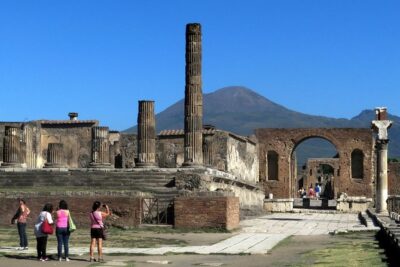
Next comes the Tempio di Giove Capitolino (Temple of Jupiter Capitolino). In the background, Mount Vesuvius looms. The temple honored the Capitoline Triad: Jupiter, Juno, and Minerva—an important reminder that Roman worship was tied to the structure of the state.
Why it’s worth your time: it gives you a lens for how monumental architecture wasn’t only about power in public spaces. It also shaped how people understood authority and the universe.
Quick consideration: at many temples, the remnants are partial. The guide’s explanation makes the difference between seeing stones and understanding why they were arranged the way they were.
More of the story behind the stones

Temple of Apollo: the oldest religious building angle
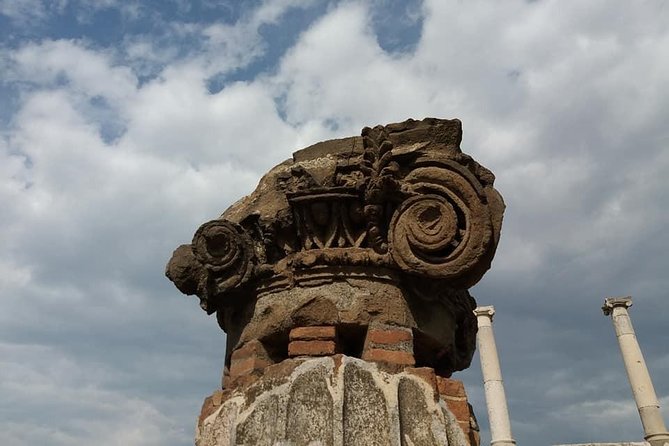
The Temple of Apollo is considered the oldest religious building in Pompeii. The site includes a reproduction of a bronze statue of Apollo, shown holding a bow and arrow pose, set among Corinthian columns.
What you learn here: you start to see how the Romans and Greeks shared and reshaped religious imagery. Apollo’s portrayal isn’t random; it’s about myth, prophecy, and how people sought meaning from the divine.
Good to know: the stop is short. Treat it like orientation plus one strong visual idea, then move on with your eyes more trained.
Roman Amphitheatre: a gladiator machine built for crowds
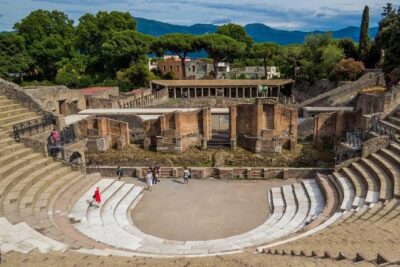
Then you reach the Roman Amphitheatre, built in 80 a.C. It’s described as the oldest amphitheatre of its kind, and it could hold up to 20,000 spectators. The seats were arranged in sections based on class.
Why I like this stop: it turns Pompeii from a silent ruin into a place with a crowd’s energy. Even if the seats are worn down, you can still picture how an event would ripple across the space.
Practical note: it’s one of those places where the guide’s context helps you understand the layout. Without it, you might just admire size. With it, you start thinking about social structure—who sat where, and why.
Casa del Menandro: why the name is tied to art
The Casa del Menandro is a lavish home with frescoes and mosaics. The key detail is that it’s named not after the owners, but after a fresco depicting the Greek poet Menander.
Why this is a smart stop: it teaches you how labels for Pompeii sites often come from what survives visually—not always from official records.
If you like art: this stop is a strong match. You get a sense that Pompeii’s interiors were carefully curated to communicate identity.
Casa dei Vettii: freed slaves who spent big
Casa dei Vettii belongs to the brothers Vettii, described as having become freed slaves. After gaining freedom, they apparently didn’t hold back on spending. The result was a home packed with impressive frescoes and wall paintings.
Why you’ll care: it’s a reminder that Pompeii wasn’t only wealthy families from the start. Social mobility existed, and art could be used to shout your new status.
Villa dei Misteri: the fresco story you’ll remember
Finally, Villa dei Misteri. The “Camera d’Iniziazione” area features nine sequential painted scenes, showing a rite of passage—an initiation tied to a bride becoming an adult—and also linking to the cult of Dionysus, the Greek god connected to wine and fertility.
This is one of the strongest reasons to do a guided visit. Without context, it’s impressive to look at. With context, you understand what you’re seeing as a narrative cycle rather than random imagery.
Trade-off: the stop time is brief, so I’d treat this as your moment to focus on the big picture of the nine scenes. If you want more detail later, you’ll know exactly what to return to in your own exploration.
Day 2: the Roman Catholic Sanctuary adds a modern layer
Day 2 isn’t another long run through the archaeological park. Instead, you get a visit to the Roman Catholic Sanctuary of Pompeii. Admission is included, and the visit is described as free-entry with about one hour allocated.
Why this helps: Pompeii isn’t only an ancient stop. It sits in a living landscape with religious traditions that continue today. This extra hour gives you a contrast: the ruins as a historical shock, and the sanctuary as a place people still visit.
What to expect: it’s a calmer pace compared with the intense stop-to-stop movement of Day 1. It can be a relief if your legs were already feeling the first day.
Price and value: what $36.12 buys you (and what it doesn’t)
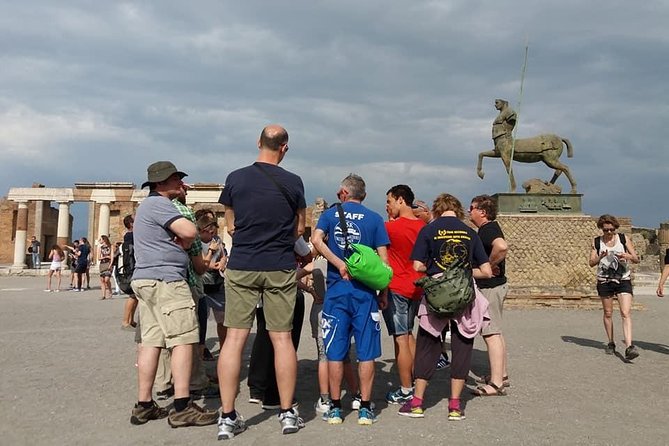
The guided portion costs $36.12 per person. The biggest pricing reality: the Pompeii entrance ticket is not included, and it’s listed at €22 per person.
So your “all-in” cost for Pompeii proper is the guide fee plus the entry ticket. If you also need day-to-day spending, think about that before you commit. If you qualify for free entrance—minors under 18, EU senior +65, and certain professional categories listed such as journalists and students/docents—your value usually jumps, since the €22 is removed.
What you’re really paying for: not just access to ruins, but a guided route that covers the big anchors, plus ticket-office entry help. That’s worth something, especially in peak season when timing and lines can eat your energy.
Also note the tour caps at 25 people. That tends to make for a more personal experience than huge group bus tours.
Group size, language, and how to avoid confusion
This is offered in English, with an Italian & English guide format. The practical catch is that language coverage can depend on what you show up with on the day and how the group mixes.
One helpful sign: in a mixed-language situation, Simone handled the visit in English and stayed available to repeat in Italian if people had doubts. That tells me the operator values clarity over sticking rigidly to one plan.
My advice for you: if you’re traveling with someone who prefers Italian, ask early in booking messages what language support is likely on your date. And once you’re there, listen carefully at the start—language support matters most when the guide sets your mental map.
Timing is split over two days. Day 1 is the heavier one on foot, and Day 2 adds a shorter sanctuary stop. Plan for real walking and bring something you can use comfortably all day.
Logistics that matter in Pompeii (and how to plan your day)
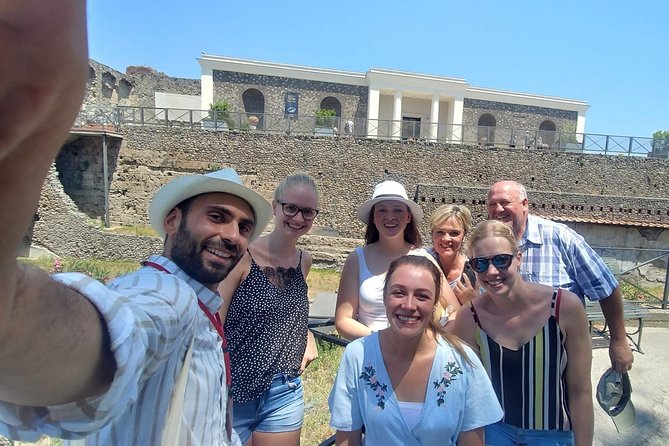
Pompeii is famously walkable in short bursts, and famously exhausting if you try to do everything without a plan. This tour gives you a plan, but you still need to prepare for what the terrain and crowds can do.
Here are a few practical moves that will make the experience better:
- Wear shoes you trust. You’ll walk between multiple major zones across uneven ground.
- Bring water and something light for snacks. The listed stop durations are short, so you can’t count on long breaks.
- Use your guide’s pacing. If they say look at something and then move on, it’s usually because the next stop builds your context.
- Think of Day 1 as your core. Villa dei Misteri and the Amphitheatre are the kinds of sites you’ll want to remember first.
- Day 2 is recovery-plus. The sanctuary hour is easier on the body and adds a modern connection.
Weather matters too. The tour requires good weather, and if conditions are poor, you’ll be offered a different date or a full refund.
And one more thing: service animals are allowed, and the meeting point is near public transportation. That makes the start less stressful if you’re relying on transit.
Should you book this Pompeii Ancient City Walking Tour?
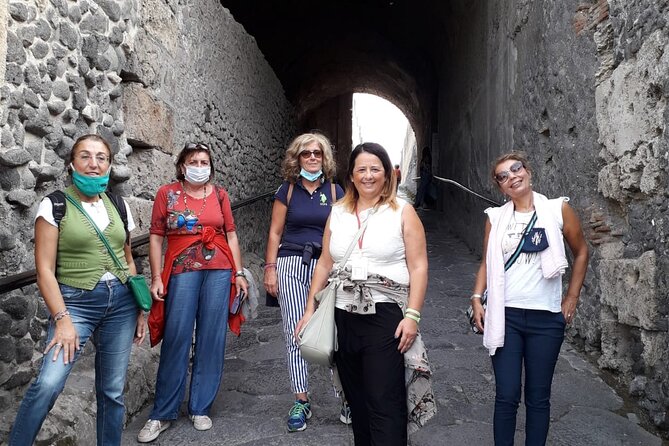
If you want Pompeii with structure—someone helping you connect the dots between temples, houses, and the Amphitheatre—this is a strong choice. The biggest “yes” signs for me are entrance facilitation, a route packed with the most meaningful stops (including the Villa dei Misteri and the Amphitheatre), and a group size capped at 25.
I’d think twice only if you strongly prefer fully independent wandering without time limits. The stops are short, so a guided day can feel a little controlled if your style is slow and detailed. Also, because there’s at least one serious case of meeting trouble tied to the operator, I’d be extra careful about arriving early and keeping your booking confirmation accessible.
If you do book, do two things: plan for the extra €22 entrance ticket, and keep Day 1 as your anchor in your own schedule. You’ll get the most value when the guide’s route is driving your curiosity, not your fatigue.
FAQ
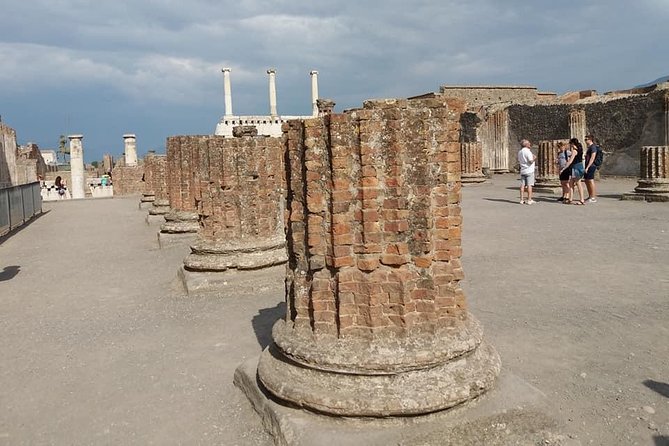
Is the Pompeii entrance ticket included?
No. The Pompeii entrance fee is listed as €22.00 per person. Entry is free for minors under 18, EU senior citizens +65, and for certain categories like journalists and students/teachers (UE).
What language is the tour offered in?
The tour is offered in English. The operator also provides an Italian & English guide format, and there’s an example of a guide repeating explanations in Italian when needed.
How long is the tour?
It runs over 2 days (approximately), with Day 1 focused on the Pompeii Archaeological Park route and major sites, and Day 2 including a sanctuary visit.
Where does the tour start and end?
The tour starts at Piazza Porta Marina, 80045 Pompei NA, Italy, and it ends back at the same meeting point.
What group size should I expect?
This activity has a maximum of 25 travelers.
Is a service animal allowed?
Yes, service animals are allowed.
More Tour Reviews in Pompeii
- Pompeii Small Group Tour with an Archaeologist★ 5.0 · 6,593 reviews
- Discover the Ancient Ruins of Pompeii: Day Trip from Rome★ 3.5 · 2,247 reviews
- Pompeii and Herculaneum Small Group Tour with an Archaeologist★ 5.0 · 1,350 reviews
- Skip the Line Guided Tour of Pompeii led by an Archaeologist★ 5.0 · 703 reviews
- Pompeii Ticket + Tour with Optional Tasting Experience at Pompeii★ 5.0 · 663 reviews
The Story of the City, More Ways In
- Discover the Ancient Ruins of Pompeii: Day Trip from Rome★ 3.5 · 2,247 reviews
- 2 hours Pompeii Tour with Local Historian – Ticket Included★ 5.0 · 335 reviews
- Stories of Pompeii: Small Group tour with archeology expert guide★ 5.0 · 191 reviews
- Ancient Pompeii Private Tour: Skip the Line & Kid-Friendly Option★ 5.0 · 167 reviews
- Skip-the-Line Half-Day Private Tour Ancient Pompeii Highlights with Native Guide★ 5.0 · 146 reviews
Still in the Ruins? Keep Walking
- Pompeii 3 Hours Walking Tour Led by an Archaeologist★ 5.0 · 126 reviews
- Explore Pompeii: 2-Hour Guided Walking Tour with Included Ticket★ 4.5 · 77 reviews
- Pompeii: walking tour with 3D glasses and with entrance ticket★ 4.5 · 61 reviews
- Pompeii walking tour★ 5.0 · 29 reviews
- Small Group Guided Walking Tour of Ancient Pompeii Highlights★ 5.0 · 27 reviews
Just reviewed: more Pompeii tours and day trips




Pompeii Guided Ruins Walks, compared.
 ★ 4.3Guided Walking Tour with Entrance TicketFrom $501,423 reviews
 ★ 4.8Discover Pompeii: French Walking Tour of the Buried CityFrom $41253 reviews
 ★ 5.0Pompeii 3 Hours Walking Tour Led by an ArchaeologistFrom $256126 reviews
 ★ 4.6Highlights Guided Walking TourFrom $53105 reviews
 ★ 4.33D Walking Tour with Entry TicketFrom $61102 reviews
 ★ 4.5Explore Pompeii: 2-Hour Guided Walking Tour with Included TicketFrom $5277 reviews
 ★ 4.5walking tour with 3D glasses and with entrance ticketFrom $6261 reviews
 ★ 5.0Herculaneum: Private Walking Tour with Archeologist GuideFrom $31759 reviews
Browse the lists this tour appears in