Reviewed · POMPEII
Pompeii Tour & Admission included in a Small Group
Pompeii hits hard when someone explains it well. This small-group tour focuses on the city’s main sights with a clear story arc, from Porta Marina to the Forum and on to the houses and theaters. You’ll also get that powerful Vesuvius connection, so the ruins don’t feel random.
What I like most is that it’s built for understanding, not just wandering, and it’s paced so you can actually take it in without feeling lost.
Two things I really like: (1) admission is included, so you don’t have to wrestle with tickets while you’re in Pompeii, and (2) the guide and headset setup helps you hear the story even when crowds are thick. The one drawback to plan around is that this is a highlights-focused route—so if you’re the kind of person who wants every excavation detail, you may feel it moves on before you’re ready. Also, some guarded areas can close earlier in the day, depending on what’s open when you arrive.
In This Review
- Key things to know before you go
- The value: $66.01 buys real guidance, not just entry
- Meeting point at the Villa of the Mysteries (and why it matters)
- Entering Pompeii through Porta Marina: the eruption story starts early
- The main loop: Forum buildings, baths, and the “daily life” backbone
- Forum and Basilica context
- Baths of the Forum and the feel of routine
- Recently reopened sights and pacing
- Stops for religion: Venus, Apollo, and Jupiter’s dramatic setting
- Temple of Venus (patron goddess)
- Sanctuary of Apollo at a strategic spot
- Temple of Jupiter with Vesuvius behind it
- Macellum and the food economy: markets, casts, and quick context
- Thermopolia (old diners) and snack-stop realism
- Two major house stops: Casa del Fauno and the Vettii house
- House of the Faun
- House of the Vettii
- Via dell’Abbondanza and Teatro Grande: street life and performances
- Via dell’Abbondanza (main street)
- Teatro Grande (Greco-Roman theater)
- What the best guides do (and what you should look for)
- Walking reality check: uneven ground and how to make it easier
- Price and logistics: where the $66 really goes
- Who should book this Pompeii tour
- Should you book Pompeii Tour & Admission in a Small Group?
- FAQ
- Is the Pompeii admission ticket included?
- How long is the Pompeii tour?
- What language is the tour offered in?
- Is there a headset?
- Where does the tour start and where does it end?
- Is bottled water included?
- What group size should I expect?
- What’s the cancellation policy?
Key things to know before you go
- Small group max 15: easier questions, less sprinting, better pacing through crowded sections
- Admission included: Pompeii site entry is part of the price
- Headset included when crowded: you’re meant to hear the guide clearly on busy days
- A “daily life” route: Forum buildings, baths, market areas, and shops, not just monuments
- Stops include major religious sites: Venus, Apollo, and Jupiter get quick context
- Some house stops depend on openings: Casa del Fauno and the Vettii house can be seasonal
The value: $66.01 buys real guidance, not just entry
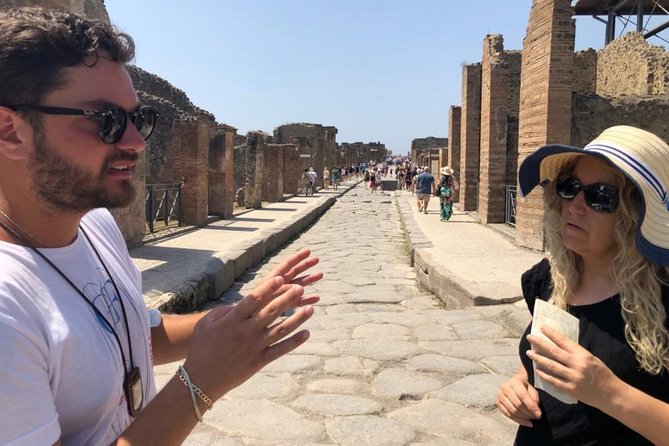
At $66.01 per person for about two hours, the big value here is the mix of Pompeii admission plus an authorized guide/archaeologist. If you’ve ever tried to do Pompeii solo, you know the ruins can feel like an outline: impressive, but tough to interpret quickly. This format gives you the “what am I looking at, and why does it matter” as you walk.
You also get a few practical perks that matter at Pompeii:
- Mobile ticket so entry day is simpler
- A paper map so you can reconnect the dots once you split off
- Headset if it’s crowded, which helps a lot when you’re standing near walls and in tight lanes
One small note: bottled water isn’t included. Pompeii is hot in many seasons, and you’ll be walking on uneven surfaces, so plan to have water with you.
Not decided yet? A few more Pompeii tours worth weighing before you book.
- Pompeii Small Group Tour with an Archaeologist
★ 5.0 · 6,593 reviews - Discover the Ancient Ruins of Pompeii: Day Trip from Rome
★ 3.5 · 2,247 reviews - Pompeii and Herculaneum Small Group Tour with an Archaeologist
★ 5.0 · 1,350 reviews
Meeting point at the Villa of the Mysteries (and why it matters)
The tour starts at the Villa of the Mysteries, address: Via Villa dei Misteri, 2, 80045 Pompei NA, Italy. That’s a helpful anchor point because it gives you a real starting location instead of a vague “near the entrance” idea.
It’s also described as near public transportation, which is useful if you’re juggling train timing or arriving from elsewhere in the area. The tour ends back at the meeting point, so you’re not stuck figuring out a one-way exit plan.
Before you arrive, do yourself a favor: wear shoes you trust on stone and uneven ground. Several parts of Pompeii have curbs, steps, and irregular surfaces. Good traction makes the walking feel less like a workout and more like sightseeing.
Entering Pompeii through Porta Marina: the eruption story starts early
Your guided walk goes into the Archaeological Park of Pompeii with entrance ticket included, joining at Porta Marina. This matters because you’re not just starting somewhere random—you’re starting where the guide can set context fast.
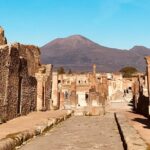
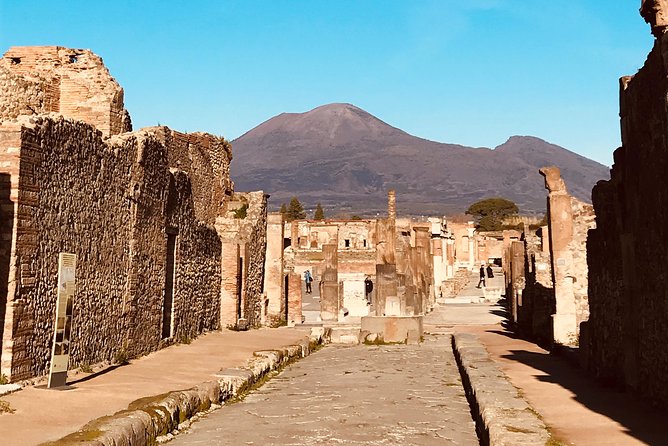
Mt. Vesuvius is part of the experience from the beginning. The tour frames Pompeii’s final moments leading up to the 79 AD eruption, then pulls you forward to how we study and excavate the site today. That combination gives you two helpful lenses at once:
- what life was like before the disaster
- how the archaeology helps us rebuild that life
And you’ll get a guided pass through major areas that first-time visitors often struggle to prioritize: the Roman Forum, the Basilica, market areas, and the main temples. Instead of just seeing big stones, you’ll learn what each area was for.
The main loop: Forum buildings, baths, and the “daily life” backbone
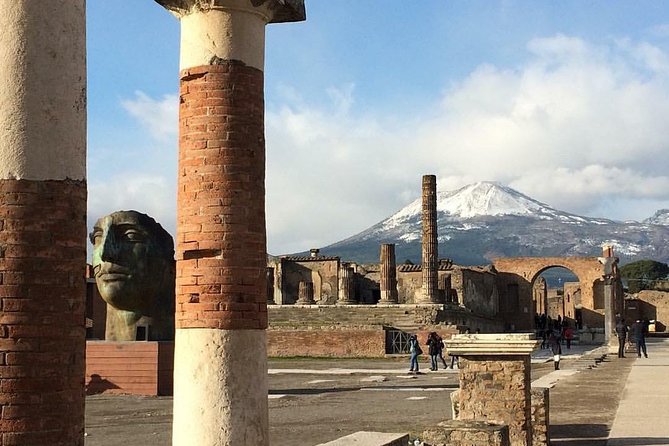
The heart of the tour is a long stretch through the city’s core. You’ll move along the Decumanus Maximus, the main east-west street, with multiple stops designed to build a picture of Roman life.
Forum and Basilica context
In the Forum area, you’ll get quick orientation around key civic spaces. The Forum is described as the center of daily life, and the Basilica is highlighted as the major large building used for business and administration of justice. Even with short stops, this kind of context helps you see beyond the columns. It gives you an answer to the question: where did people go to work, settle disputes, and conduct city life?

Baths of the Forum and the feel of routine
One of the standout “I get it now” stops is the Forum Baths. These are among the best-preserved parts of Pompeii, and the guide points out that the male and female areas had separate entrances. That detail is the kind that turns architecture into lived experience. You start to imagine schedules, routines, and what a visit to the baths meant socially.
Recently reopened sights and pacing
Some stops are noted as recently opened, including a “most beautiful domus” and an impressive Roman baths experience along the route. Reopened areas can be a great bonus because you’re seeing parts of the city that many people haven’t experienced yet—even if they’ve been to Pompeii before.
The pacing is built around short stops—think about 10 minutes per major point—so you’re not stuck in one spot while the rest of the site passes you by. The tradeoff is time pressure: you’ll get the big ideas, but not hours of lingering.
Stops for religion: Venus, Apollo, and Jupiter’s dramatic setting
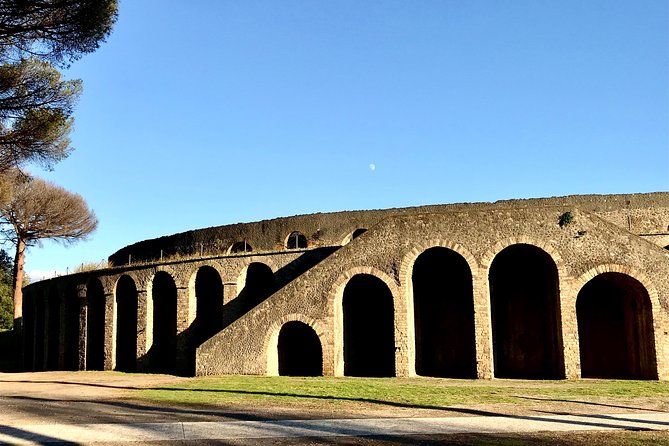
This tour doesn’t ignore sacred spaces. It gives you quick but meaningful pauses at some of Pompeii’s best-known religious locations:
Temple of Venus (patron goddess)
The Temple of Venus is a dedicated place of worship tied to Venus, patron goddess of Pompeii. A short stop like this is useful because it keeps the guide’s story focused: people didn’t live in “separate categories.” Faith was woven into street life, politics, and daily habits.
Sanctuary of Apollo at a strategic spot
The Sanctuary of Apollo is described as among the oldest worship locations in Pompeii, positioned along the street that leads from Porta Marina to the public heart of the city. That strategic placement matters. It signals how people moved, where they gathered, and which spaces carried the most attention.
Temple of Jupiter with Vesuvius behind it
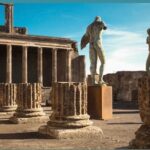
The Temple of Jupiter dominates the north side of the Forum, and the guide adds a visual cue: behind it rises Vesuvius. This is one of those moments where geography does a lot of storytelling for you. The setting helps you understand why certain temples were where they were.
Macellum and the food economy: markets, casts, and quick context
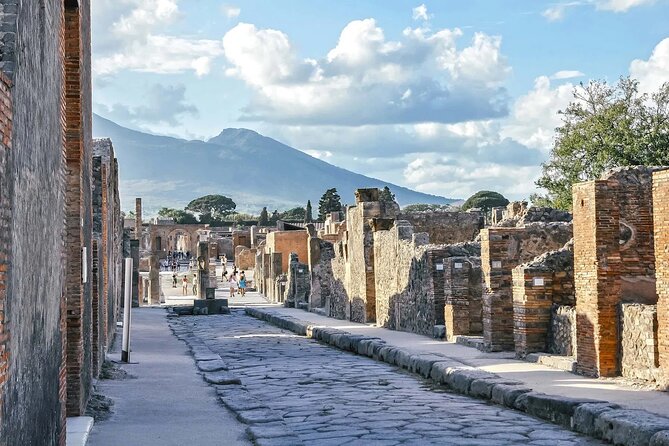
If you want Pompeii to feel like a real city, don’t skip the food-and-goods angle. This tour includes the Macellum, a monumental building used for selling food and daily consumer products.
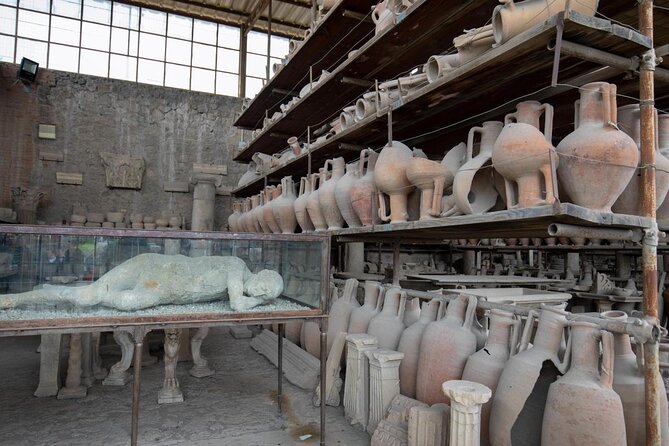
You’ll also have a chance to see plaster casts of bodies—described as an archaeological method used to find the ancient people as they were at the time of the eruption. Even if you’ve heard about these casts before, seeing them within the market context hits differently. The message becomes: this wasn’t an abstract tragedy. It interrupted normal shopping, eating, and routines.
Thermopolia (old diners) and snack-stop realism
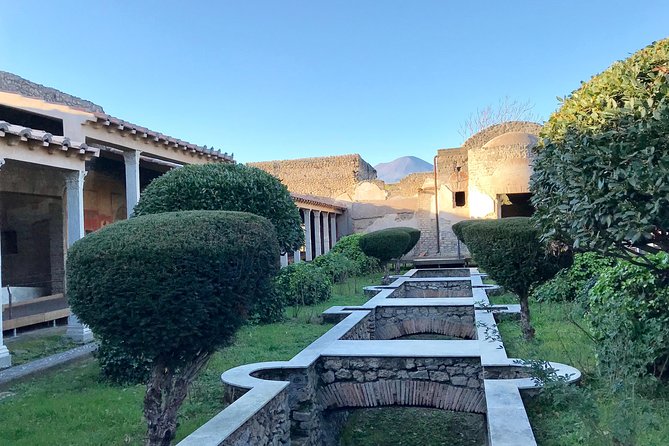
A thermopolium is essentially the Roman version of a snack and drink stop—fast, practical, and built for people on the move. This tour includes the Thermopolium of Vetuzio Placido, framing it as an old diner where inhabitants went for refreshment.
This is the kind of detail that makes the whole experience feel less like sightseeing and more like understanding how people filled their days. And yes, it’s a reminder that most ruins you’ll see were built for ordinary use, not just ceremonies.
Two major house stops: Casa del Fauno and the Vettii house
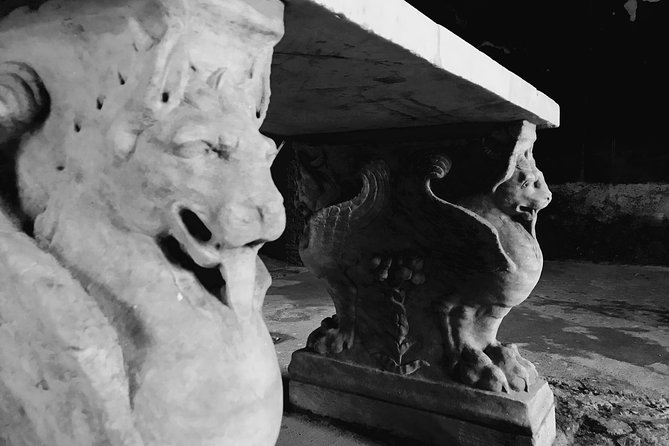
Pompeii’s houses can be the most emotional part of the visit, because they show the difference between private life and public space.
House of the Faun
The tour includes Casa del Fauno, one of the larger houses in Pompeii. You’ll also see the sidewalk welcome inscription in Latin: HAVE. Those small touches are what make Roman domestic spaces feel human instead of purely architectural.
House of the Vettii
The route also includes the House of the Vettii, described as one of the richest and most famous in Pompeii, under the protection of Priapus, the god of prosperity. The guide ties those symbols back to daily beliefs and status.
Important practical note: the houses mentioned are subject to seasonal openings and closings. That means the tour’s best layout might still change slightly on the day. If a house is closed, the guide will still give you the core story where you can see it.
Via dell’Abbondanza and Teatro Grande: street life and performances
Two last big-picture stops bring you back out into the public rhythm of Pompeii:
Via dell’Abbondanza (main street)
Via dell’Abbondanza is presented as the ancient main street, also known as the decumanus maximus. On foot, you start to understand how people moved between civic spaces, religious sites, and entertainment. It’s easier to grasp the city when you’re walking the spine of it.
Teatro Grande (Greco-Roman theater)
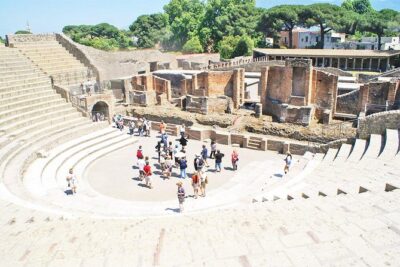
At Teatro Grande, you’ll see where comedies and tragedies in the Greco-Roman tradition were performed. A theater stop is a quick way to understand social life. It hints at who gathered, what entertainment meant, and how shared stories circulated in the city.
What the best guides do (and what you should look for)
This tour earns high marks for the guide experience, with names like Livio, Antonio, Riccardo, Ornella, Annalisa, and Angelo showing up in the praised guide profiles. The common thread is clear communication and strong storytelling, especially around how Pompeii’s architecture connects to everyday life.
I’d expect these strengths to show up in your tour:
- Strong English and pacing so the stops feel organized, not rushed
- Real expertise tying buildings to the way people lived
- Respect for a serious site so the tragedy stays grounded rather than turned into a gimmick
- Extra helpfulness if the day runs tight; one guide was noted for making sure people knew how to find the exit when they had to leave early for transport
Guides do vary, of course. But the overall format is designed so even a short stop lands well.
Walking reality check: uneven ground and how to make it easier
Pompeii is famous, but it’s also physical. One key practical theme from the experience is that you’ll cover a good amount of ground on uneven terrain, including sidewalk curbs and stepping stones.
Here’s how you make that work:
- wear shoes with good grip
- plan a steady pace and don’t rush from stop to stop
- bring or buy water (since bottled water isn’t included)
- if you’re visiting with kids or anyone with limited mobility, choose to go in with realistic expectations about walking surfaces
The headset and smaller group size help with comfort, but they can’t fix the stones.
Price and logistics: where the $66 really goes
Let’s put the cost in plain terms. You’re paying for:
- Pompeii admission included
- an authorized guide/archaeologist
- headset if it’s crowded
- a paper map
So you’re not paying just for entry. You’re paying to get context in the middle of a complicated site.
At this price point, it’s also an advantage that the tour caps at 15 travelers. Smaller groups generally mean less stop-and-go confusion, and it’s easier to keep your bearings without losing the guide.
Bottled water isn’t included, and some house or guarded areas can close earlier depending on the day. Those are the two budget “gotchas” to plan around.
Who should book this Pompeii tour
This is a strong fit if:
- you’re visiting Pompeii for the first time and want a structured route
- you have limited time (about 2 hours) and want key sights covered
- you want a guide who links buildings to daily life and the eruption story
- you like small-group tours with a maximum of 15 people
It’s not the best choice if:
- you’re hunting for a slow, excavation-heavy, technical deep dive
- you need access to every guarded interior, every time (openings vary, and closing times can affect what you see)
Should you book Pompeii Tour & Admission in a Small Group?
If you want Pompeii to make sense quickly, I think this is a smart buy. The combination of admission included, an authorized guide/archaeologist, and headset support is exactly what you want at a site this big. The overall rating is high—4.8 with 96% recommended—so the experience is landing well for most people.
Just go in with the right expectations: it’s a highlight-focused circuit with short stops. If you’re the kind of visitor who loves absorbing everything slowly, you may want extra self-exploration time after the tour to linger where you feel the strongest pull.
If you’re ready for Pompeii’s story in a tight, well-paced walk, book it.
FAQ
Is the Pompeii admission ticket included?
Yes. The Pompeii admission ticket to the Archaeological Park is included in the tour price.
How long is the Pompeii tour?
It runs about 2 hours (approx.).
What language is the tour offered in?
The tour is offered in English.
Is there a headset?
Yes. Headsets are included in case the site is crowded.
Where does the tour start and where does it end?
It starts at the Villa of the Mysteries (Via Villa dei Misteri, 2, 80045 Pompei NA, Italy) and ends back at the same meeting point.
Is bottled water included?
No. Bottled water is not included.
What group size should I expect?
The tour has a maximum of 15 travelers.
What’s the cancellation policy?
Free cancellation is available up to 24 hours in advance for a full refund, based on local time.
More Tour Reviews in Pompeii
- Pompeii Small Group Tour with an Archaeologist★ 5.0 · 6,593 reviews
- Discover the Ancient Ruins of Pompeii: Day Trip from Rome★ 3.5 · 2,247 reviews
- Pompeii and Herculaneum Small Group Tour with an Archaeologist★ 5.0 · 1,350 reviews
- Skip the Line Guided Tour of Pompeii led by an Archaeologist★ 5.0 · 703 reviews
- Pompeii Ticket + Tour with Optional Tasting Experience at Pompeii★ 5.0 · 663 reviews