Reviewed · POMPEII
Pompeii Archaeological Small-Group tour for 15 people
Two hours, and Pompeii actually makes sense. This Pompeii small-group tour stays focused with an archaeological guide and includes headsets (when the group is 10+), so you don’t miss the story while you’re moving.
I like the way the tour is built around key public spaces and major houses without turning it into a frantic photo hunt. You also get a Pompei Express entrance ticket, which helps you get into the most important stops as you go.
One thing to consider: the route is fast by design. If you want Pompeii at a slower, more “linger at every corner” pace, 2 hours may feel tight—and Villa dei Misteri isn’t listed as a stop, even though the meeting point is nearby.
In This Review
- Key things to know before you go
- Why this Pompeii route works in 2 hours
- Entering at Porta Marina Superiore: the tour starts with context
- Vicolo delle Terme, 2: a quick look at commerce and shelter
- Foro de Pompeya: the ancient main square you can feel
- Granaries of the Forum: where everyday infrastructure gets eerie
- The main street walk: get your bearings fast
- House of Menander: luxury you can read in the details
- Stabian Baths (Terme Stabiane): the oldest thermal complex
- Lupanar: the brothel that people talk about for a reason
- House of the Faun: big residence, big impression
- Teatro Grande: closing on Pompeii’s performance space
- Price and value: $77.06 for a focused Pompeii plan
- Who this Pompeii tour fits best
- Should you book this Pompeii small-group tour?
- FAQ
- FAQ
- How long is the Pompeii Archaeological Small-Group tour?
- What group size should I expect?
- Do we get headsets?
- Where do we meet, and where does the tour end?
- What’s included with admission tickets?
- Are food and drinks included?
- Is there free cancellation?
Key things to know before you go

- Max 15 people with headsets for groups of 10+ keeps the pacing sane
- Pompei Express entrance ticket helps cover multiple major sites in one sweep
- Granaries of the Forum includes marble tables, fountain basins, and victim casts (plus a dog and a tree)
- Stabian Baths (Terme Stabiane) are the oldest thermal complex in the city
- Lupanar is the most famous brothel in Pompeii, and it’s handled on a historical timeline, not gossip
Why this Pompeii route works in 2 hours
Pompeii can feel like a huge open-air museum where everything is important. This tour makes a smart choice: it gives you a tight, logical route through the places you need to understand the city—public life, private life, and daily rituals—then lets you keep wandering afterward on your own.
The small-group limit (15) matters more than it sounds. In a place like Pompeii, where entrances, steps, and narrow walkways slow everyone down, a big group turns into a traffic jam. Here, you’re more likely to hear the guide clearly and actually see what they’re pointing at.
Timing is also realistic. Most stops are about 10 minutes, with a couple of 15-minute moments for the bigger sites. That means you’ll leave with a coherent overview rather than a handful of disconnected impressions.
Not decided yet? A few more Pompeii tours worth weighing before you book.
- Pompeii Small Group Tour with an Archaeologist
★ 5.0 · 6,593 reviews - Discover the Ancient Ruins of Pompeii: Day Trip from Rome
★ 3.5 · 2,247 reviews - Pompeii and Herculaneum Small Group Tour with an Archaeologist
★ 5.0 · 1,350 reviews
Entering at Porta Marina Superiore: the tour starts with context
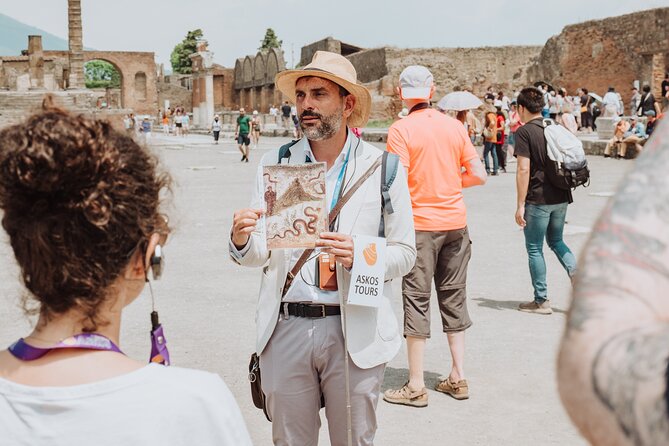
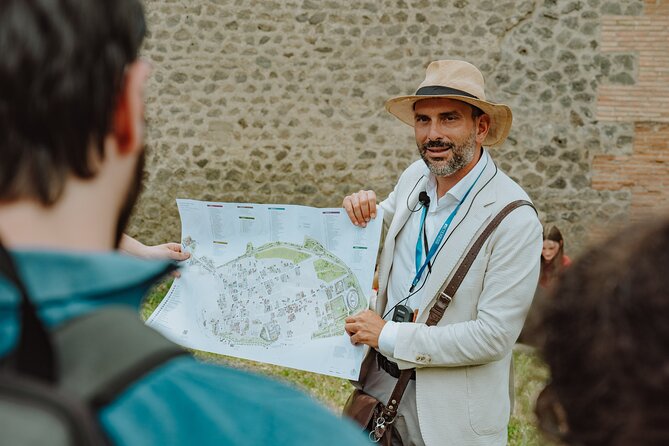
You meet at the main entrance area called Porta Marina Superiore, in front of Hortus Bar & Restaurant. The guide holds an Askos Tours sign, so you can spot the group quickly and get moving without guesswork.
This is a good starting point because it frames how Pompeii is laid out. You’re not just walking randomly; you’re being guided into the city’s rhythm. There’s also a “warm-up” feel at the first two stops, which are marked as admission-free—helpful if you want to settle in before the ticketed highlights begin.
If you’re traveling on a busy date, don’t panic. One helpful theme from real-world experiences is that guides can adjust how they move through crowds so you still get the planned flow. Pompeii is popular, and that’s not the tour’s fault—it’s the calendar’s.
Vicolo delle Terme, 2: a quick look at commerce and shelter
The route continues to Vicolo delle Terme, 2, where the focus is a basilica-like open portico. This kind of space mattered because it sheltered merchants and supported everyday activity—so it’s not only about grand monuments.
Here’s why this matters for your visit: Pompeii isn’t just emperors and theaters. It’s also a working city. Seeing the “in-between” spaces helps you understand why streets, porticoes, and meeting points were so central to daily life.
It’s only around 10 minutes, so treat it as a setup. You’re going to get deeper into buildings next, but this start helps the rest click into place.
Foro de Pompeya: the ancient main square you can feel
Next up is Foro de Pompeya, the ancient main square. This is one of those stops where your brain will naturally start organizing what you’re seeing: civic power, public movement, and the social core of the city.
You’ll spend about 10 minutes here. That’s enough time to orient yourself—who would pass through, where people would gather, and how the square connects to surrounding functions.
A practical tip: if you want the best photos, don’t block the walkway while you frame your shot. The guide’s pace is tight, and Pompeii punishes slow-moving bottlenecks.
Granaries of the Forum: where everyday infrastructure gets eerie
The tour then shifts to the Granaries of the Forum, a stop with some of the most striking details in the whole route. You’ll see marble tables and baths for fountains that adorned entrances of houses. Yes, even utilitarian spaces had style.
Even more memorable are the casts of victims of the eruption, including a dog and a tree. That combination can hit hard, but it’s also important context. Pompeii’s tragedy isn’t only human bodies; it’s animals, plants, and objects caught in place.
This stop runs about 10 minutes, so it’s not built for a slow, emotional pause. If you want to spend longer here, plan to return later after your guided portion ends.

The main street walk: get your bearings fast
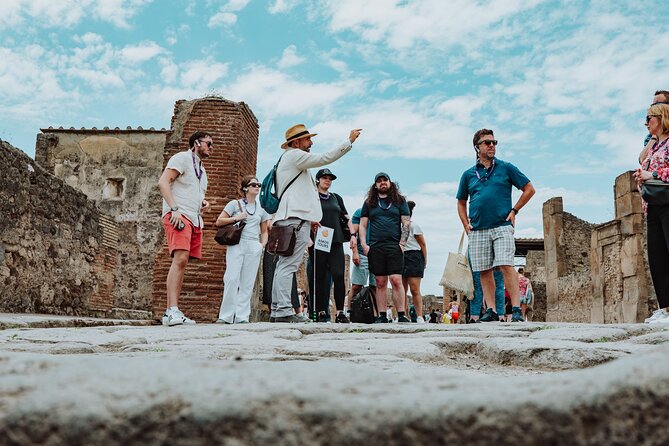
Between major buildings, the tour includes a walk along the main street of Pompeii. This isn’t filler. A guided stroll through the main spine of the city helps you understand scale and direction so you can navigate after the tour ends.
Think of this part as your internal map. Without it, Pompeii can feel like a maze of isolated attractions. With it, you’re more likely to connect where things are relative to each other—especially helpful if you’ll also explore the amphitheatre and necropolis later.
House of Menander: luxury you can read in the details
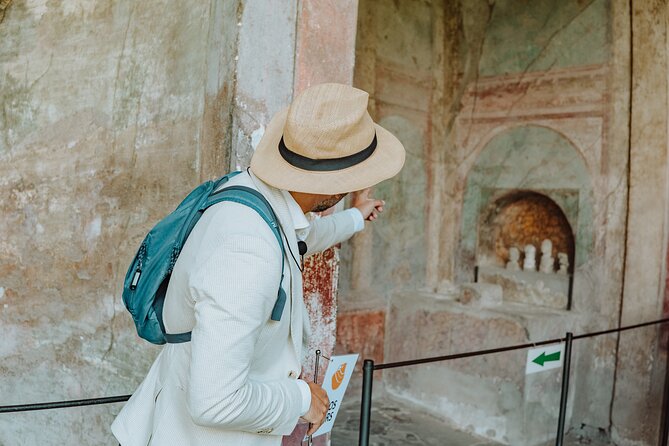
One of the richer stops on the route is the House of Menander, described as one of Pompeii’s most magnificent homes in architecture, decoration, and contents. You’ll get about 15 minutes here—enough to understand what makes it “rich” without getting stuck in one room forever.
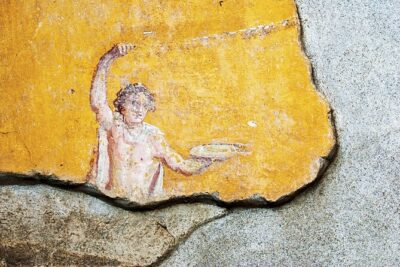
This is where you start seeing Pompeii’s private world. Look for how decoration signals status. Pay attention to how the home is arranged, because the “layout story” often tells you as much as the paintings do.
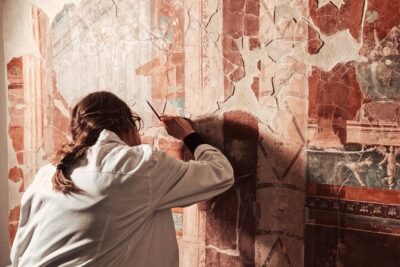
Guides can bring extra electricity to this stop by connecting art and daily life. In one set of experiences, guides with an archaeological background also shared what current digs are exploring in Pompeii and nearby—so you’re not only looking backward, you’re learning how the site is still being studied.
Stabian Baths (Terme Stabiane): the oldest thermal complex
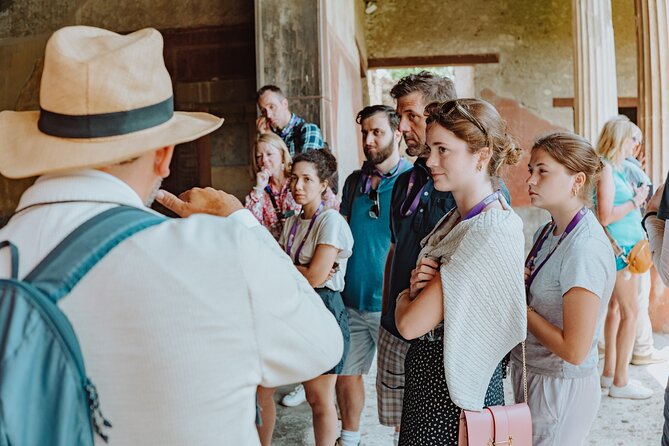
The Stabian Baths take things out of elite interiors and back into city-wide routine. These baths cover a vast area and are described as the oldest thermal complex in Pompeii.
You’ll spend about 15 minutes, which is perfect for understanding the idea of Roman bathing as a social system. Baths weren’t just about cleanliness; they were about meeting people, relaxing, and moving through stages of temperature.
If you’ve never toured a Roman bath complex before, this is a smart stop to include early enough in your visit that you can interpret the “why” behind the architecture. By the time you reach theaters and houses, you’ll already have a sense of how public life functioned.
Lupanar: the brothel that people talk about for a reason
Next is Lupanar, Pompeii’s most famous brothel. This can make people nervous going in, so it helps that the tour’s structure keeps it historical and grounded.
The point isn’t shock. It’s understanding what Pompeii preserved: entertainment and commerce, and the way certain services were built into the urban economy. This stop is about 10 minutes, so you’ll get the essentials without turning it into a long debate.
If you’re traveling with kids, this is the one stop that might feel uncomfortable depending on age. Even in guides’ own pacing choices, 2 hours overall tends to work best for teenagers and adults.
House of the Faun: big residence, big impression
Then comes the House of the Faun, one of Pompeii’s largest private residences. You’ll get 15 minutes, which usually means you’ll have time to grasp what “large and impressive” means: the overall scale, standout decoration, and why this home is treated as a key example of status.
This is a useful counterbalance after Lupanar and baths. Pompeii’s story changes when you step from public spaces into private ones. You begin to see the city’s layers: civic life, leisure, trade, and social standing all coexisting.
If you like architecture and layout, this house can be a highlight. If you mostly care about the eruption story, it still helps because it shows what people were living like before the catastrophe.
Teatro Grande: closing on Pompeii’s performance space
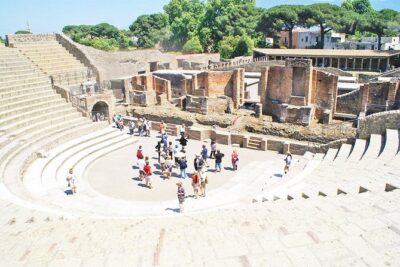
The final major stop is Teatro Grande, described as Pompeii’s most important theater. You’ll spend about 10 minutes here.
A theater stop is a nice way to finish because it pulls multiple threads together: public gatherings, civic identity, and the entertainment side of Roman culture. Plus, by the end of the tour, you’re already primed to notice how spaces were designed for crowds.
After this, the tour ends inside the ruins. That matters because you’re not rushed out to a bus. You can keep exploring at your own pace using what the guide just helped you understand.
Price and value: $77.06 for a focused Pompeii plan
At $77.06 per person for about 2 hours, this tour lands in the “serious value” zone if you want structure. The reason isn’t just the guide. It’s what’s included with your access.
You get:
- a Pompei Express entrance ticket
- guidance for the full duration
- licensed guidance with archaeological background
- small-group size (max 15)
- headsets if your group size is 10+
That combination is what keeps the money from feeling like you’re paying just for someone to walk beside you. In Pompeii, entrance access and interpretation are the real costs. A tight route with built-in context helps you extract more meaning per minute.
Would I call it a bargain? It’s more accurate to say it’s a sensible buy if you’re short on time or overwhelmed by Pompeii’s sprawl. If you’re traveling with plenty of time and you love self-guided wandering, you might decide you don’t need a guide for the first pass. But if you want the city to click, paying for the guide is usually the faster path.
One clarity note: even though you meet near Via Villa dei Misteri, it isn’t listed as a stop on this specific route. If Villa dei Misteri is a must-see for you, you may want to budget extra time or check which add-ons or tickets you’d need separately.
Who this Pompeii tour fits best
This tour is a strong match if:
- you want a high-impact overview in about 2 hours
- you prefer English guidance and clearer explanations through headsets
- you like homes, public spaces, and daily-life architecture (not only the big headline monuments)
It may be less ideal if:
- you need a slower pace with long breaks at each site
- you expect a “complete Pompeii” experience in one tour
It can also be a good pick for mixed interests. One person might love the bath layout, another might focus on the theater, and the rest will be drawn to the houses and casts. The route is designed to give each person something to grab.
Should you book this Pompeii small-group tour?
I’d book it if you’re the type of traveler who wants Pompeii to make sense quickly. With a group capped at 15, a guide with an archaeological background, and headsets for clarity, you’re set up to get meaning instead of just motion.
I’d think twice if you’re expecting everything—especially if Villa dei Misteri is on your personal top list. In that case, plan your day so you’re not disappointed when it’s not part of the guided route.
FAQ
FAQ
How long is the Pompeii Archaeological Small-Group tour?
It runs for about 2 hours.
What group size should I expect?
The group is kept small, with a maximum of 15 travelers.
Do we get headsets?
Yes. Headsets are provided for groups of 10 or more.
Where do we meet, and where does the tour end?
You meet at Via Villa dei Misteri, 2, 80045 Pompei NA, Italy, and the tour ends at Piazza Esedra inside the ruins.
What’s included with admission tickets?
The tour includes the Pompei Express entrance ticket, and several stops are listed as admission included (including the Foro de Pompeya, Granaries of the Forum, House of Menander, Stabian Baths, Lupanar, House of the Faun, and Teatro Grande).
Are food and drinks included?
No. Food and drinks are not included.
Is there free cancellation?
Yes. You can cancel up to 24 hours in advance for a full refund.
More Tour Reviews in Pompeii
- Pompeii Small Group Tour with an Archaeologist★ 5.0 · 6,593 reviews
- Discover the Ancient Ruins of Pompeii: Day Trip from Rome★ 3.5 · 2,247 reviews
- Pompeii and Herculaneum Small Group Tour with an Archaeologist★ 5.0 · 1,350 reviews
- Skip the Line Guided Tour of Pompeii led by an Archaeologist★ 5.0 · 703 reviews
- Pompeii Ticket + Tour with Optional Tasting Experience at Pompeii★ 5.0 · 663 reviews